Sign In



 Australia; NSW
News release
From:
Sydney communities may be missing out on crucial tree planting projects intended to combat urban heat, leaving western and eastern parts of Greater Sydney with less protection from extreme heat, a University of Sydney-led study has revealed.
In a surprising finding, researchers found that while Greater Sydney’s total tree canopy increased by 4.2 percent from 1.514 billion square metres to 1.578 billion square metres between 2016 and 2022, this growth was not evenly distributed.
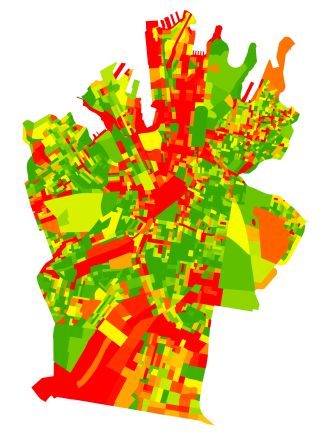
When they examined the data at a street and neighbourhood level, patterns of increasing inequality in tree canopy distribution emerged.
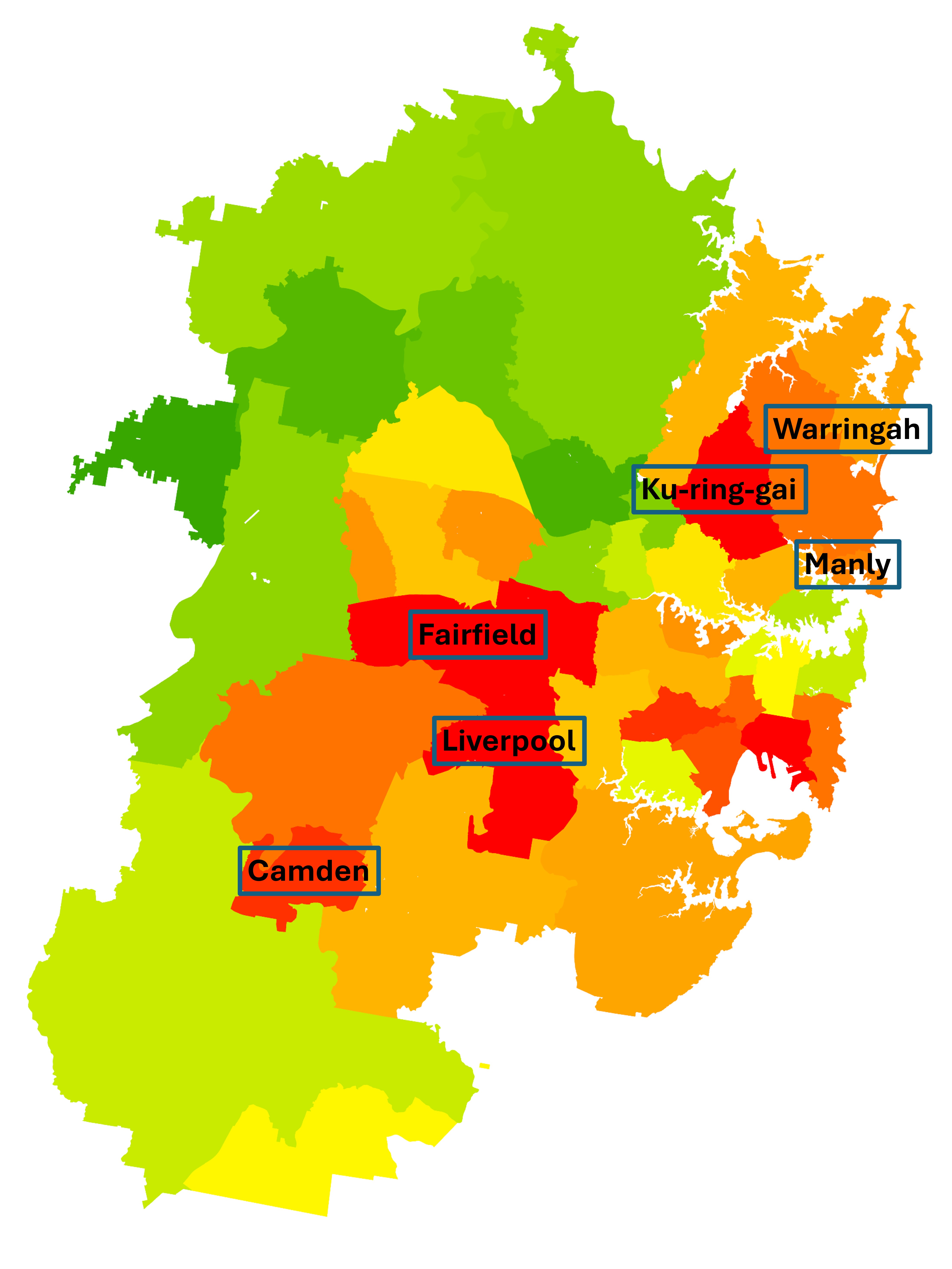
Neighbourhood blocks in areas including Liverpool, Ku-ring-gai, Warringah, Manly and Fairfield received less tree canopy than would be expected under fair distribution benchmarks, according to the analysis.
As Sydney experiences more frequent and intense heatwaves, extreme urban heat is becoming an increasing concern for planners and councils. Heat resilience projects, such as tree planting, are widely used to keep streets and homes cooler during heatwaves.
The researchers say this could help explain why some neighbourhoods remain hotter than others, despite significant investment in sustainability and greening programs to reduce heat exposure.
The researchers analysed urban tree canopy data for Greater Sydney in 2016 and 2022, alongside heat vulnerability and vegetation data. The heat vulnerability index uses indicators of heat exposure, sensitivity to heat, and an area’s ability to adapt to extreme heat conditions.
The analysis was conducted using existing public data from the NSW Government, including the State NSW Department of Climate Change, Energy, the Environment and Water, and NSW Planning, Housing, and Instructure. This was combined with population data from the Australian Bureau of Statistics.
The combined dataset allowed the team to examine tree canopy distribution in high resolution.
and run simulations on what would happen in with three scenarios: distributing trees evenly, prioritising the least green areas, and ensuring everyone reaches a minimum level of tree canopy.
This was then compared with the actual distribution of tree coverage in 2016 and 2022.
The study, published in ‘Cities’ shows that well-intentioned urban greening projects can still increase inequality in communities, depending on how distributional justice (resource allocation) is defined, measured and implemented.
Lead author PhD student Amir Hossein Pakizeh from the Faculty of Engineering, said heat resilience projects led by governments and councils comes from a genuine interest in reducing heat exposure.
“There are sustainability and greening programs in place across NSW, but we uncovered many places that are accidentally being missed when analysing at street level,” said Mr Pakizeh, from the School of Project Management.
“City-wide averages can hide these gaps, while closer local analysis shows that some areas remain consistently more exposed to extreme heat under different ideas of fairness.
“The issue is not simply how many trees are planted across the city, but where they end up. Different definitions of what counts as ‘fair’ in planning lead to very different outcomes on the ground, even when the total number of trees is the same.”
Associate Professor Nader Naderpajouh, head of School of Project Management, Faculty of Engineering, said the way we define and measure justice profoundly shapes the outcomes of heat resilience projects, and without clarity even well intended projects can end up widening existing injustices.
“Extreme heat is often called the ‘silent killer’ and is the leading cause of weather-related mortality in high income countries.
“The findings could help identify gaps and support councils, governments and city planners in designing more just and resilient heat adaptation strategies.
“There is an increasing policy focus on expanding and integrating green infrastructure across Greater Sydney, and we see outcomes change depending on whether decisions are made across Greater Sydney or by individual councils, and that coarse data can hide local injustices that only appear when you zoom in.”
Multimedia