 Sign In



 Australia; NSW
News release
From:
Silky skills: Australian spider rewrites the rules of web design
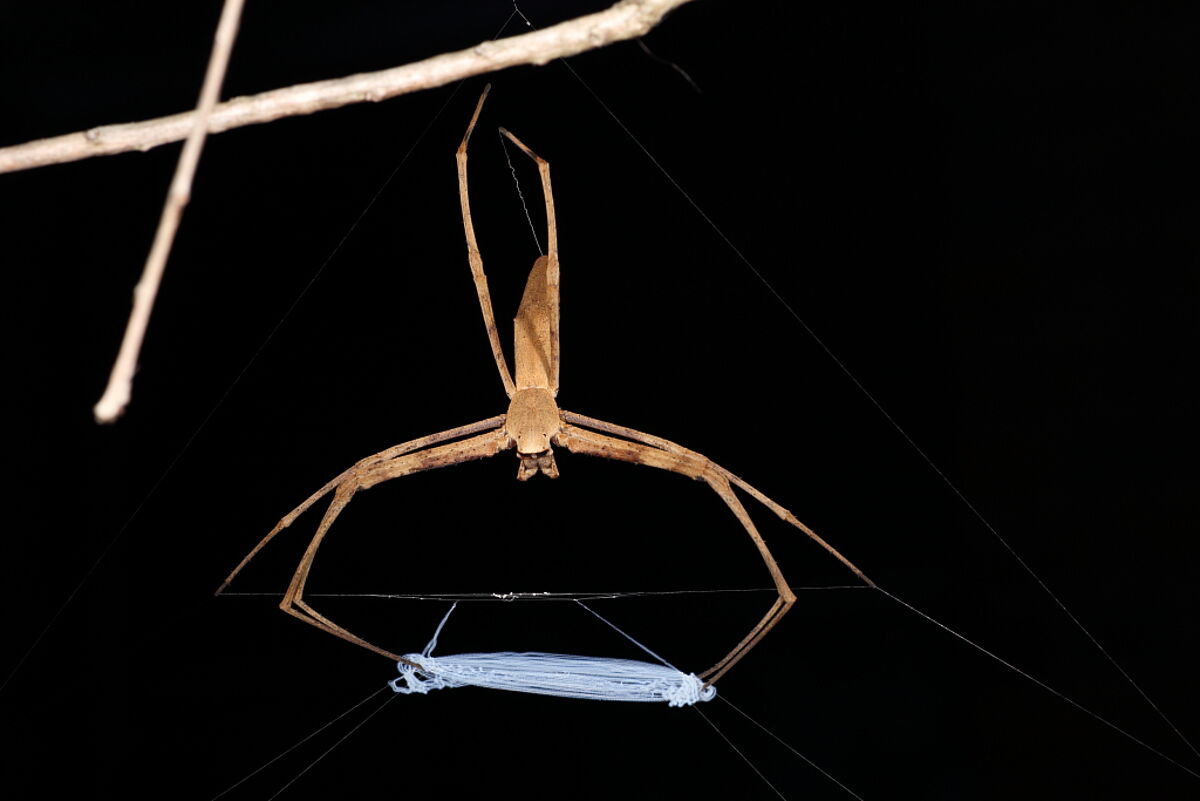
Researchers working at Macquarie University and in Germany and Argentina have found that an Australian spider species has a unique approach to web engineering which bypasses the usual trade-off between strength and elasticity.
Their detailed insights into how the rufous net-casting spider (Asianopis subrufa) of eastern Australia skilfully spins its web and the specialised structure of the spider’s silk may have application in future high-tech synthetic fibres for safety devices, medical applications and even aviation.
Rather than building a static web to catch insects, net-casting spiders (family Deinopidae) make a small, sticky net and ambush prey by using their front legs to cast the net at lightning speed.
“Just by observing the spider’s behaviour, we suspected something spectacular was going on,” said Dr Martín Ramírez, of the Museum of Natural Sciences in Buenos Aires, Argentina, co-author of the study just published in the scientific journal PNAS.
Remarkably, research found the spider’s net can expand by up to 150% in some dimensions but then retracts and contains the prey securely as the spider retrieves it.
“The net is incredibly stretchy,” said Dr Ramírez. “No normal spider silk can extend that far yet still return to its original form.”
Rufous net-casting spiders were initially collected on Macquarie University’s Wallumattagal campus in Sydney and at the nearby Bidjigal nature reserve, then studied in the lab using high-speed video (1000-1300 frames per second) and high-resolution scanning electron microscopy.
Microscopic analysis revealed a previously unknown “meta-structure”: the central silk threads of the net are elastic, but the spider adds curly and crinkled threads that change the net’s material properties.
“We found that the prey-catching silk has a flexible, wool-like, winding structure which allows the spider to cast the net rapidly,” explained lead study author Dr Jonas Wolff of the University of Greifswald, Germany, who is an Honorary Research Fellow in the School of Natural Sciences at Macquarie.
“As soon as the fibres have been stretched, the microstructural loops straighten, giving the material much greater strength and preventing the thread from breaking under the strain of hauling in captured prey,” said Dr Wolff, who spent several years at Macquarie as a postdoctoral researcher.
Slow-motion videos helped researchers study the net-casting spider’s reel-spinning technique, revealing how it moves its tiny spinnerets to mix fibre and create loops in different sections of its web to integrate both extensibility and load-bearing capacity.
Translation of these discoveries from spider silk research could open new avenues for innovation in materials science, the researchers suggest, offering the potential to develop high-tech fibres that are flexible and robust at the same time, overcoming the trade-off between stability and elasticity.
Dr Jonas Wolff leads the Evolutionary Biomechanics research group, Zoological Institute and Museum, University of Greifswald, Germany, and is an Honorary Research Fellow in the School of Natural Sciences, Faculty of Science and Engineering, Macquarie University, Australia
Dr Jonas Wolff is based in Germany but is available for interview by phone or Zoom.
Multimedia


