 Sign In



 International

News release
From:
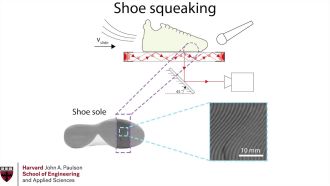
Physics: The secret of squeaky sneakers (N&V) *IMAGE*
Credit: Adel Djellouli
Download: High resolution (119.6 KB)
The squeak that happens when basketball shoes slide on a polished court is caused by deformations of the soft material rippling across the surface. The research, published in Nature this week, identifies ways to modify these effects, which could control friction between materials.
Understanding the dynamics that occur between two surfaces may offer insights into the effects of friction across a range of systems, from synthetic materials to geological faults. When soft materials slide over rigid surfaces, they can cause squeaking sounds. Previous studies looking into interactions between surfaces have suggested that pulses are created when two materials stick and slip, but such studies have focused on slow movements, which do not create squeaks.
Katia Bertoldi and colleagues look at interactions between surfaces at speeds that produce noise. They film a basketball shoe squeaking as it strikes a smooth glass plate. High-speed imaging captures deformations of the rubber sole pulsing in bursts across the surface. The pitch of the squeak matches the rate of the bursts, which is determined by the stiffness and thickness of the shoe sole. In additional experiments with other samples, the authors show that if a soft surface is smooth, the pulses are irregular and produce no sharp sounds, whereas ridged surfaces (like the grip patterns on sports shoes) produce consistent pulse frequencies, resulting in a high-pitched squeak.
In an accompanying News & Views, Bart Weber notes that “the work raises a deeper question about the nature of sliding at strongly pinned interfaces”. He adds: “If these processes can eventually be understood and controlled, they might offer routes for deliberately tuning frictional behaviour.”
Multimedia

Attachments
Note: Not all attachments are visible to the general public. Research URLs will go live after the embargo ends.


