News release
From:
Springer Nature
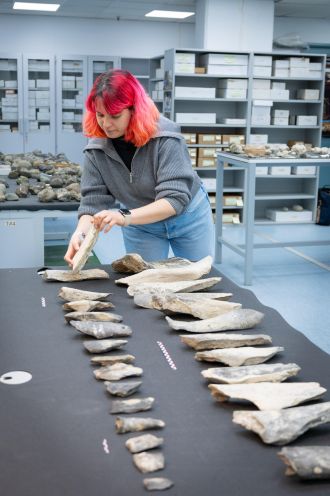
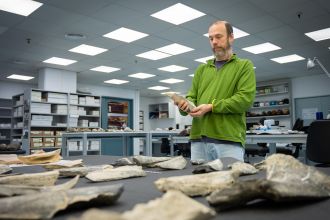
Human evolution: The earliest known bone toolkit *IMAGES*
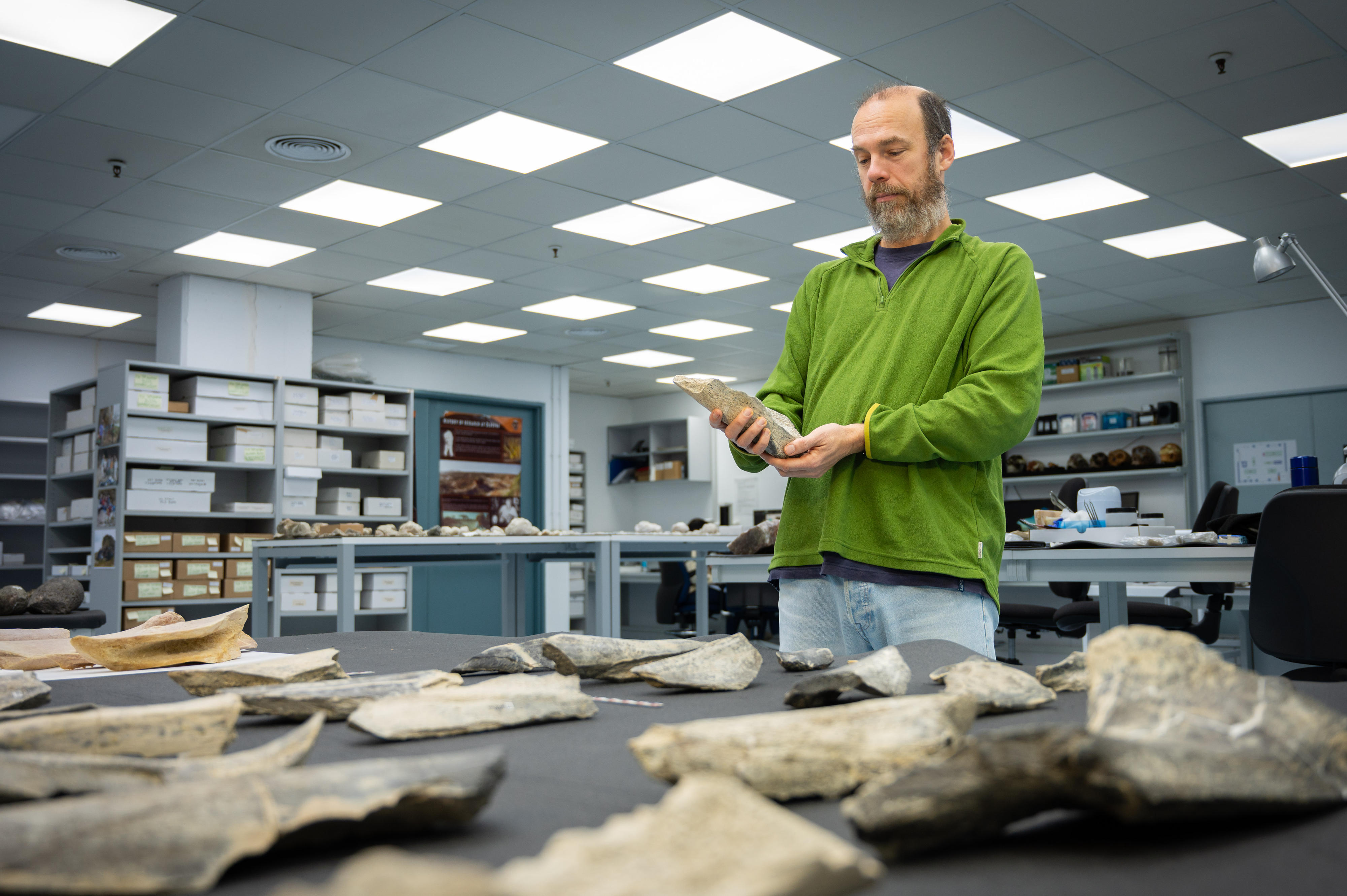
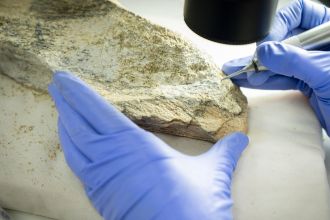
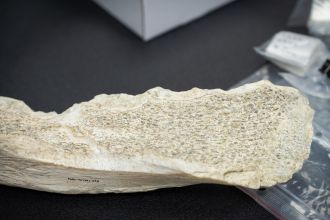
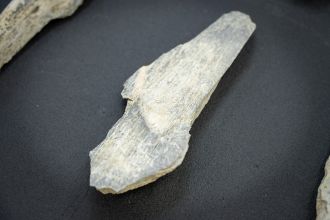
Ancient humans were systematically producing bone tools as early as 1.5 million years ago, a Nature study suggests. Bone tools discovered in Tanzania pre-date previous evidence of systematic bone tool production by more than a million years.
Evidence for stone tools goes back at least 3.3 million years. However, the earliest systematic production of tools made from bone, and fully shaped by knapping, is more recent, hailing from European sites between around 400,000 and 250,000 years ago.
Ignacio de la Torre and colleagues document 27 bone tools from the Olduvai Gorge site in Tanzania. Fragments of long bones, mostly from hippopotamus and elephant, were knapped to produce a variety of sharp, heavy-duty implements that are up to 38 cm long. It was previously thought that the production of bone tools by early hominins was sporadic and expedient. The new findings suggest that early humans at Olduvai may have been routinely selecting specific bones from large mammals and then shaping them using standardized production patterns. This evidence indicates that these humans were culturally innovative, able to transfer and adapt their stone knapping skills to a new raw material.
Journal/
conference:
Nature
Organisation/s:
CSIC-Spanish National Research Council, Spain
Funder:
Permits issued to the Olduvai Gorge Archaeology Project to conduct
research at Olduvai were granted by the Tanzanian Commission of Science and Technology,
Department of Antiquities (Ministry of Natural Resources and Tourism) and Ngorongoro
Conservation Area Authority. We thank the Olduvai fieldwork crew who participated in the
2015–2022 excavations at the T69 Complex, particularly to A. Lucas and A. Venance; the CSICPleistocene
Archaeology Laboratory personnel (particularly A. Seisdedos and C. Fernández) for
their assistance in producing the supplementary videos, the spatial analysis and Extended Data
Fig. 2; and C. Sáiz and B. Notario (CENIEH) for thin-section preparation and photography. L.D. and
F.d’E. were financially supported by the following agencies: Initiative d’Excellence IdEx, University
of Bordeaux, Talent program grant no. 191022-001 (to F.d’E. and L.D.); French government in the
framework of the University of Bordeaux’s IdEx ‘Investments for the Future’ program/GPR ‘Human
Past’ (to F.d’E. and L.D.); the Research Council of Norway, Centres of Excellence (SFF), Centre for
Early Sapiens Behaviour, SapienCE grant no. 262618 (to F.d’E.); European Research Council
(Synergy grant for the project Evolution of Cognitive Tools for Quantification (QUANTA), no.
951388; to F.d’E.) and (Starting grant for the project Pleistocene Expedient Osseous Technology
(ExOsTech), no. 101161065; to L.D.)). Fieldwork grants by Fundación Palarq and the Spanish
Ministry of Culture, and major funding by the European Research Council-Advanced grants:
Biogeographic and Cultural Adaptations of Early Humans during the First Intercontinental
Dispersals (BICAEHFID, no. 832980), are gratefully acknowledged.
 Sign In



 International