 Sign In



 International
News release
From:
These giant, prehistoric salmon had tusk-like teeth
Paleontologists believe the teeth may have been used for defense, competitive fighting, or as digging tools
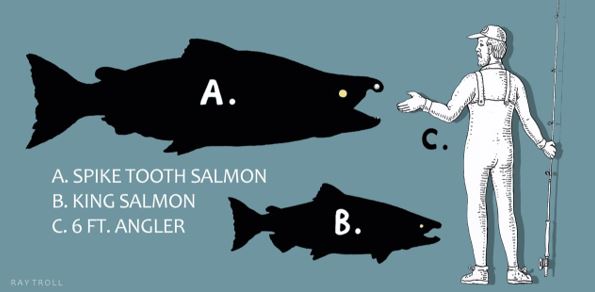
Oncorhynchus rastrosus, a giant species of salmon that lived in the North American Pacific Northwest a few million years ago, sported a pair of front teeth that projected out from the sides of its mouth like tusks, according to a study published April 24 in the open-access journal PLOS ONE by Kerin Claeson from the Philadelphia College of Osteopathic Medicine, USA, and colleagues.
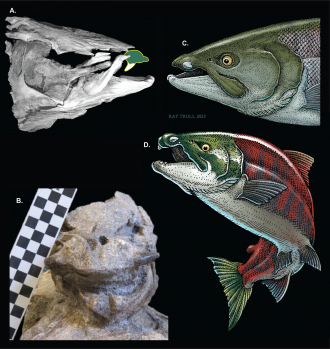
O. rastrosus, first described in the 1970s, has been estimated to reach up to 2.7 meters (8.9 feet) long, making it the largest member of the Salmonidae family ever discovered. Initially, researchers thought its oversized front teeth pointed backward into the mouth like fangs, in large part because fossils of the teeth were found apart from the rest of the skull. This led to the common name “saber-toothed salmon.” But through new CT scans and analysis of various Oncorhynchus rastrosus fossils collected over the years, researchers have now been able to confirm that the teeth actually pointed sideways out of the fish’s mouth, similar to a warthog. As a result, the authors say, the species should be renamed the “spike-toothed salmon.”
While it’s unclear exactly what these teeth may have been used for, the researchers believe they were likely used for fighting — either against other spiked-toothed salmon or as a defense against predators — or as a tool for digging out nests. It’s also possible the teeth were used for multiple purposes, the authors note. But the teeth likely weren’t used for catching prey, since Oncorhynchus rastrosus is believed to have been a filter-feeder that dined on plankton.
Kerin Claeson, lead author and professor of anatomy at Philadelphia College of Osteopathic Medicine, adds: "We have known for decades that these extinct salmon from Central Oregon were the largest to ever live. Discoveries like ours show they probably weren't gentle giants. These massive spikes at the tip of their snouts would have been useful to defend against predators, compete against other salmon, and ultimately build the nests where they would incubate their eggs."
Edward Davis, associate professor of earth sciences at the University of Oregon and director of Condon Collection at the UO’s Museum of Natural and Cultural History, adds: “I’m delighted that we have been able to put a new face on the giant spike-tooth salmon, bringing knowledge from the field in Oregon to the world.”
Brian Sidlauskas, professor and curator of fishes at Oregon State University, adds: “We also stress that females and males alike possessed the enormous, tusk-like teeth. Therefore, the sexes were equally fearsome.”
Multimedia

Attachments
Note: Not all attachments are visible to the general public. Research URLs will go live after the embargo ends.


