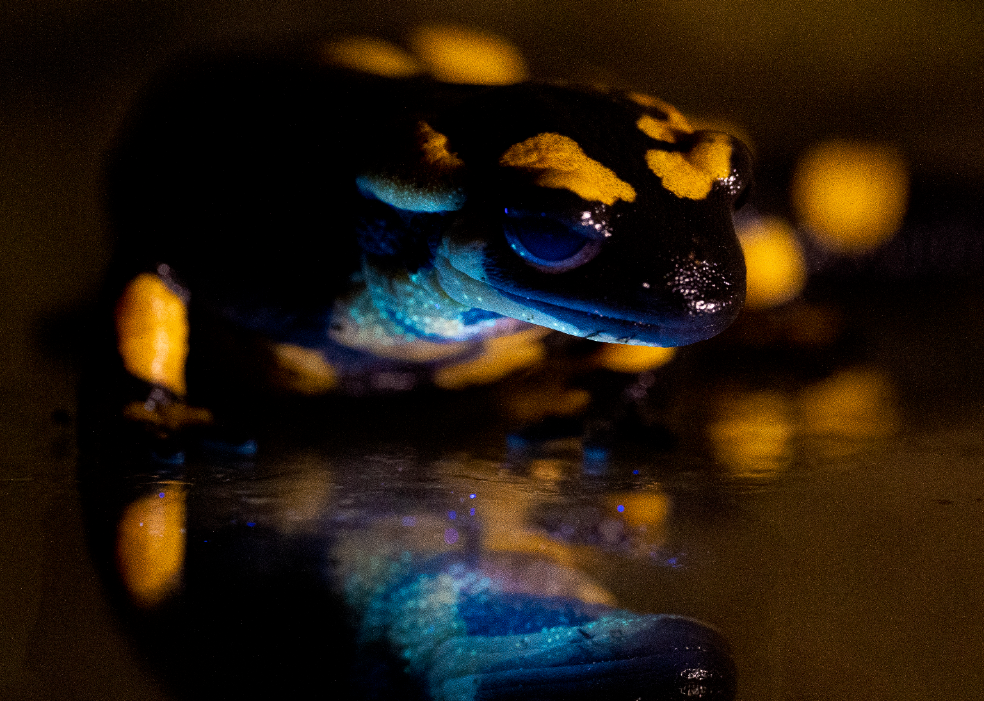
Some Spanish salamanders glow under UV light

Publicly released:
International
Salamander glow - Glandular biofluorescence in fire salamanders (Salamandra salamandra): first evidence and ecological implications. Royal Society Open Science

International researchers have reported the first evidence of biofluorescence in fire salamanders (Salamandra salamandra). Under UV light, 10 of 12 salamanders in Catalonia, Spain, showed bright speckled blue-green fluorescence. This glow was mainly visible on the sides and underside of the salamanders, as well as in their glandular secretions. This placement suggests the fluorescence could play a part in salamander communication, according to the team.

News release

From: The Royal Society

Glandular biofluorescence in fire salamanders (Salamandra salamandra): first evidence and ecological implications

Royal Society Open Science

This study reports the first evidence of biofluorescence in fire salamanders (Salamandra salamandra). Under ultraviolet light, these urodeles display striking blue-green fluorescence across their skin, appearing as bright speckles on the flanks and ventral region, as well as in their glandular secretions. Our analyses reveal that different tissues produce distinct fluorescent signals, likely involving compounds transported through the bloodstream. Remarkably, these secretions remain fluorescent on surfaces for over 24 hours. The distribution of external fluorescence together with the persistent glow of secretions suggests that fluorescence could play a role in communication of fire salamanders, adding new evidence to the growing number of studies showing ecologically relevant fluorescence in amphibians.

Multimedia
Salamander glow
Salamander glow

Attachments

Note: Not all attachments are visible to the general public. Research URLs will go live after the embargo ends.

Research The Royal Society, Web page The URL will go live after the embargo lifts.
Journal/
conference:
Royal Society Open Science
Research:Paper
Organisation/s: Institute of Evolutionary Biology, Spain
Funder: This project was funded by Fundació Barcelona Zoo (Amphibian Project 2024), by Grant PID2023-152955NA-I00 funded by MICIU/AEI/10.13039/501100011033 and ERDF/EU. AEB was supported by a George-Forster Scholarship from the Humboldt foundation. MS was supported by the European Research Council (ERC) under the European Union’s Horizon 2020 research and innovation programme (grant agreement No. 949745). ME was supported by FPI grant from Ministerio de Ciencia e Innovación, Spain (PRE2022-101473); ST was supported by an AGAUR-FI Joan Oró fellowship from the Departament de Recerca i Universitats de la Generalitat de Catalunay and the European Social Fund Plus (2024FI-101035).
Media Contact/s
Contact details are only visible to registered journalists.