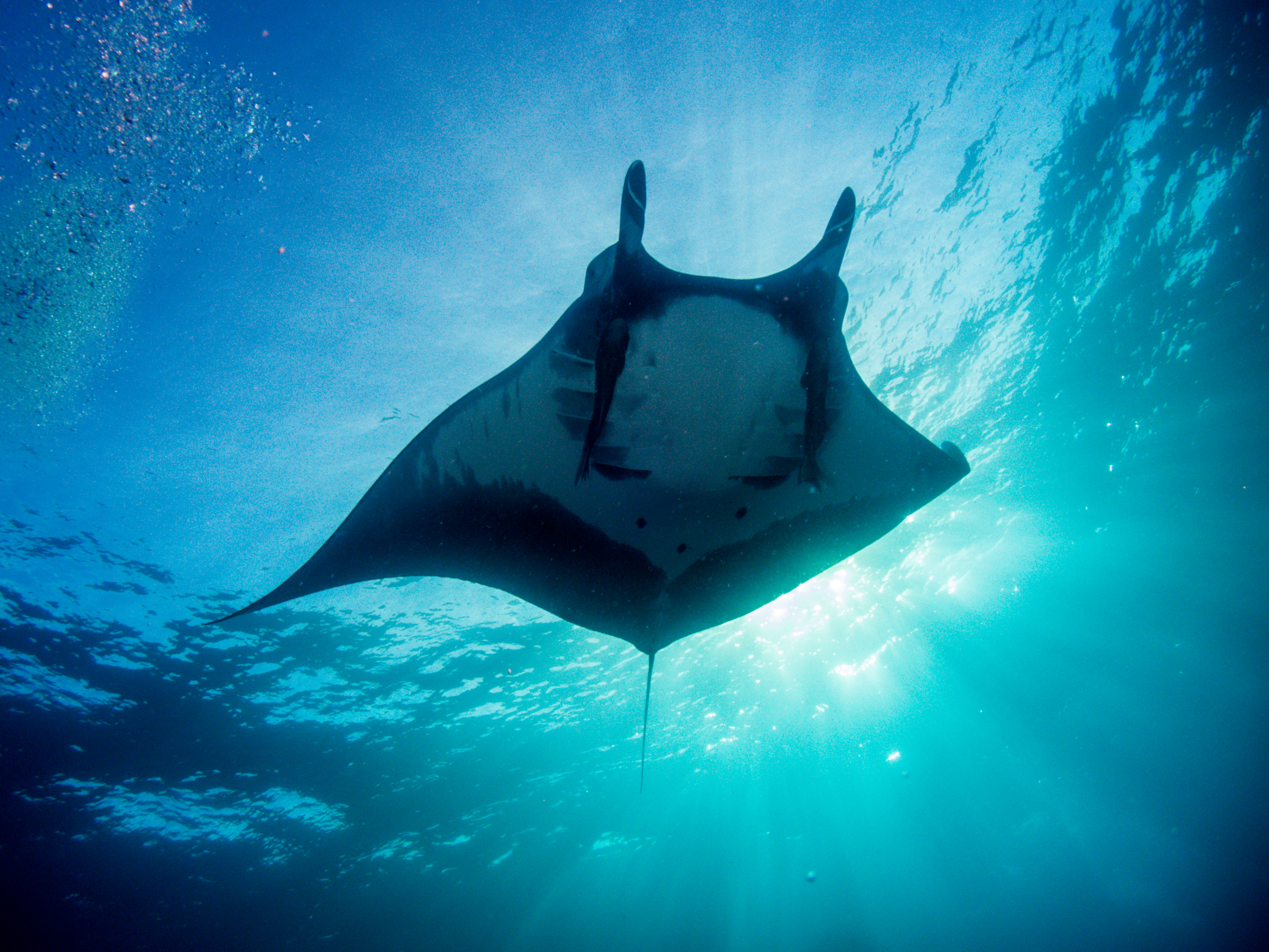
Massive manta rays dive deep during moonlit nights in the Hauraki Gulf

Publicly released:
New Zealand
By Stevelaycock21 - Own work, CC BY-SA 4.0, https://commons.wikimedia.org/w/index.php?curid=71093894

For the first time ever in NZ, researchers tracked 12 endangered oceanic manta rays in the Hauraki Gulf using GPS tags to understand their movements and foraging behaviour. The gentle giants spent most of their time near the surface, but often dived below five metres at night and when the moon getting close to full. This behaviour is seen in other regions, and might mean the rays forage on different species at different times of the day or simply follow their movements. The Gulf lies on the border of how south these rays will roam, and more work is needed to clarify what exactly the rays eat there so as to guide conservation efforts for this data-deficient species.

News release

From: The Royal Society

We tracked Endangered oceanic manta rays in northern Aotearoa New Zealand using high-resolution GPS tags to understand their movements and foraging behaviour. The manta rays mostly stayed within the Hauraki Gulf area and showed the movement typically associated with foraging in association with gentle northerly winds. Mantas spent most of their time near the surface but also dived deeper at night and during gibbous moon phases. These patterns suggest that environmental conditions strongly influence manta behaviour in the southern limit of their range. More information on their prey distribution is needed to guide conservation efforts for this data-deficient species.

Attachments

Note: Not all attachments are visible to the general public. Research URLs will go live after the embargo ends.

Research The Royal Society, Web page URL after publication
Journal/
conference:
Royal Society Open Science
Research:Paper
Organisation/s: University of Auckland, Department of Conservation, Auckland War Memorial Museum, Manta Watch Charitable Trust; Conservation International
Funder: This research was generously funded by MAC3 Impact Philanthropies, Daniel Roozen, Audrey and Shannon Wong and Save the Blue Foundation, Live Ocean Foundation, Wolcott Henry Foundation, Katrine Bosley, Barry and Fiona Gray, Marie-Elizabeth Mali, and the Wolcott Henry Foundation. T.S. was supported by a University of Auckland Research Master’s Scholarship, and L.G. was supported by Live Ocean Foundation, Pub Charity and Lion’s Foundation.
Media Contact/s
Contact details are only visible to registered journalists.