 Sign In



 New Zealand; International
News release
From:
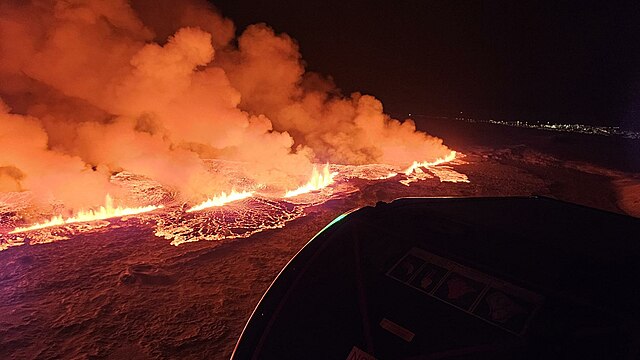
The 15-kilometer-long magma dike that formed beneath Grindavík, Iceland, in November 2023, which caused widespread damage and evacuation of the local population, reached an unprecedented subsurface magma flow rate of 7400 cubic meters per second, researchers report. The dike formation preceeded the more recent Sundhnúkur eruptions in December 2023 and January 2024. The study, which combined satellite-based geodetic observations and seismic measurements of the Sundhnúkur crater chain and physical modeling, shows how fracturing and tectonic stress can drive massive magma flow into dikes with only modest overpressure in the feeding magma body. According to the authors, the measurement of such high flow rates provides insight into the formation of major dikes and demonstrates a serious hazard potential for this and other dike systems with similar features, which can result in large-volume surface eruptions. Vertical dikes in the Earth’s crust can transport magma to the surface and cause an eruption. However, the timescales and processes underlying dike formation aren’t fully understood. In November 2023, a massive dike began to rapidly form below the Sundhnúkur crater chain in southwest Iceland, passing under the town of Grindavík. To better understand the Grindavík dike’s formation and the physical processes involved, Freysteinn Sigmundsson and colleagues analyzed satellite-based three-dimensional ground deformation measurements and seismic observations to model the dike’s evolution and magma transport. The findings show that the subsurface magma flow rate peaked at an unexpectedly fast 7400 cubic meters per second during the formation of the Grindavík dike and demonstrate that tectonic stresses and fracturing are important factors in dike formation beyond pressure from the underlying magma source itself.
Expert Reaction
These comments have been collated by the Science Media Centre to provide a variety of expert perspectives on this issue. Feel free to use these quotes in your stories. Views expressed are the personal opinions of the experts named. They do not represent the views of the SMC or any other organisation unless specifically stated.
Sigrún Hreinsdóttir, Geodetic Scientist, GNS Science, comments:
In November 2023, a 15km long magma dike propagated beneath the town of Grindavík, Iceland, causing widespread damage and evacuation. The dike formation was followed by fissure eruptions on 18 December 2023 and 14 January 2024, with lava flowing into Grindavík. Using satellite based geodetic observations and seismic measurements researchers show that the dike reached an ultra-rapid subsurface magma flow rate of 7400 cubic meters per second. The study demonstrates that fracturing and tectonic stress are important factors in dike formation and imply a high hazard potential for intrusions that propagate to the surface, leading to eruptions.
New Zealand has a different volcano-geological setting to Iceland. However, the most similar volcanoes we have are those in the Auckland Volcanic Field. There are at least 53 volcanoes identified in the Auckland area, with the most recent eruption occurring about 660 years ago, forming Rangitoto Island. Auckland volcanoes tend to mainly produce runny lava flows and volcanic gas, similar to those in Iceland. Unrest as magma rises would likely generate earthquakes and ground cracking also similar to Iceland. While it is entirely possible that we will have another eruption in Auckland in our lifetimes, the chances are low. What is important is understanding the timescale and processes involved which would be crucial for our preparedness and any emergency response.

Attachments
Note: Not all attachments are visible to the general public. Research URLs will go live after the embargo ends.

