Humans are enabling jackals to sneak across Europe

Publicly released:
Australia; International; NSW
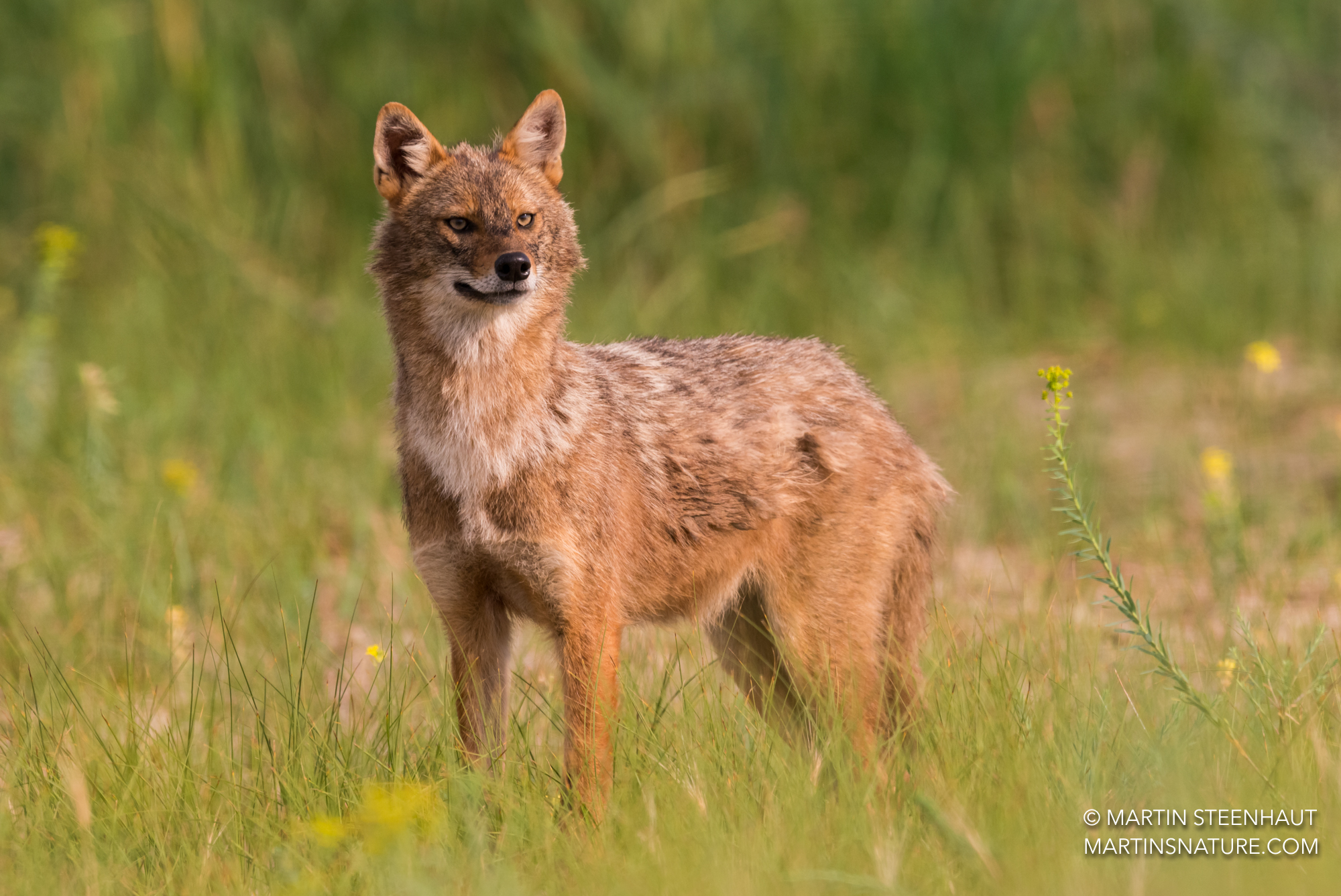
Portrait of a golden jackal in summer fur  Credit: Martin Steenhaut, martin.steenhaut@gmail.com
Portrait of a golden jackal in summer fur Credit: Martin Steenhaut, martin.steenhaut@gmail.com

By killing or driving off wolves in Europe, humans have enabled the expansion of golden jackals across the continent, say International and Australian researchers. The team looked at survey data of people hearing the howls of jackals from 2001 to 2017 across 13 European countries, and found that although a shorter time with snow cover, a good amount of forest cover and being close to bodies of water were all linked to the presence of jackals, the presence of wolves was the biggest block to their spread. The team explain that we might act as a 'human shield' and allow animals such as jackals protection, where predators would otherwise stay away. It's possible that the area we are shielding could cover up to 75% of the total area of the continent, and could be further facilitated by climate change and land-use modification, the team adds.

News release

From: Springer Nature

A ‘human shield’ is helping jackals spread across Europe
Human activity may be enabling the expansion of golden jackals across Europe by reducing the suppressive effect of grey wolves, suggests research published in Nature Ecology & Evolution. This human-mediated interaction could allow jackals to occupy up to 75% of the continent, almost six times more than the current area, the authors suggest.

Previous research has suggested multiple reasons for the spread of jackals in Europe, such as climate warming, land cover change and the absence of predators. Wolves, which can outcompete and prey on jackals, were once widespread across the continent, but centuries of persecution and growing human populations have restricted them to a fraction of their former range. Research conducted in North America has shown that the human-driven absence of wolves is beneficial to coyotes, which are similar in size and ecology to golden jackals, but whether similar dynamics are ecologically important in Europe has remained unclear.

Nathan Ranc and colleagues analysed jackal howling survey data collected from 2001 to 2017 at 8,991 locations across 13 European countries. They found that shorter snow-cover duration, intermediate forest cover and proximity to water bodies are all associated with jackal presence. Wolf presence was found to be the strongest constraint on jackal occurrence: jackals are most likely to be present where wolves are absent and least likely in the core areas of stable wolf packs. However, proximity to human settlements appears to reduce this suppressive effect, which supports the concept of a ‘human shield’, where animals stay near people as predators avoid those areas. Jackals tend to avoid developed areas in regions where wolves are absent, but are more likely to occur near humans where wolves are present. Jackals currently occur mostly in southeastern and central Europe (although some individuals have been found as far west as Spain and as far north as the Arctic), but the authors found that 75% of the total area of the continent is environmentally suitable for this species.

The authors note that, although ongoing wolf recovery in Europe may reduce suitable areas for jackals, the persistent ‘human shield’ effect — combined with climate change and land-use modification — is likely to continue facilitating their expansion.

Multimedia

Image 1
Image 1
Image 2
Image 2
Image 3
Image 3

Attachments

Note: Not all attachments are visible to the general public. Research URLs will go live after the embargo ends.

Research Springer Nature, Web page The URL will go live after the embargo ends
Journal/
conference:
Nature Ecology & Evolution
Research:Paper
Organisation/s: The University of New South Wales, Harvard University, Cambridge, MA, USA
Funder: N.R. was supported by a Harvard University Graduate Fellowship and a Fondazione Edmund Mach International Doctoral Programme Fellowship for part of this project. M.K. was supported by the Slovenian Research and Innovation Agency (grant numbers P4-0059, J1-50013). L.M. was supported by the NextGenerationEU in the framework of the National Biodiversity Future Center. F.C. contributed to this work partly under the Institut de recherche pour le développement Fellowship at Fondation IMéRA, Institute for Advanced Studies at Aix-Marseille Université. J.H. was a recipient of the Doctoral Fellowship of the Austrian Academy of Sciences at the Institute of Wildlife Biology and Game management. I.A.-P. received funding support from the National Museum of Natural History at Bulgarian Academy of Sciences and the Program ‘Young Scientist’ of the Bulgarian Academy of Sciences for data collection in Bulgaria. D.C. and A. Penezić received funding support from the Ministry of Education, Science and Technological Development of the Republic of Serbia, grant number 451-03-68/2022-14/ 200178. J.L. was supported by the RRF-2.3.1-21-2022-00014 (National Multidisciplinary Laboratory for Climate Change). M.Š. was supported by the Czech Academy of Sciences in frame of the programme Strategy AV21 (Strategie AV21 Krize biodiversity) and the research aim of the Czech Academy of Sciences (grant number 68081766). P.U. was supported by the Cultural and Educational Grant Agency of the Ministry of Education, Research, Development and Youth of the Slovak Republic (grant numbers 036UMB-4/2018 and 003UMB-4/2023).
Media Contact/s
Contact details are only visible to registered journalists.