Getting to know the Neanderthals

Publicly released:
Australia; International
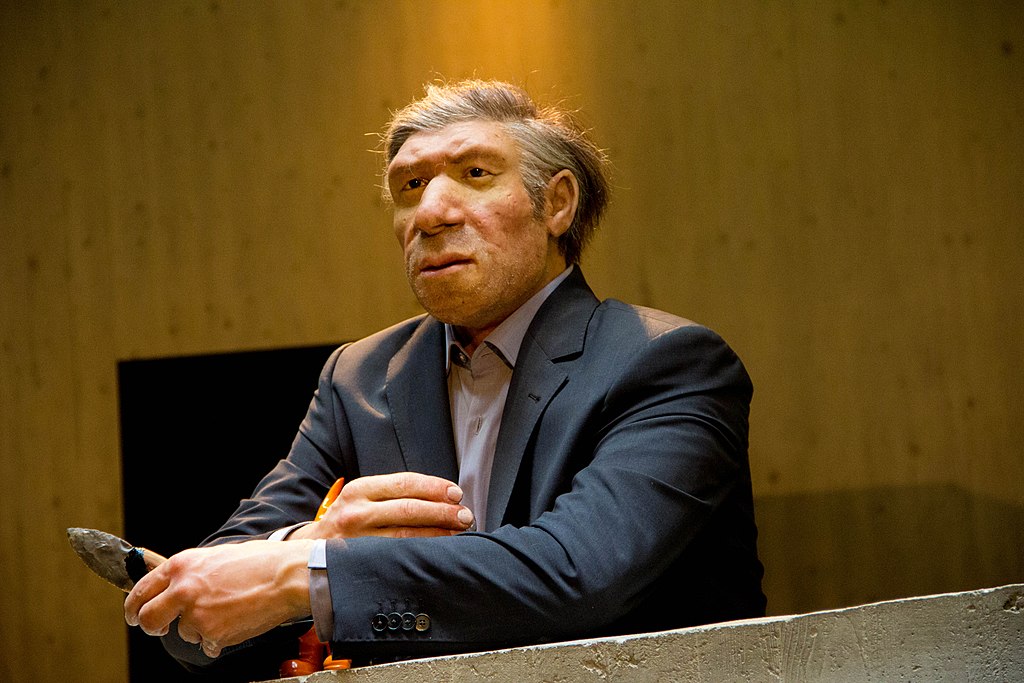
Neanderthal_in_a_business_suit By Clemens Vasters - CC BY 2.0

International scientists, including an Australian, say our extinct cousins, the Neanderthals, probably lived in small communities of around 20 individuals, and that females likely migrated from their own communities to join male mates, who stayed in one spot. The team looked at the DNA of 13 Neanderthals from two caves in present-day Russia, Chagyrskaya Cave and Okladnikov Cave. They noted that the diversity of Y chromosomes, inherited exclusively from the father, was low, while the diversity of mitochondrial DNA, inherited exclusively from the mother, was a lot higher. That suggests male Neanderthals stayed put, while females migrated from other communities to join them, the scientists say. The authors caution that the findings may not be representative of the whole Neanderthal population, because they sampled just 13 individuals. Wider sampling should be the focus of future studies, they conclude.

Media release

From: Springer Nature

A genetic snapshot of Neanderthal families

The first known description of relationships and social organization of a small community of Neanderthals is revealed in a paper published in Nature this week. The findings — based on an analysis of the ancient DNA of 13 Neanderthal individuals from two caves in Asia — provide new insights into the social organization of Neanderthals. It is the largest known genetic study of Neanderthals reported to date.

Neanderthals occupied western Eurasia from around 430,000 to 40,000 years ago and are closely related to modern humans. Genetic data in the form of nuclear DNA retrieved from the remains of a total 18 Neanderthal individuals (reported in a number of individual studies) so far have provided a broad review of the population. However, little is known about their social organization.

Laurits Skov and colleagues obtained and analysed genetic data from the remains of 11 Neanderthal individuals from Chagyrskaya Cave and 2 from Okladnikov Cave in the Altai Mountains of southern Siberia, Russia. The authors found that some Chagyrskaya individuals were closely related, including a father and his teenage daughter, along with a pair of second-degree relatives. The results indicate that at least some of them lived around the same time. The authors also found that the genetic diversity of Y chromosomes (passed down the male line) is a lot lower than that of the mitochondrial DNA (passed from mothers) in these individuals, which suggests that females were more likely to migrate than males. The authors propose that the findings can be best explained by a small community size (around 20 individuals) where 60% or more of females migrated from another community to join their mates’ families while the males stayed put.

The authors cautioned that the sample size is small and may not be representative of the social lives of the whole Neanderthal population. Therefore, future studies should aim to include more individuals from other communities to shed more light on the social organizations of our close cousins.

Attachments

Note: Not all attachments are visible to the general public. Research URLs will go live after the embargo ends.

Research Springer Nature, Web page The URL will go live after the embargo ends
Journal/
conference:
Nature
Research:Paper
Organisation/s: University of Wollongong, ARC Centre of Excellence for Australian Biodiversity and Heritage (CABAH), Max Planck Institute for Evolutionary Anthropology, Germany
Funder: V.S. was funded by the Alon Fellowship, M.H. was funded by Marie Skłodowska Curie Action (MSCA-IF-EF-ST LIF, “ORIGIN” no. 844014), S.T. was funded by the European Research Council Horizon 2020 Research and Innovation Programme grant “RESOLUTION” (no. 803147), K.D. was funded by the European Research Council Horizon 2020 Research and Innovation Programme grant “FINDER” (no. 715069), R.G.R. was funded by the Australian Research Council fellowship FL130100116, T.H. was funded by the European Research Council Seventh Framework Programme (FP7/2007-2013) grant 324139 “PalaeoChron”, K.A.K. was funded by Russian Science Foundation, project N 21-18-00376, M.T.K. was funded by National Science Centre, Poland, grant 2018/29/B/ST10/00906, B.V. was funded by Social Sciences and Humanities Research Council, Canada, Insight grant 435-2018-0943. This project was funded by the European Research Council (grant agreement no. 694707 to S. Pääbo).
Media Contact/s
Contact details are only visible to registered journalists.