Few male whales becoming dads

Publicly released:
New Zealand; Pacific
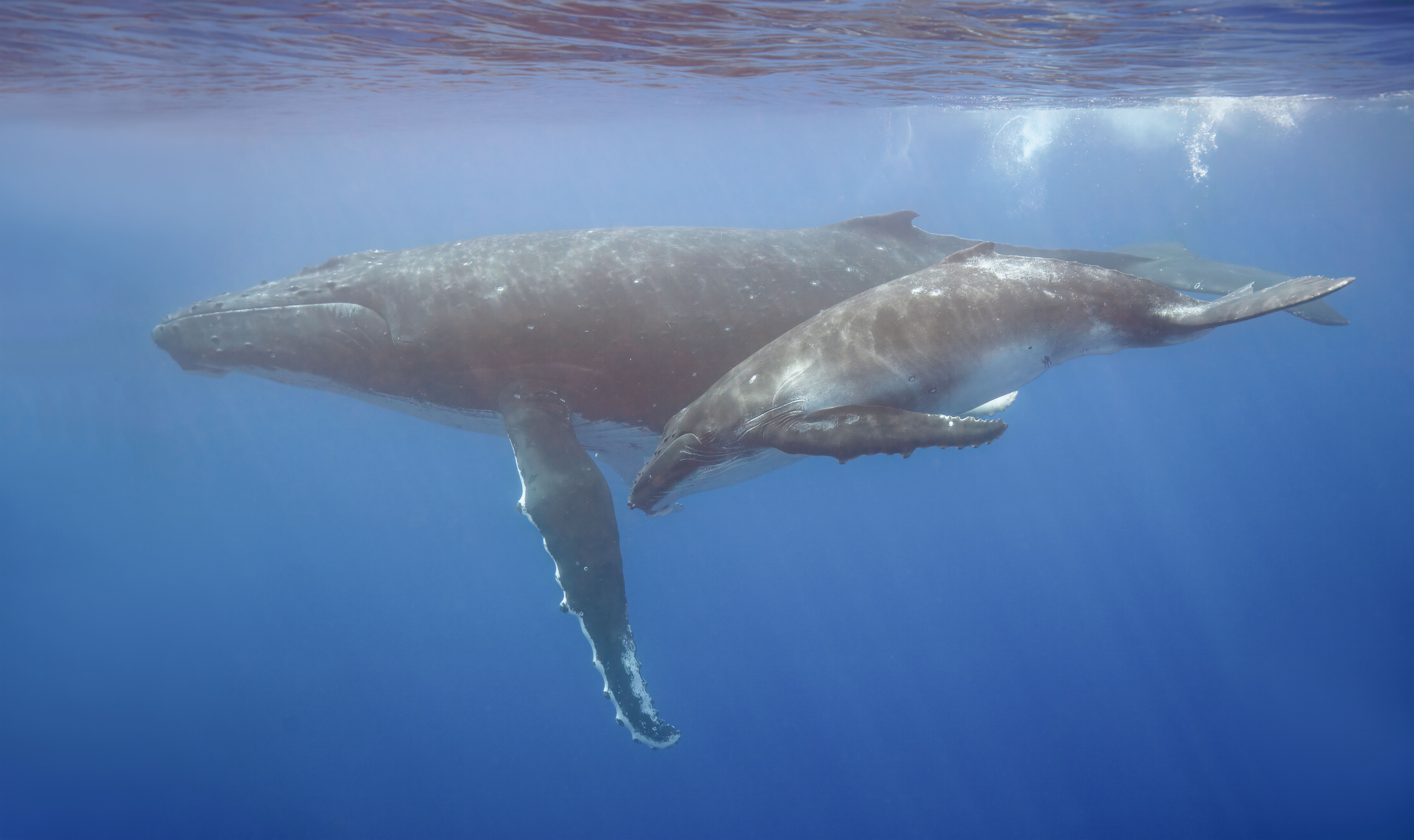
Charles J. Sharp, CC BY-SA 4.0 <https://creativecommons.org/licenses/by-sa/4.0>, via Wikimedia Commons

Paternity testing on humpback whales breeding around New Caledonia shows only about 7% of males become fathers—and those that do, only have one or two calves. Researchers used photos, genetic testing of skin samples, and modelling to analyse paternity for almost 180 mother-offspring pairs and more than 900 adult males over 25 years. Their results show many males in the population aren’t mating at all, but also that males from neighbouring populations in Oceania may be fathering calves in New Caledonia. The authors note that the effects of historical whaling could be influencing the humpback whales’ reproductive patterns.

News release

From: The Royal Society

Patterns of paternity offer crucial insights into a species’ mating system and population growth. Parentage analyses in cetaceans are rare, and the underlying forces of sexual selection acting on their mating behaviours remain poorly understood. By combining 25 years of photo-identification and genetic data, we assess patterns of paternity and reproductive autonomy of an endangered humpback whale breeding population in New Caledonia (Oceania, South Pacific). Our results provide critical insights into the mating competition of male humpback whales and population dynamics across Oceanian populations, two important factors affecting the slow recovery from whaling across the South Pacific region.

Expert Reaction

These comments have been collated by the Science Media Centre to provide a variety of expert perspectives on this issue. Feel free to use these quotes in your stories. Views expressed are the personal opinions of the experts named. They do not represent the views of the SMC or any other organisation unless specifically stated.

Dr Emma Carroll, Associate Professor of Biological Sciences, University of Auckland

Our research shows that competition between male humpback whales is more about having any offspring at all, rather than a few males having lots of offspring at the expense of others.

"While this work uses an amazing 25 year dataset from a South Pacific humpback whale wintering ground, the shadow of whaling likely hangs over the population. It could be as the population recovers, patterns in reproduction change. 

"This work was only possible through a long-term collaboration between IRD in New Caledonia, the University of St Andrews and the University of Auckland.

Last updated:  07 Jan 2025 1:04pm
Contact information
Contact details are only visible to registered journalists.
Declared conflicts of interest Dr Emma Carroll is an author of this study.

Multimedia

Humpback whales
Humpback whales
Humpback whales
Humpback whales

Attachments

Note: Not all attachments are visible to the general public. Research URLs will go live after the embargo ends.

Research The Royal Society, Web page URL will go live after the embargo lifts
Journal/
conference:
Royal Society Open Science
Research:Paper
Organisation/s: University of Auckland, University of New Caledonia (UNC), University of St Andrews (UK), UMR ENTROPIE (New Caledonia), Opération Cétacés (New Caledonia), Oregon State University (USA)
Funder: This work was funded by grants to E.C.G. from a Royal Society University Research Fellowship (UF160081 and URF\R\221020), Royal Society Research Fellows Enhancement Award (RGF\EA\180213), Royal Society Research Grants for Research Fellows 2018 (RGF\R1\181014), National Geographic Grant (#NGS-50654R-18), Carnegie Trust Research Incentive Grant (RIG007772), British Ecological Society Small Research Grant (SR18/1288) and School of Biology Research Committee funding. F.E. was supported by a University of St Andrews School of Biology PhD scholarship and a Royal Society Research Fellows Enhancement Award (RGF\EA\180213 to E.C.G.). E.L.C. was supported by a Rutherford Discovery Fellowship from the Royal Society of New Zealand Te Aparangi. C.G. was supported by the Internation Fund for Animal Welfare (IFAW), Fonds Pacifique, Provinces Sud, North and Isles, Vale S.A., Fondation d’Entreprise Total and Total Pacifique, Ministère de la Transition Ecologique et Solidaire
Media Contact/s
Contact details are only visible to registered journalists.