 Sign In



 Australia; New Zealand; NSW
News release
From:
MEDIA RELEASE: Fake clues: using misinformation about odour to protect rare bird species
Mammalian predators rely primarily on smell as their main cue, enabling them to detect food from a distance. Smell is – usually – a reliable strategy for food location. As part of long-running research into the behaviour of introduced mammalian predators in New Zealand and Australia, researchers from Manaaki Whenua - Landcare Research and the University of Sydney asked whether it might be possible to manipulate predator behaviour by using tactical misinformation.
Could we use unrewarded prey odour cues to habituate predators, and make them ignore real prey cues? If we could increase a predator’s foraging costs, making them less efficient, might we also make them miss real prey?
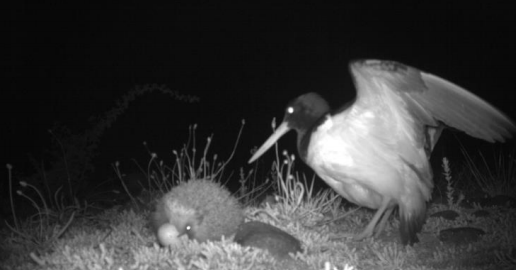
Over two nesting seasons, the researchers tested the response of cats, ferrets and hedgehogs to false odour cues at nesting sites for three shorebird species – the banded dotterel, wrybill and South Island pied oystercatcher. These native bird species nest on the ground on braided rivers in Canterbury, New Zealand, and are highly vulnerable to predators.
The researchers made odorous pastes from three types of bird - chicken, quail and kelp gull – and tested whether repeated exposure to these odours would affect the predators’ behaviours. Every three days they set out the pastes at 300 to 400 points across nesting sites before the birds arrived to nest, and also during the nesting season. Nesting sites without paste treatment were used as a control.
Camera traps were used to monitor predators’ interest in the paste, and to monitor the survival of nests with and without odour paste.
In the second nesting season, the paste/no-paste sites were swapped to increase the reliability of the results. All three types of predator were attracted by the paste odours, and the study showed that ferrets and cats in particular quickly lost interest in unprofitable odours.
Thus, when the birds arrived to nest, the predators had already altered their behaviour by ignoring bird odour, including that of the real birds. The nest survival statistics were striking for all three bird species: compared with non-treated sites, odour treatments resulted in a 1.7-fold increase in chick production over 25–35 days, and doubled or tripled the odds of successful hatching.
For banded dotterel, the researchers estimate that this intervention could result in a 127% increase in modelled population size in 25 years of annual odour treatment. The method is best suited to small areas of vulnerable biodiversity where lethal control methods are difficult to implement.
Lead researcher Dr Grant Norbury of Manaaki Whenua - Landcare Research worked with colleagues at the University of Sydney, Dr Catherine Price and Prof Peter Banks, who developed the idea. Dr Norbury says that this field experiment provides clear evidence of altering predators’ perceptions of prey availability on a landscape scale, and “could significantly reduce predation rates and produce population-level benefits for vulnerable prey species at ecologically relevant scales, without any direct interference with animals.”
Expert Reaction
These comments have been collated by the Science Media Centre to provide a variety of expert perspectives on this issue. Feel free to use these quotes in your stories. Views expressed are the personal opinions of the experts named. They do not represent the views of the SMC or any other organisation unless specifically stated.
Dr Grant Norbury, Researcher, Wildlife Ecology & Management, Manaaki Whenua - Landcare Research
We went to the Mackenzie Basin, chose four 1,000 hectare sites, riverbed systems where birds are really vulnerable to predators. On two of those sites we put out bird odour that we'd extracted from chicken and quail, before the banded dotterels, pied oystercatchers and wrybill arrived for nesting.
The expectation was that predators would sniff out that bird odour without getting a reward, and they'd get bored with the smell. So when the birds arrive for breeding, the predators wouldn't pursue them. We found that nesting success increased by about 1.7 times on the sites where we put bird odour compared to those where we didn't.
What's well known about mammals is they use smell as their primary cue to hunt for food, and they have to get bored with cues that aren't rewarding, in order to maintain their optimal foraging. But it wasn't until we saw the work in Australia that we thought we could use this to help species that are affected by predation. Because in this case we're not removing a single predator, we're just fooling with their minds, trying to outsmart them - and it seems like we have.
However it only lasts for a short period - about a month. It's not a technique that's going to work in the vast back-country of New Zealand, it'll only work in small, specialised areas. But it'll be useful during the start of breeding seasons, for short periods of time, and also perhaps during translocations.

