Drop bears! Koalas may be the closest living relative of the marsupial lion

Publicly released:
Australia; SA; TAS
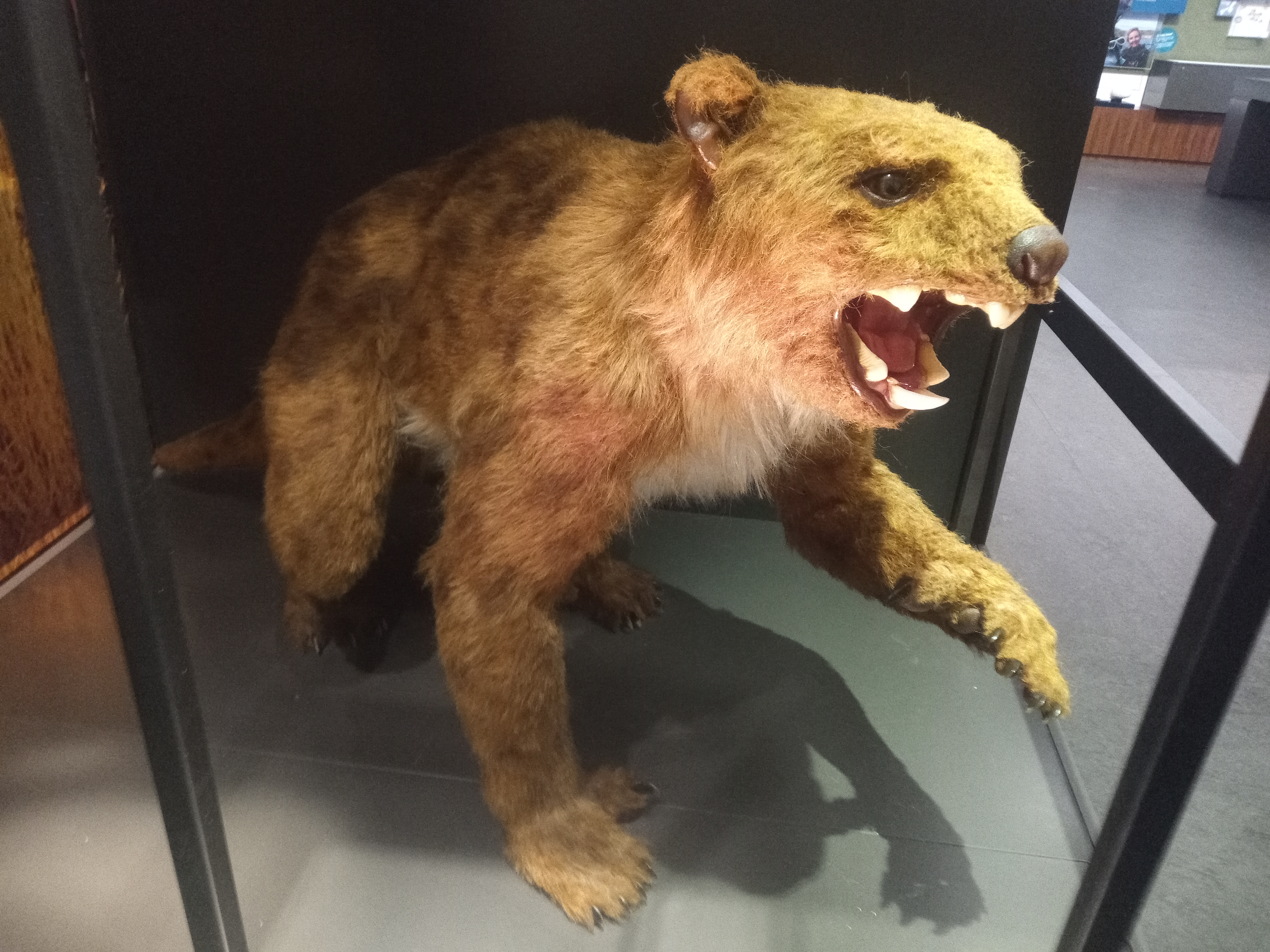
Thylacoleo carnifex sculpture at the Australian Museum. Credit:Xyxyzyz, CC0, via Wikimedia Commons

The classic Aussie myth of the drop bear as a carnivorous version of the koala might have some truth behind it after all, with Australian researchers revealing that koalas may in fact be the closest living relative of the carnivorous 'marsupial lion' Thylacoleo. Using a new technique which creates a unique fingerprint for species based on the collagen proteins in their fossils, the researchers traced the evolutionary history of three extinct Australian megafauna animals: Zygomaturus - a herbivore that looked a bit like a 500kg wombat, Palorchestes - another herbivore that resembled a tapir, and Thylacoleo carnifex - the marsupial lion. They found that the data suggested that the koala may be the closest living relative of the ‘marsupial  lion’, Thylacoleo carnifex.

News release

From: The Royal Society

Collagen fingerprinting and sequence analysis provides a molecular phylogeny of extinct Australian megafauna

Proceedings of the Royal Society B: Biological Sciences

During the Late Pleistocene, the former land mass of Australia, Tasmania, and New Guinea faced one of the greatest waves of megafaunal extinctions on the planet, wiping out hippo-sized wombats and ‘marsupial lions’ among other enigmatic giants. Pushing far beyond ancient DNA preservation, here we use ZooMS collagen fingerprinting to screen marsupial megafaunal fossils for sequencing, successful in samples up to 100,000 years old. Our phylogenetic analyses provide the first biomolecular evidence for the relationships of the extinct Zygomaturus, Palorchestes, and Thylacoleo, with the latter indicating that the koala may be the closest living relative of the so-called 'marsupial lion'.

Attachments

Note: Not all attachments are visible to the general public. Research URLs will go live after the embargo ends.

Research The Royal Society, Web page Please link to the article in online versions of your report (the URL will go live after the embargo ends).
Journal/
conference:
Proceedings of the Royal Society B
Research:Paper
Organisation/s: The University of Adelaide, The University of Manchester, Tasmanian Museum and Art Gallery
Funder: M.B. acknowledges funding from the Royal Society (RGF/EA181057) and E.R. acknowledges funding from the University of Adelaide Interdisciplinary Research Fund for fieldwork and OSL dating for Femur Fest Caev. R.E. acknowledges support from the Plomley Foundation.
Media Contact/s
Contact details are only visible to registered journalists.