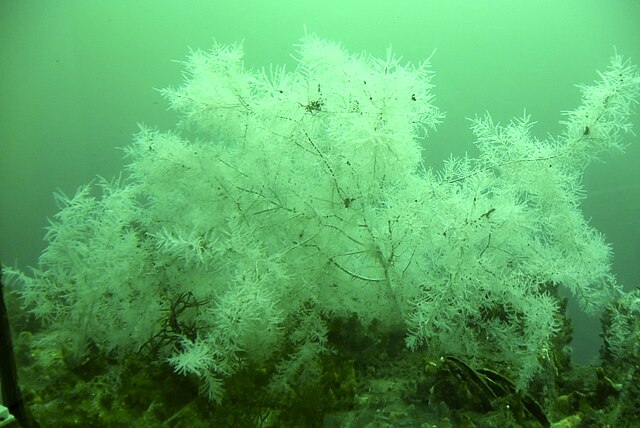
Bottom trawling threatens sea critters' climate refuges in Aotearoa

Publicly released:
New Zealand
Hannahsydney, CC BY-SA 4.0 <https://creativecommons.org/licenses/by-sa/4.0>, via Wikimedia Commons

Sites crucial to the future survival of vulnerable sea life like cold-water corals are at risk from bottom trawling in NZ waters. Scientists modelled how a 30-year period of historical trawling had affected ten types of seafloor life—representing vulnerable ecosystems—in their current homes and in areas resilient to climate change. Their numbers and ranges have been lessened already, and their density drops by about 10% in climate refuges under future warming, due to bottom trawling. The authors say we must identify and protect these refuges to lessen risks of extinction.

Attachments

Note: Not all attachments are visible to the general public. Research URLs will go live after the embargo ends.

Research Elsevier, Web page Paper is freely available online
Journal/
conference:
Ocean & Coastal Management
Research:Paper
Organisation/s: University of Waikato, University of Auckland, National Institute of Water and Atmospheric Research (NIWA), Victoria University of Wellington, Department of Conservation, Newcastle University (UK)
Funder: This research was supported by a doctoral scholarship from the School of Science at the University of Waikato. Additional support was provided by the National Science Challenge Sustainable Seas Projects 3.2 Communicating Risk & Uncertainty (C01X1901) and Project 1.1 Ecological Responses to Cumulative Effects (C01X1515). We are grateful to Fisheries New Zealand for providing the 30-year time series of bottom trawl fishing effort and distribution and to the Department of Conservation for sharing the R code used for the dRBS modelling developed as part of CSP project INT 2022-04 Risk Assessment for Protected Corals.
Media Contact/s
Contact details are only visible to registered journalists.