 Sign In



 International
News release
From:
How baleen whales sing under the sea
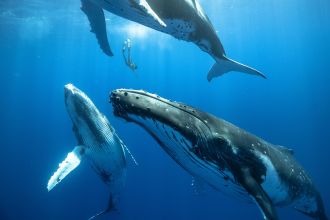
Baleen whales produce their vocals using a specialized larynx, according to a paper published in Nature this week. The study highlights the physiological limits of their song, suggesting that the animals may be uniquely impacted by the noise of shipping vessels.
Whales have complex social and reproductive behaviours that are mediated through their distinctive vocalizations. When the ancestors of whales returned to the oceans from the land, major adaptations were required to make this vocal communication feasible underwater. Toothed whales evolved a nasal vocal organ, whereas baleen whales are thought to use the larynx, although it is not clear exactly how they produce sound.
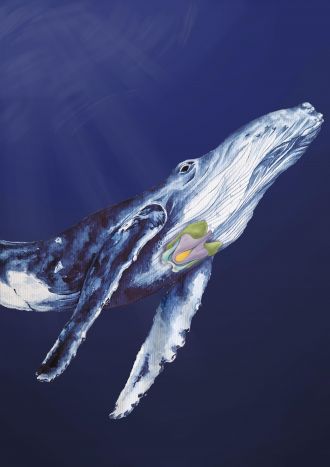
Coen Elemans and colleagues examined the larynges of three stranded baleen whales of the sei, common minke and humpback species and used scanning and modelling techniques to reconstruct how vocalization could occur. In all three, it was found that sound is produced by aerodynamic vibrations of specific vocal structures in the baleen larynx that are not seen in toothed whales. These specialized structures allow the production of sound and recycling of air while preventing inhalation of water.
Computational models of the vocalizations indicate that they enable low-frequency communications over large distances of opaque water, with a maximum depth of 100 m and maximum frequency of 300 Hz. The authors posit that the laryngeal structures would be unable to produce sound at higher frequencies, preventing communication over longer distances (hundreds of kilometres). Importantly, these limits leave the song within the range of noise that is typically created by shipping vessels (30–300 Hz), suggesting that the communication between baleen whales would be severely impacted by human activity, as their vocal physiology would prevent them from exceeding this range.
Multimedia

Attachments
Note: Not all attachments are visible to the general public. Research URLs will go live after the embargo ends.


