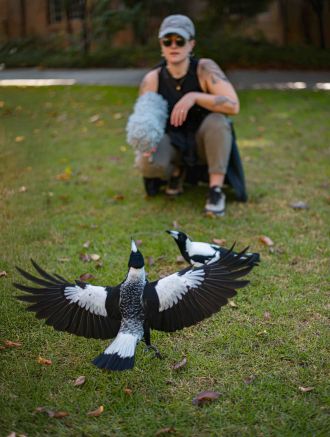
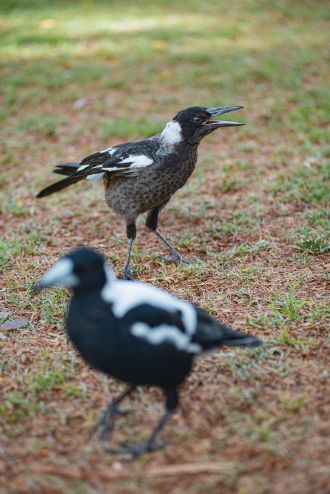
Young magpies learn calls just like human toddlers learn sounds, words and then sentences

Publicly released:
Australia; WA
Credit: Andrew Leslie

Young magpies learn their complex calls in a similar way to the way human toddlers learn sounds, words and then sentences, according to Australian research. The researchers studied 11 fledgling magpies in WA for 200 days after leaving the nest. They found that the magpies learnt how to turn simple sounds into more complex calls and sequences, thanks to their social group, ordering them and combining them to be meaningful. The fledglings learned the specific sequences of their social group, and the more social a fledgling was, the more sophisticated its vocal calls became.

News release

From: The Royal Society

Ontogenetic evidence of socially learned call sequences in Western Australian magpies

Proceedings of the Royal Society B: Biological Sciences

Research into syntactic vocalisations in animals has largely focused on cross-sectional studies of adult individuals, limiting our capacity to uncover the developmental origins and drivers of variation in these vocalisations. Here, we perform the first longitudinal, developmental study of non-song call sequences, revealing that Western Australian magpies learn their sequence repertoires from their social groups—the first evidence of this outside of humans. Furthermore, fledglings that spend more time with others develop their repertoires faster, and those with more social contacts develop larger repertoires. These findings provide the first individual-level and ontogenetic support for combinatoriality being driven by sociability.

Multimedia
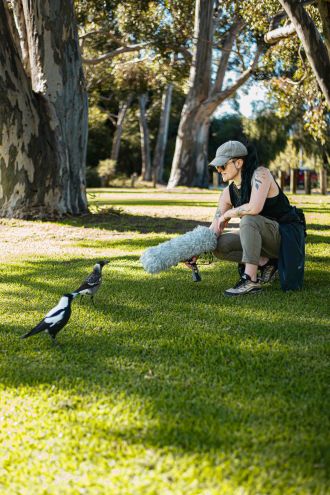
Dr Stephanie Mason with juvenile magpies
Dr Stephanie Mason recording fledgling magpies

Attachments

Note: Not all attachments are visible to the general public. Research URLs will go live after the embargo ends.

Research The Royal Society, Web page Please link to the article in online versions of your report (the URL will go live after the embargo ends).
Journal/
conference:
Proceedings of the Royal Society B
Research:Paper
Organisation/s: The University of Western Australia
Funder: This project was supported by the University of Western Australia Research Collaboration Award (2022/GR000734) and an Australian Government Research Training Program (RTP) Scholarship
Media Contact/s
Contact details are only visible to registered journalists.