Sign In



 Australia; International; NSW; SA
News release
From:
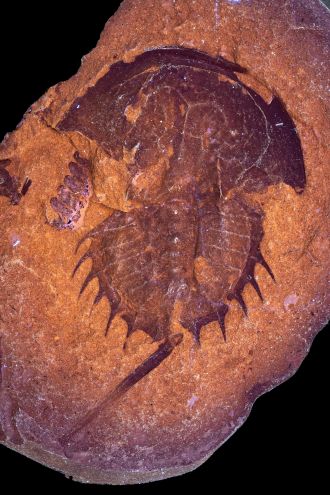
A remarkably preserved horseshoe crab fossil from North America offers rare insight into some of the earliest known cases of animal disease in a Late Carboniferous swamp – more than 300 million years before the age of dinosaurs.
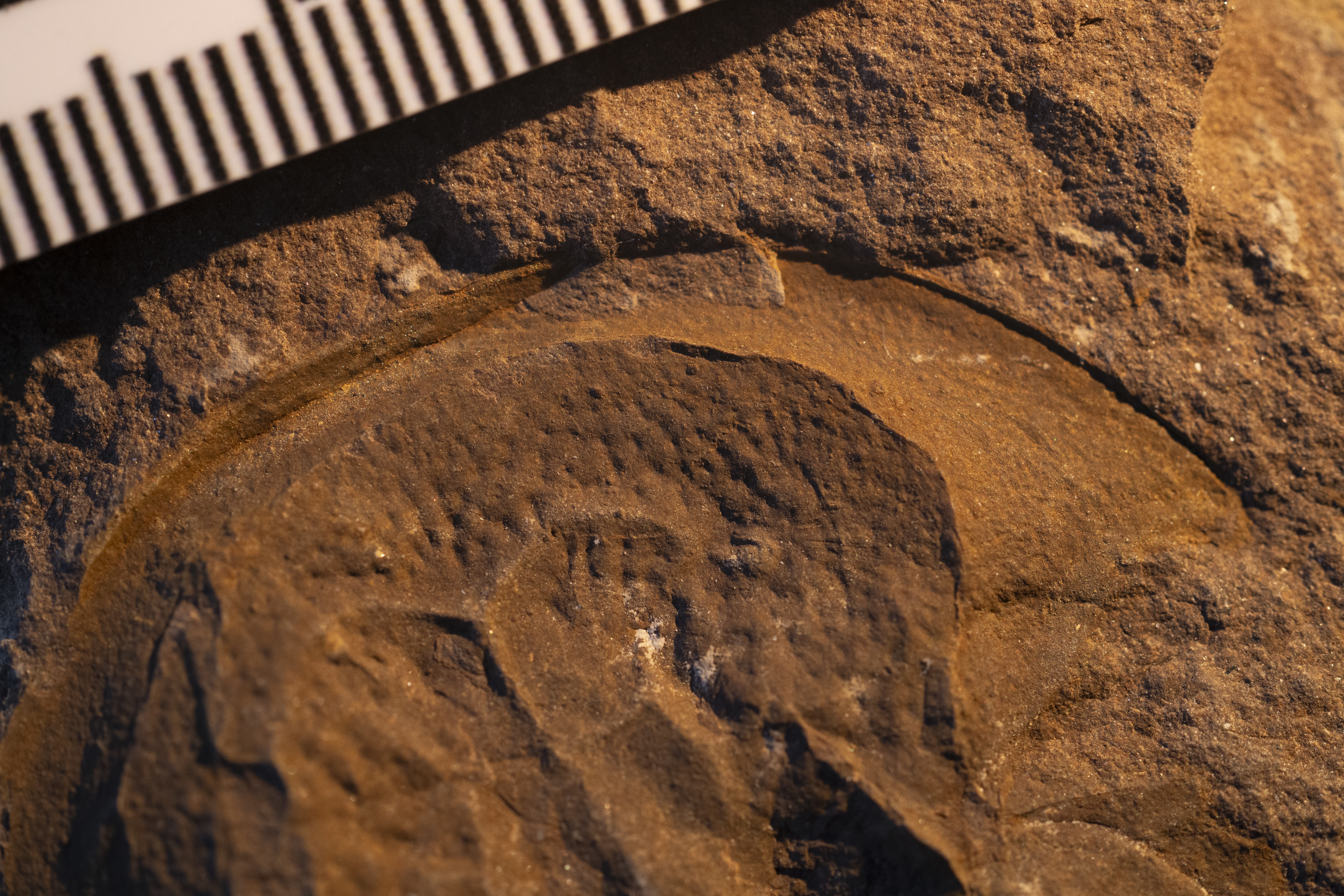
The specimen, uncovered from the mass-burial fossil deposit at the famous Mazon Creek Lagerstätte in Illinois in the US, shows more than 100 small pits across the front of its shell, representing one of the earliest documented examples of microbial or algal infection killing groups of these ancient aquatic animals.
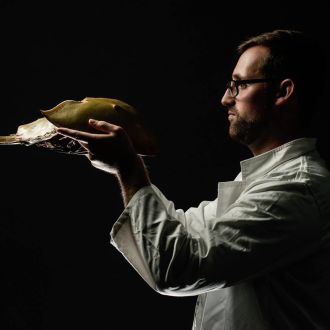
“Ancient arthropods faced many of the same ecological pressures that modern species experience today, including microbial attacks and environmental stress,” says Dr Russell Bicknell, lead author of a new Biology Letters article, and recent appointee at Flinders University in South Australia.
“This fossil links a specific biological event – likely microbial or algal infestation – to a broader evolutionary picture, showing that interactions between animals and microbes were already well established long before dinosaurs evolved,” says Dr Bicknell, who previously worked at the American Museum of Natural History in New York.
“It also ties the specimen to the Late Carboniferous world, a time when Earth’s ecosystems were undergoing significant changes that shaped the future of animal evolution.
“From an evolutionary perspective, this discovery pushes back evidence of such infestations in horseshoe crabs by more than 300 million years. “
Dr Bicknell, an Australian Research Council DECRA fellow at Flinders University, says the fossil horseshoe crab (Euproops danae) regularly shed their shells while growing so the “heavy fouling” indicates the specimen had stopped moulting and reached maturity.
“The Late Carboniferous nutrient-rich environment at Mazon Creek, with its regular flooding and fluctuating salinity, would have promoted microbial growth and rapid burial. These conditions helped preserve organisms inside ironstone concretions with exceptional detail.”
At the time, vast forests covered the planet, oxygen levels were high, and land animals – including amphibians and reptile ancestors, were diversifying.
“This fossil adds to a new piece of the ecological puzzle, highlighting the pressures shaping ancient marine anthropods and their evolutionary responses to infestation.”
Horseshoe crabs are related to spiders and scorpions today.
The article, ‘Unique, dimple-like exoskeletal structures suggest syn-vivo infestations in Late Carboniferous horseshoe crabs’ (2025) by Russell DC Bicknell (American Museum of Natural History, University of New England and Flinders University), Jason Dunlop (Museum für Naturkunde, Berlin), Andrew Young (Lauer Foundation, Illinois), Bruce Lauer (Lauer Foundation), René Lauer (Lauer) and Victoria E McCoy (Lauer Foundation and University of Wisconsin-Milwaukee) has been published in the journal of Biology Letters (Royal Society)- DOI: 10.1098/rsbl.2025.0565.
Acknowledgement: This research was funded by a MAT Program Postdoctoral Fellowship to Dr Bicknell. With thanks for access to the collection at the Lauer Foundation for Paleontology, Science and Education. Fossil images courtesy Gregory Lewbart (North Carolina State University).
Images: https://www.dropbox.com/scl/fo/ihtxe571yvlz72icf6pz5/ANQG4cpm-WAxa29_ITV1LMo?rlkey=odle8a2n385leioiuc2oilts2&dl=0
Multimedia