 Sign In



 Australia; NSW
News release
From:
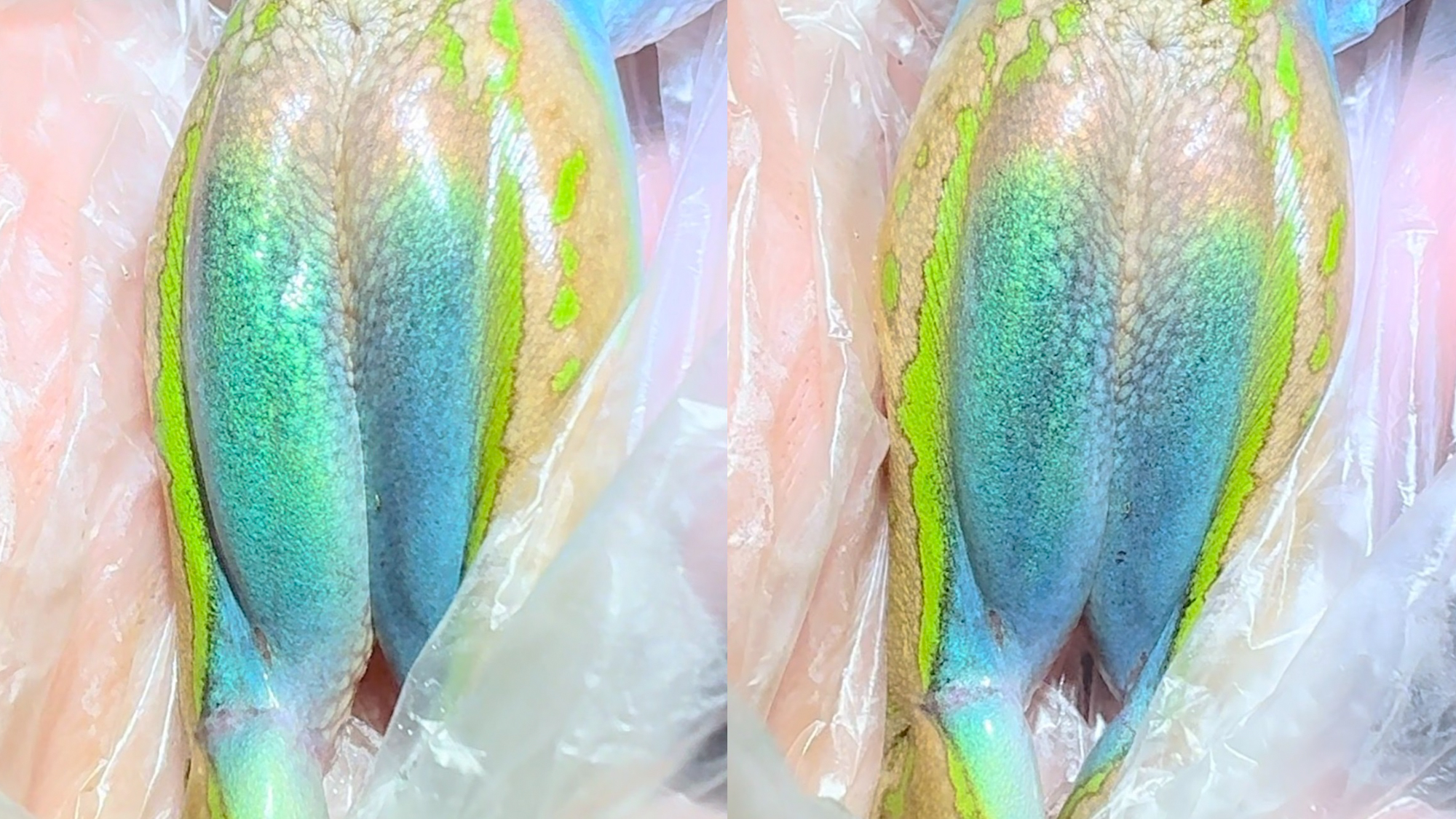
University of Newcastle researchers have documented one of the clearest examples of iridescence ever recorded in an amphibian, revealing that the endangered green and golden bell frog (Ranoidea aurea) possesses intricate colour-shifting skin previously unseen in the species.
The discovery, published today in the journal Austral Ecology, provides new insight into how frogs produce structural colour and suggests the striking blue flash markings on the species’ inner thighs may be even more visually effective at deterring predators than previously thought.
Lead author Dr John Gould, a conservation biologist from the University of Newcastle, said iridescence is an extraordinary optical phenomenon more commonly associated with birds, butterflies and beetles.
“Iridescence occurs when colour changes according to the angle from which it is viewed,” Dr Gould said.
“Two people standing in different locations can look at the same patch of tissue at the same time and see different colours. It's a remarkable optical effect, but it's very rarely documented in amphibians.
“Given the green and golden bell frog is such a well-known Australian species, our finding highlights how much remains to be discovered in the animal kingdom.”
The research provides clear photographic evidence that the blue inner thigh skin of the green and golden bell frog shifts from blue to green depending on the viewing angle, demonstrating true iridescence.
The coloured skin is normally hidden from view but can be revealed when the frog moves or jumps. Scientists believe the bright blue patch functions as a ‘flash colouration’ signal to startle or distract predators.
“The blue inner thigh is already thought to play an important role in anti-predator defence,” Dr Gould said.
“Our findings suggest that iridescence may enhance that visual signal, making it even more conspicuous and attention-grabbing when the frog moves.”
The findings also challenge long-held assumptions about how blue colouration is produced in frog skin.
Across the animal kingdom, blue colours are rarely created by pigments. Instead, they are typically produced through microscopic tissue structures that interact with light, creating what scientists call structural colouration.
While frogs are known to produce blue and green colours using reflective platelets within specialised skin cells, researchers have previously suggested that blue colouration may result from light scattering through randomly arranged structures.
Dr Gould said the discovery of iridescence points to a more organised arrangement.
“True iridescence only occurs when these microscopic structures are ordered as opposed to completely random, similar to what we see in butterfly wings,” he said.
“The presence of iridescence in this frog shows the blue colour isn't being produced through random scattering alone. Instead, it indicates that ordered reflective platelets are responsible for creating the structural blue colour.”
The finding opens new avenues for understanding colour production in amphibians.
“People are often surprised to learn that frogs produce structural colours at all,” Dr Gould said.
“This study demonstrates that amphibian skin can be far more complex than we previously appreciated and suggests there may be other examples of iridescence waiting to be discovered.”
Multimedia


