 Sign In



 Australia; New Zealand; NSW; QLD
News release
From:
An international team of scientists has uncovered evidence glaciers in the Southern and Northern hemispheres were synchronous during the last ice age.
The finding challenges prevailing theories and provides critical information to help model how today’s ice sheets will respond to a changing climate.
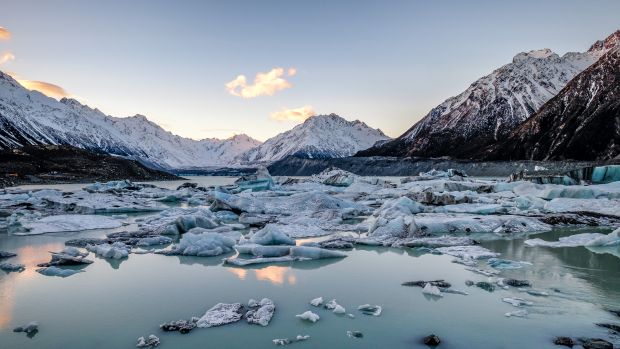
Researchers from The University of Queensland, Ifremer, NIWA, the University of New South Wales, the Alfred Wegener Institute and CNRS, constructed the first complete record of glacial fluctuations in the Southern Alps of New Zealand by analysing a marine sediment core.
Professor Helen Bostock from UQ's School of the Environment said when the evolution of the New Zealand glaciers was compared to their European and North American counterparts, they were found to retreat simultaneously.
"Our work shows a period of global warming, likely caused by an increase in the global energy imbalance, preceded glacial retreats in both hemispheres at the same time,” Professor Bostock said.
“The finding challenges previous theories of an inter-hemispheric ‘bipolar seesaw’.”
Until now, it was thought the Northern and Southern Hemispheres changed in opposite ways during the Heinrich Stadials, a period when a large influx of melt water to the North Atlantic slowed the Atlantic Meridional Overturning Circulation (AMOC) which caused heat to accumulate in Southern Hemisphere’ oceans enhancing glacial retreat in New Zealand.
Previously, past glacier movements were reconstructed by dating boulders in debris left by glaciers, but they are an incomplete record because they are disturbed by subsequent glacier advances.
“Marine sediment cores provide a time capsule, a continuous, well-dated history of the glacial expansion and retreat, unlike dating boulders,” Professor Bostock said.
“The record of glacial sediments can also be directly compared with past changes in ocean temperatures recorded by microfossils preserved in the sediment.
“The record shows a tight connection between warming oceans and glacial retreat.”
Dr Samuel Toucanne, lead author and Ifremer researcher said the study demonstrated the complex, sensitive and interconnected nature of the Earth's climate system.
“A better understanding of these past climate mechanisms is essential for refining current prediction models and anticipating the impact of global climate change linked to human activities.”
The research was published in Nature Geoscience.

