 Sign In



 Australia; NSW; QLD
News release
From:
Ganalay and guli are species of native grasses - used as a food source and ground into a flour - that used to thrive on the black alluvial soil plains of Moree, New South Wales, particularly after heavy rains or flooding.
In summer, they produce florets containing seed that can be eaten raw or cooked as flour.
However, grazing, cropping, water regulation, and irrigation have caused their decline.
But a project led by Griffith University historian Dr Margaret Cook and Kamilaroi knowledge-holder and researcher Kerrie Saunders in Moree has helped restore Kamilaroi women’s knowledge.
Their 2024-25 research, funded by the Murray-Darling Basin Authority, explored how changing water flow regimes and agriculture had affected the Kamilaroi people, the grasses, soils and waterways in Moree.
“In Kamilaroi culture, harvesting grain was women’s work,” Ms Saunders said.
“Much of the food consumed by Aboriginal people was plant based, harvested and cooked by women.
“Through colonisation much of the knowledge of the grasses, harvesting and food production has largely receded into memory.”
Ms Saunders and Dr Cook recorded the oral histories of 19 Kamilaroi women, and informed by sensory ethnography, they asked each woman to smell a cup of wet guli as a mnemonic device or memory trigger.
This opened a rich seam of childhood stories about playing cubby houses in the long grasses and catching fish and swimming in the Mehi River, which was once clear, abundant with animals, flowing, and fresh to drink.
In the 1970s, the New South Wales Government constructed Copeton Dam, six weirs and regulators to regulate the flows of the Mehi River and creeks.
“With water supply seemingly assured in a wet decade, unregulated water licenses were over supplied by about 50 per cent of the river system’s capacity,” Dr Cook said.
“This brought cotton to the region, which has become highly industrialised, corporate and large scale, and depends on fertilisers and pesticides to sustain high yields.”
Ms Saunders and Dr Cook said the Kamilaroi women spoke of hearing the pumps starting as soon as there was any flow in the river and seeing the Mehi River run backwards, such was the strength of the pumps.
Although restrictions have since been introduced, irrigation continues, and the largest water users in Moree Shire currently are irrigators (mainly cotton producers) who used on average 95 per cent of the water consumption.
“Excessive water extraction, pesticides and fertilisers, the women say, brought pollution and sickness to the rivers and Kamilaroi people,” Ms Saunders said.
“The women lamented the loss of favourite fishing holes and declining fish numbers and species.
“Land holdings and weirs meant swimming places were fenced off, so that now rivers rarely flowed and the water was murky and stank.
“Many of the women stopped swimming in the river as children ‘were coming home with yellow toes’ and ‘their hair started falling out from the chemicals in the water’.
“They drink bottled water as the river water is no longer safe to drink.
“The riverbanks are bare and surviving grasses have gone yellow from no nutrients.”
As the river’s health declined, the government introduced environmental water flows designed to restore the environment.
While they helped, the women criticised their timing, with water released after the harvest and not when the wetlands need them.
Despite the degradation and water loss, guli (native millet) and ganalay (curly Mitchell grass) have survived and can flourish if watered at the right time.
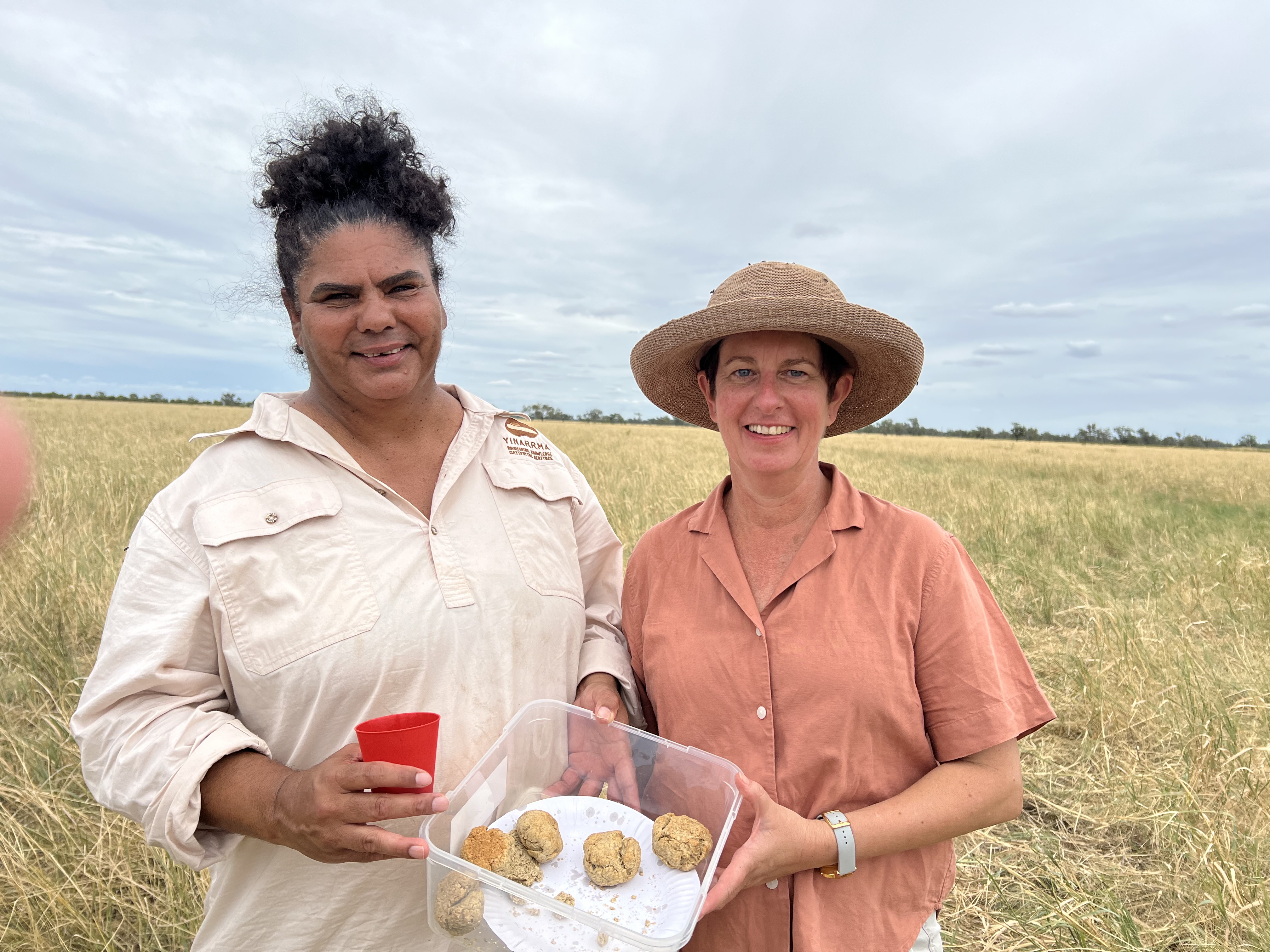
Ms Saunders has been working with local grazier, Patrick Johnston, to harvest grasses and together they are working to produce native flour.
“Ganalay and guli require less water than imported grasses, are gluten free and have a higher protein content and lower glycaemic index than wheat, making them a healthy alternative,” she said.
“It’s my dream to put Australian native grasses into mainstream Australian diets.”
Through her business, Yinarr-ma, Ms Saunders hoped to sell ganalay and guli flour for everyone’s cooking.
“The Kamilaroi women’s stories remind us that water policy is never just technical —it is also cultural and political,” Cook said.
“Rivers are not only about flow rates or farming; they incorporate social justice, health and respect.
“A rethinking in water management is needed that honours Aboriginal rights and restores ecological relationships.”
The report ‘Wetland Grasses, Ancient Grains, and Indigenous Food Production’ has been published by the Murray Darling Basin Authority.

