Foals that spend longer with mum develop better

Publicly released:
International
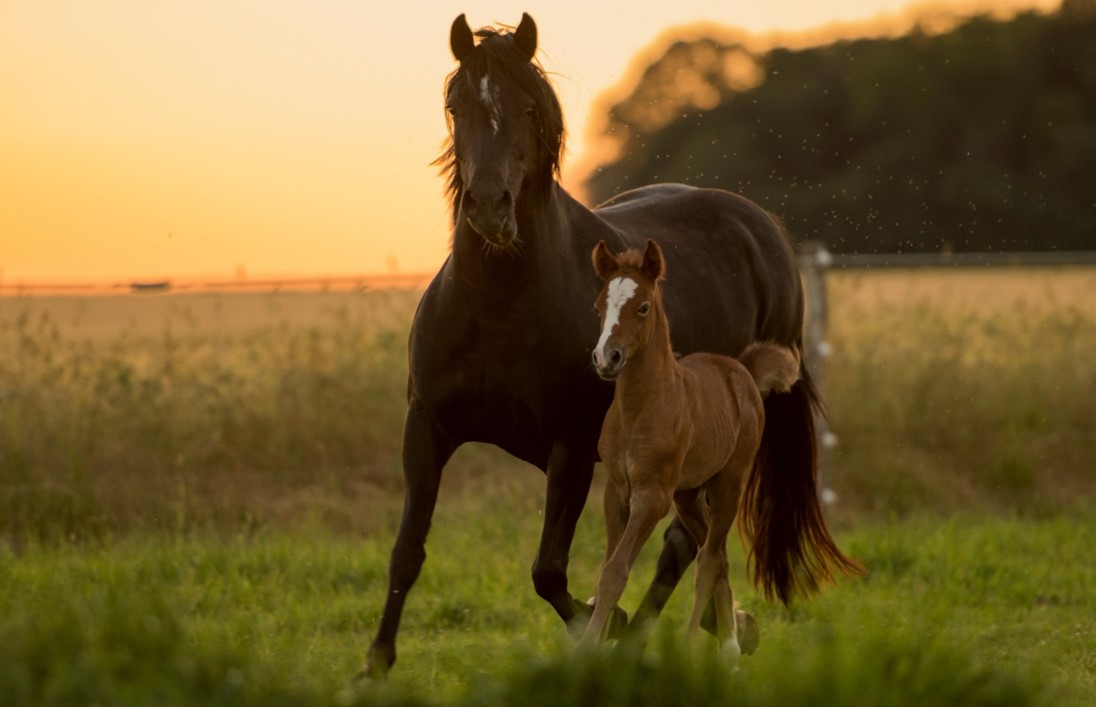
Story by Steven Mew, Australian Science Media Centre. Affliative interactions between mare and foals. Credit: UMR PRC INRAE-CNRS-Université de Tours. M.E. Le Bachelier de la Rivière

Keeping young horses with their mothers for longer could have a positive impact on their brain development and social interactions, according to international researchers, who used brain scans of 24 foals, half of whom had been removed from their mothers at six months of age. The team found that foals who stayed with their mothers longer were more mature in several brain regions, and that these foals were more sociable, engaged more in positive social interactions, explored their environment more, and gained more weight (despite spending less time feeding), compared to the foals separated at six months.

News release

From: Springer Nature

Horse brain scans reveal the importance of the mother-foal bond

Prolonged contact between horse foals and their mothers may be beneficial to the offspring, conferring potentially positive effects on brain structure and function, and on social development, according to a study published in Nature Communications.

In large social mammals, caregiving adults may promote the acquisition of social skills that are necessary for the survival and reproductive fitness of their offspring. For horses, it has been shown that severing this bond by weaning at approximately four to six months old can induce long-lasting negative outcomes for foals. However, the reason for these effects remains unknown.

David Barrière and colleagues conducted brain scans (including functional magnetic resonance imaging) and a combination of physiological, social, and cognitive tests on 24 domestic horse (Equus caballus) foals followed from the age of 6 to 13 months. Half of the foals had been separated from their mothers at six months of age, and the other half had remained with their mothers up to the conclusion of the experiment. The authors observed that prolonged maternal presence was associated with increased maturation in several brain regions. This included regions involved in regulating socioemotional behaviours (anterior cingulate cortex and retrosplenial cortex) and physiological regulation (hypothalamus and amygdala). They also found that these foals were more sociable, engaged more in positive social interactions, explored their environment more, and gained more weight (despite spending less time feeding), compared to the foals separated at six months. Physiologically, prolonged maternal presence was associated with higher concentrations of circulating lipids (triglycerides and cholesterol), and lower levels of cortisol (a hormone associated with stress).

The findings provide further evidence for delaying maternal weaning of foals under human care and position the domestic horse as a good candidate for studying caregiver-offspring relationships in large mammals.

Multimedia
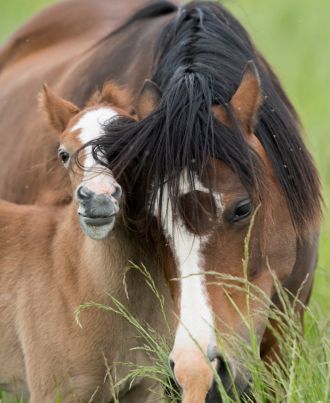
Affliative interactions between mare and foals 1
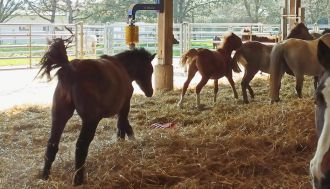
Young horses
Young horses
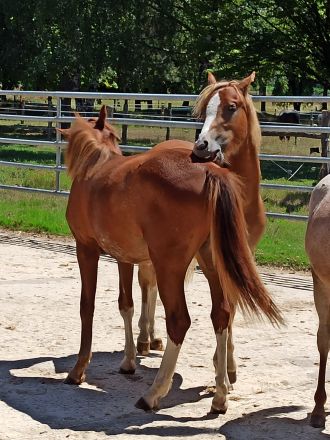
Mutual grooming
Mutual grooming
Affliative interactions between mare and foals
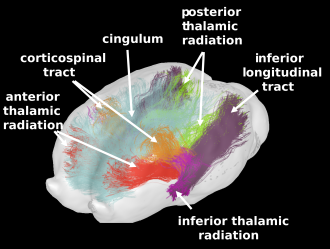
Top view of the Turone equine brain fibre atlas obtained using diffusion imaging
Journal/
conference:
Nature Communications
Research:Paper
Organisation/s: CNRS, France
Funder: M.V. and M.K. gratefully acknowledge support from the European HORIZON 2020 Marie Skłodowska-Curie Actions (MSCA) (project number: 101033271, MSCA European Individual Fellowship, https://doi.org/ 10.3030/101033271, fellow: MV, host supervisor: MK) and the Institut Français du Cheval et de l’Equitation (IFCE) for co-funding this project (DEVELOPPEMENTPOULAIN project, M.V., M.K.). This work was also supported by the French National Research Institute for Agriculture, Food and the Environment (INRAE), which, through its specific experimental units, Unité Expérimentale de Physiologie Animale de l’Orfrasière and the PIXANIMimaging platform belonging to the UMR Physiologie de la Reproduction and des Comportements, provided both animals and technical facilities for successful MR imaging on domestic horses. This work also benefited from the Phenotyping–Endocrinology Laboratory for the hormonal assays and the IT infrastructure of the ISLANDe platform, particularly a computing cluster financed by the European Regional Development Fund n° 159037.
Media Contact/s
Contact details are only visible to registered journalists.