Sign In



 International
News release
From:
By Emenyeonu Ogadimma, University of Sharjah
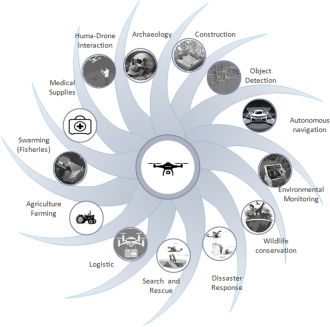
Intelligent drones and unmanned aerial systems (UAS) are rapidly evolving from experimental prototypes into essential infrastructure across disaster response, healthcare delivery, agriculture, logistics, archaeology, environmental monitoring, and numerous other fields vital to human development, scientists say in new research.
The study, published in the International Journal of Cognitive Computing in Engineering, notes that “drone technology is poised for remarkable advancements across multiple domains,” with the potential to significantly improve quality of life worldwide.
According to the authors, next-generation drones are expected to have far greater endurance, with longer flight ranges, extended operational duty cycles, and enhanced resilience. These improvements will enable drones to support long-duration missions, such as long-distance medical or commercial deliveries, and wide-area surveillance in both densely populated urban zones and forest environments.
Current progress in artificial intelligence and machine learning is further accelerating this transformation, with AI enabling drones to perform complex tasks autonomously. The latest advancements have made it easy for drones to recognize objects, plan their path, and avoid obstacles.
“Drones will become more adept at perceiving their surroundings as sensor technology advances, such as LiDAR, multispectral cameras, and sophisticated IMUs, making drones useful tools for mapping, surveying, and agriculture,” the researchers emphasize.
Mapping the future of autonomous drone navigation
The study adopts a three-stage research framework to assess the current state of drone technology and chart a pathway toward the advancements expected in a sector that has become essential in an era defined by digitization, artificial intelligence, and machine learning.
To balance theoretical rigor with real-world applicability, the authors, affiliated with the University of Sharjah in the United Arab Emirates, Algeria’s Université Constantine 2, and Malaysia’s Taylor's University, focus on mathematical models that underpin autonomous navigation in unmanned aerial vehicles (UAVs).
They introduce “optimization-based path loss models incorporating terrain and environmental constraints” and compare them with the existing “state-of-the-art approaches to assess their effectiveness and performance.”
Meanwhile, the study highlights the fundamental principles and mathematical foundations of autonomous navigation, proposes an optimization model for path-loss prediction, offers a comparative assessment of contemporary models, and outlines the most advanced algorithms and techniques in UAV research.
It evaluates a broad spectrum of optimization methods, including genetic algorithms, particle swarm optimization, colony optimization, and reinforcement learning, that enable drones to compute efficient flight routes, reduce energy consumption, and avoid obstacles that could delay or compromise mission objectives.
The research underscores how recent advancements in unmanned aerial systems and artificial intelligence have “accelerated research in a variety of fields, including human-drone interaction, autonomous navigation, security, object detection, urban air mobility, energy-efficient design, environmental monitoring, archaeological research, wildlife conservation, medical supply delivery, disaster response, and precision agriculture.”
Call for stronger regulations and ethical safeguards
With drone technology expected to advance rapidly, countries will need to update and strengthen the regulatory frameworks governing drone applications, the authors add, noting that “concerns such as privacy alongside airspace management are expected to be addressed by regulatory bodies as they improve and adapt regulations to ensure reliable and accountable drone operations.”
The researchers anticipate that future innovation will increasingly focus “on designing specialized drones to meet … industries' demands. Drone flights will go up due to improvements in battery technology and energy efficiency, which reduce recharge frequency, making them more useful for long-duration missions.”
Looking ahead, the authors emphasize that nations must devote greater attention to drone security and counter-drone technologies. These areas are becoming increasingly crucial as drone use grows, increasing the need “to prevent illegal or harmful drone activities.” In densely populated areas, “drone sustainability, such as noise and emission reduction, should garner more attention.”
They write, “Drones will have a significant role in the worldwide Internet of Things (IoT) ecosystem with the aid of 5G and 6G networks for immediate data transfer and communication. Growing public interest in UAM, which uses passenger drones for transportation, has sparked efforts to develop safe and efficient UAM systems.”
However, the authors raise concerns about the ethical challenges that accompany these technological leaps. Advanced drones, equipped with high-quality cameras and sensitive sensors, can collect personal or confidential data without consent, posing risks to fundamental ethical standards.
They are also quick to note that the use of UAS is not without environmental consequences. “Drones’ flight may disturb wildlife, especially bird habitats, and they may change their migration and nesting behaviors. Another aspect of wildlife disruption is noise pollution.
“Regarding environmental sustainability, the need for high production of lithium batteries for drones causes electronic waste. Consequently, we suggest a balance of technological advancements and ecological maintenance to ensure biodiversity and environmental sustainability.”
Linking theory to practice
The study makes a substantial contribution to drone research by helping bridge the divide between “theoretical path loss models and practical UAV applications.” In doing so, it lays important groundwork for real-world deployment for future models in domains such as wildlife monitoring, disaster management, and precision agriculture. “Future drones will have longer ranges and more endurance, expanding their application across various industries,” the authors note.
The authors further argue that continued technological progress will lead to the development of specialized drones specifically designed to meet distinct industrial needs, which are largely unattainable by current models. Technological advancements are expected in both commercial and industrial drone applications.
Looking to the future, the study highlights the design of energy-efficient drones that “will increase flight times, and security precautions will prevent unapproved drone activities. Quieter and greener drones will be used more frequently, especially in urban areas. While the idea of UAM gets closer to reality, integration with IoT and 5G networks will enable real-time data exchange.”
Overall, the authors conclude that the future of drone technology will be “characterized by automation, versatility, safety, and environmental consciousness. As drones redefine industries and transform everyday life, their evolution remains closely intertwined with technological progress and societal needs.”
Multimedia