Dark side of the universe revealed in new map

Publicly released:
International
ESA/Hubble & NASA, M. Postman, P. Kelly, Story by Ben Kaldi - Australian Science Media Centre

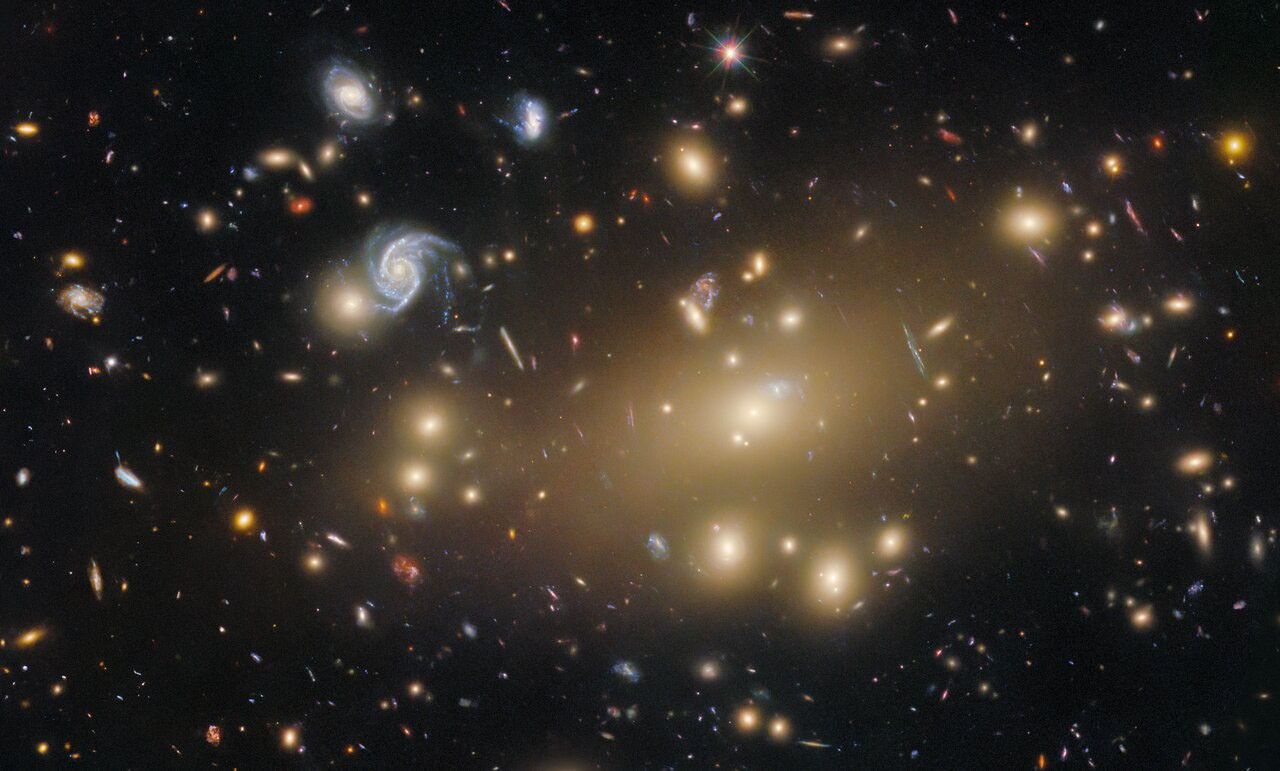
International researchers have put together an ultra-high-resolution map of the mass in our universe, which reveals how dark matter - what makes up around 85% of the Universe's matter - has helped shape the growth of galaxies for the past 10 billion years. As dark matter does not emit or absorb light, it is invisible to our standard telescopes, but the researchers instead are able to note how its gravity affects the path of light from distant galaxies. The team measured these slight distortions, and were able to plot the location of where dark matter must be hiding. The team says their new map has twice the resolution as its predecessor, and includes massive galaxy clusters and dark matter bridges which let gas and galaxies to be distributed to create the 'skeleton' of the Universe.

News release

From: Springer Nature

A detailed map of the Universe’s dark matter


An ultra-high-resolution map of mass in the Universe, revealing how dark matter has shaped the growth of galaxies over the past 10 billion years, is published in Nature Astronomy. The map has more than twice the resolution of its predecessor and extends to earlier periods in the Universe’s evolution, providing a benchmark for tests of the nature of dark matter and models of galaxy environments during the peak period of cosmic star formation, about 8–11 billion years ago.
Dark matter, which makes up around 85% of the Universe’s matter, is difficult to detect because it does not emit or absorb light and is therefore invisible to conventional telescopes. Its gravity, however, affects the paths of light from distant galaxies. By measuring the slight distortions in the shapes of a very large number of distant galaxies, scientists can trace how the intervening mass is distributed, regardless of its nature. Comparison with known luminous structures then reveals where the dark matter must lie. Previous maps, based on the Hubble Space Telescope and other facilities, have lacked either resolution, sensitivity or area, limiting the view to only the largest and most massive structures in the cosmic web.

Diana Scognamiglio and colleagues used imaging from the James Webb Space Telescope to measure the shapes of around 250,000 galaxies and reconstruct the most detailed mass map to date of any contiguous region of the Universe. The map reveals massive galaxy clusters as well as networks of dark filamentary bridges (strands of dark matter, along which gas and galaxies are distributed, forming the skeletal structure of the Universe) and low-mass galaxy groups that are otherwise too faint or too distant to be seen with conventional telescopes. These structures appear consistent with the leading cosmological model, which predicts that galaxies form at dense nodes between the dark matter filaments that thread or span the Universe.

The authors suggest that these maps will be a valuable resource for studies of galaxy evolution and the growth of cosmic structure.

Journal/
conference:
Nature Astronomy
Research:Paper
Organisation/s: California Institute of Technology, Jet Propulsion Laboratory, Pasadena, CA, USA
Funder: Support for this work was provided by NASA grants JWST-GO-01727 and HST-AR15802 awarded by the Space Telescope Science Institute, operated by the Association of Universities for Research in Astronomy, Inc., under NASA contract NAS 5-26555. G.L., R.M. and M.v.W.-K. acknowledge support from STFC via grant ST/X001075/1, and the UK Space Agency via grant ST/W002612/1 and InnovateUK (grant no. TS/ Y014693/1). D.H. was supported by the Swiss State Secretariat for Education, Research and Innovation (SERI) under contract number 521107294. This project has received funding from the European Union’s Horizon 2020 research and innovation programme under the Marie Skłodowska-Curie grant agreement no. 101148925. French COSMOS team members are partly supported by the Centre National d’Etudes Spatiales (CNES). O.I. acknowledges the funding of the French Agence Nationale de la Recherche for the project iMAGE (grant ANR-22-CE31-0007). G.M. is supported in Durham by STFC via grant ST/X001075/1, and the UK Space Agency via grant ST/X001997/1. S.J. acknowledges the European Union’ Marie Skłodowska-Curie Actions grant no. 101060888, and the Villum Fonden research grants 37440 and 13160. N.E.D. acknowledges support from NSF grants LEAPS-2532703 and AST-2510993. D.B.S. gratefully acknowledges support from NSF Grant 2407752. Z.D.L. acknowledges support from STFC studentship ST/Y509346/1. J.R.W. acknowledges that support for this work was provided by The Brinson Foundation through a Brinson Prize Fellowship grant.
Media Contact/s
Contact details are only visible to registered journalists.