 Sign In



 Australia; QLD
News release
From:
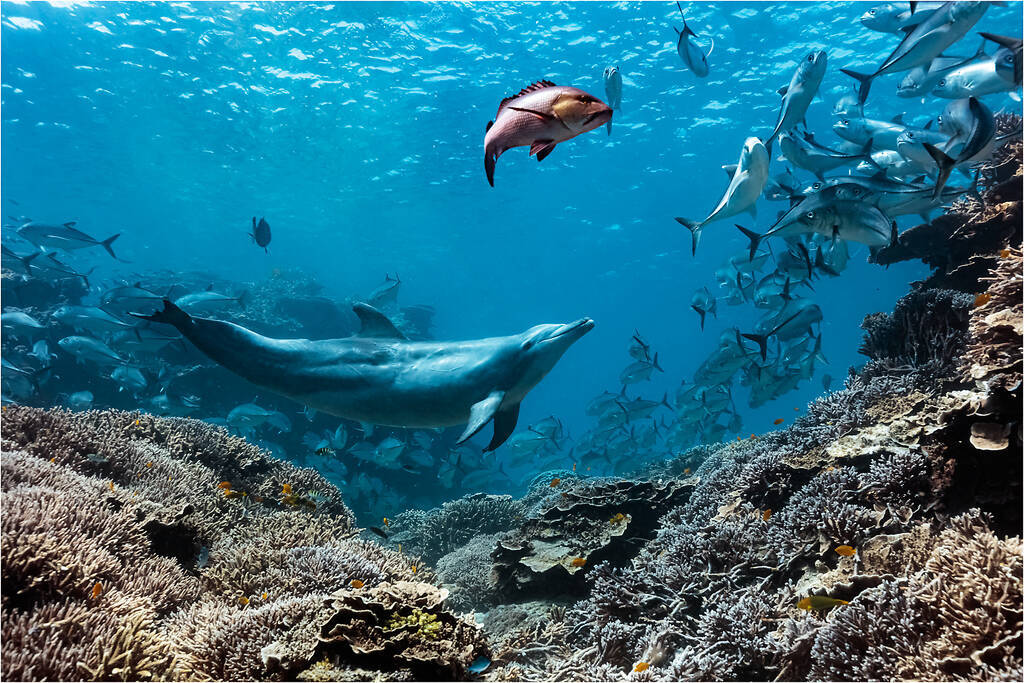
A dolphin who harasses fish until they regurgitate their food – then swoops in to steal it – has astonished University of the Sunshine Coast researchers who have documented this novel feeding strategy.
In findings published today, co-authors Dr Asia Haines and UniSC PhD student Romney Edwards-Francis say the behaviour of the common bottlenose dolphin, nicknamed Bubbles, represents the first detailed description of kleptoparasitism in a cetacean anywhere in the world.
Dr Haines said while kleptoparasitism was a common feeding strategy used by many animals to steal food caught or collected by another, it was usually opportunistic and had rarely been documented in aquatic species, particularly marine mammals.
Between 2021 and 2025, researchers observed and videoed Bubbles’ kleptoparasitic behaviour 11 times in shallow reefs off Lady Elliot Island, in the southern Great Barrier Reef.
In every instance, he harassed a school of Bigeye Trevally, selecting an individual fish and chasing it until it regurgitated its food. He’d then feasted on the expelled remains as the trevally swam away.
“We observed him repeating this behaviour over several years which suggests he may have learnt to target the fish with the fullest bellies, providing the most rewarding meals,” Dr Haines said.
The researchers say Bubbles appears to take advantage of the fish's stress response to being chased and hypothesise he may also use intense repeated clicking and low-pitched vocalisations to heighten their stress levels.
Ms Edwards-Francis said the research team believed Bubbles’ thieving tendencies might help him avoid the energy cost of catching his own food, by letting other animals do the hard work for him.
"Common bottlenose dolphins tend to forage in groups, yet Bubbles was always observed foraging alone. It may be that this specialised tactic requires less energy than directly pursuing fast-moving prey, particularly when foraging solo,” she said.
So, is this just one rogue dolphin who has found a shortcut to getting an easy meal – or is the behaviour more common than realised?
“His behaviour does demonstrate the species’ adaptability and flexibility when it comes to foraging,” Ms Edward-Francis said.
“We also suspect that rare or novel foraging tactics such as kleptoparasitism are likely underreported in dolphins or other cetaceans.
“The challenge is monitoring the animals underwater over longer time periods to capture their full range of behaviours. Combining emerging technologies such as drones with underwater surveys may provide a way to overcome this.”
And what of dolphins’ reputation as playful, friendly sea creatures? Is Bubbles’ behaviour putting this at risk? Dr Haines says no.
"This perception of dolphins as the ‘good guys of the sea’ has more to do with anthropomorphism – our tendency to assign human characteristics to them – and perhaps that’s because dolphins appear to be smiling.
“Dolphins are predators and actively hunt their prey, whether it has been stolen from another species or not.”
The findings are part of the UniSC-led Leaf to Reef project, which is undertaking long-term ecological monitoring and research on and around Lady Elliot Island with support from the Great Barrier Reef Foundation's Reef Islands Initiative.
Media resources:
Interviews: Romney Edwards-Francis and Dr Asia Haines are available for interviews by request.
Video and images: Available here.
YouTube clip for embed here.
Research paper: link to paper published in Ecology and Evolution here
Multimedia


