Sign In



 Australia; QLD
News release
From:
A single application of ‘smart’ self-repairing coating is being developed to dramatically extend rust protection for buildings, bridges, cars and other steel components.
University of Queensland nanomaterials experts have engineered powder-like particles that can turn water-based paint into self-repairing corrosion shields with the potential to slow rusting by more than 600 times compared with existing high-performance coatings.
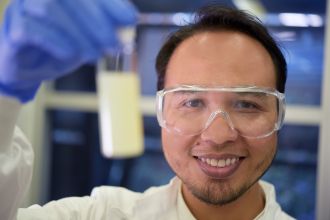
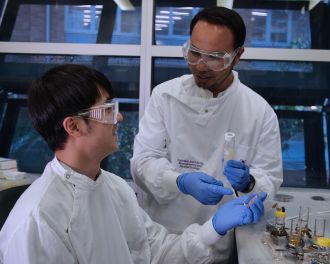
Nanoarchitect Dr Asep Nugraha said the particles were effectively tiny containers that released rust-inhibiting molecules to protect damaged surface of the coating.
“All rust-proof coatings inevitably wear and tear with time, there is no stopping that,” Dr Nugraha, from UQ’s Australian Institute for Bioengineering and Nanotechnology (AIBN) said.
“What we have created is a barrier that is constantly sensing if something is wrong so it can patch any scrapes and cracks itself, greatly extending the duration of protection.”
The Australasian Corrosion Association calculates the annual impact of rust at about $90 billion across the nation’s oil and gas, water and wastewater, infrastructure and defence industries.
Dr Nugraha said the act of rust protection itself was also an expensive and time-consuming task for businesses and governments responsible for the upkeep of public assets including bridges.
“For structures like bridges, applying a rust-proof coating comes at a great effort and cost, often to the public,” Dr Nughara.
“But imagine, for example, if you only had to put a single coat of paint on the Story Bridge that protected it for more than 100 years.”
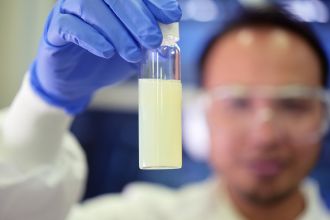
To create the coating Dr Nugraha and his team encased the common rust inhibitor Benzotriazole in an intricate nanostructure that, when added to waterborne polyurethane coatings, creates a composite with an extreme responsivity to changes in acidity.
“Each tiny particle is basically a nanocontainer that releases repair molecules only when the conditions demand it.”
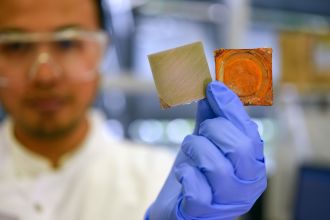
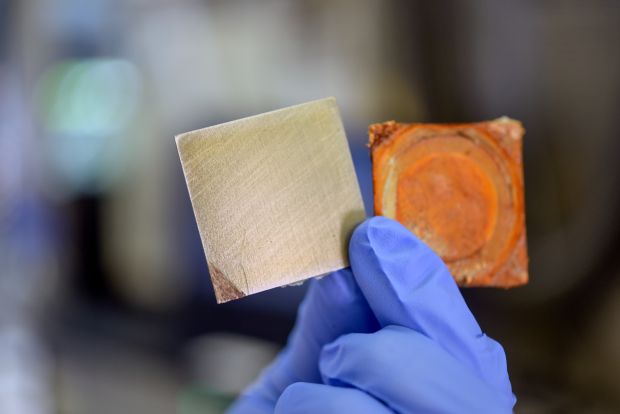
Electrochemical testing indicates Dr Nugraha’s self-healing coating can restrict corrosion to 37 nanometers per year, 600 times more effective than many existing ‘high performance’ rust-protection products that report an ability to restrict annual corrosion to 0.025 mm.
“It is not a coating that will last forever, but coatings that contain our technology will have a greatly expanded lifetime, meaning far less maintenance, and a much longer time between applications.”
Dr Nugraha said plans were imminent for pilot-scale testing the smart coating with a goal to produce a commercial product within the next 5 years.
“Nanoarchitects work at an extremely small scale to build things that often defy what is physically possible,” Dr Nugraha said.
“It is incredible to think that we could soon be telling people they might not have to worry about something rusting for several lifetimes.”
Read the research published Small Science.
Multimedia