Sign In



 International
News release
From:
By Leon Barkho, University of Sharjah
A recently discovered Greek inscription at the base of a column inside the Great Mosque of Homs in Syria has rekindled a longstanding scholarly debate about the exact location of the Temple of the Sun, whose high priest ascended to the Roman imperial throne in the third century AD under the name Elagabalus.
Known in antiquity as Emesa, Homs is the capital of its namesake province and has long been celebrated for its remarkable historical landmarks, foremost among them its imposing Great Mosque, famous for its oval layout.
The mysterious inscription was discovered beneath one of the mosque’s columns during restoration work. The site carries additional religious and historical significance as it is associated with the 12th-century Zengid ruler Nur ad-Din. Believed to have been built on the ruins of a church dedicated to St. John the Baptist, the mosque follows a rectangular architectural plan and has long been renowned for its sacred importance and significance since antiquity.
A new study published in the archaeology journal Shedet attempts to resolve the enduring question of whether the Great Mosque of Homs was built over the ruins of the Temple of Elagabalus, a question that has intrigued historians for decades but remained unanswered due to lack of definitive evidence.
Now, Dr. Maamoun Saleh Abdulkarim, professor of archaeology and history at the University of Sharjah and author of the study, argues that the inscription provides a crucial breakthrough. He believes it may finally illuminate the origins of a sacred Muslim landmark that began as a pagan temple, was later converted into a Christian church, and eventually was turned into a major place of worship in Islam.
“This inscription, uncovered during restoration work, provides new evidence in a long-standing debate: Was the Temple of Elagabalus located beneath the current Great Mosque in the city center, or was it situated in the archaeological layers atop the tell (mound), where the remains of the Islamic Citadel of Homs now stand?” explains Prof. Abdulkarim.
Different layers of faith
For many years, scholars have grappled with the question of whether the Great Mosque of Homs was originally a temple and later a church, despite extensive examination of textual, numismatic, and archaeological evidence. Only with the discovery of a new inscription has fresh light been shed on the longstanding debate.
Prof. Abdulkarim has been studying the inscription in an effort to trace a connection between the current Great Mosque and earlier pagan and Christian sanctuaries that preceded it.
“If its association with solar cult symbolism is confirmed, it may indicate a spatial continuity between the pagan sanctuary and the later religious structures built on the same site,” he said, adding, “Such evidence would significantly strengthen the argument that religious transformation in Emesa occurred through architectural layering and reinterpretation rather than a complete break. It also underscores the importance of interdisciplinary collaboration between archaeology, epigraphy, architectural history, and heritage conservation.”
The study situates Emesa – modern-day Homs - across three major religious phases: paganism, Christianity, and Islam. It offers a unique longitudinal case study of religious transformation, cultural resilience, and layered urban identity within the framework of Middle Eastern archaeology.
The research “examines the evolution of religious life in Emesa during Roman and early Byzantine times. It illustrates how the city's religious landscape changed from the worship of local gods, such as Elagabalus, to the general acceptance of Christianity in the fourth century AD,” notes Prof. Abdulkarim.
“Examining the political and social factors that led to this transformation reveals a complex history of religious tolerance and struggle that ultimately allowed Christianity to flourish.”
Mysterious Greek inscription no longer an enigma
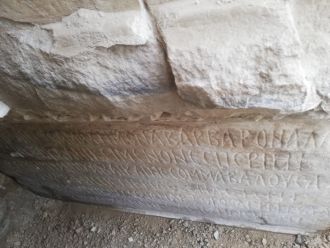
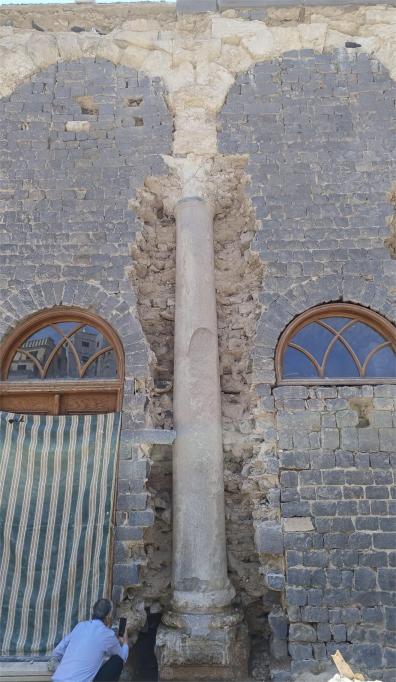
The granite inscription forms an integral part of the base of a column in the Great Mosque of Homs. Engraved in Greek, the text is carved directly into the granite surface. According to archaeologist Teriz Lyoun, head of the Excavation Department in Homs, it has been buried beneath the mosque’s floor and was first unearthed during excavations carried out in 2016.
The dimensions of the base of the column are 1×1 m. The inscribed plaque occupies approximately 75 cm of the base's front, while approximately 25 cm is allocated to the frame elements. “The writing in the inscription image appears symmetrical, formal, and spaced in horizontal lines, a style common in formal dedication or commemorative texts. The design is a multi-line inscription arranged in straight horizontal lines, and the plaque is framed by a decorative top border,” Ms. Lyoun explained.
Due to prolonged unrest in Syria, the inscription was not fully revealed until May 2016, when historian Abdulhadi Al-Najjar published the first translation of the Greek text on his Facebook page. “The passage in the inscription is characterized by a heroic and militaristic tone, depicting a warrior ruler compared to the wind, the storm, and the leopard, defeating enemies and imposing tribute with fierce royal authority,” he wrote.
The text portrays a warrior-king likened to the wind, the storm, and the leopard, as he defeats enemies and exacts tribute with commanding royal authority. Prof. Abdulkarim observes that the Greek contains several grammatical irregularities, a common feature in Syria during the Roman period, where Aramaic, rather than Greek, was the dominant spoken language.
Prof. Abdulkarim’s study and investigation of the inscription have provided additional support for the long-debated connection between the Temple of the Sun, the early church, and later the Great Mosque in Homs.
“This Greek inscription, even if it is epic in nature and not very detailed, provides clues to the connection between this mosque and a pagan building, perhaps the Temple of the Sun, especially since researchers have long proposed this connection. Thus, every inscription from the Roman era that is uncovered in this mosque will add more knowledge to our understanding of the subject,” Prof. Abdulkarim noted.
From a pagan temple to a church and finally a mosque
Prof. Abdulkarim underscores the significance of Emesa’s religious and urban identity, as well as its strategic location at a crossroads linking ancient commerce routes, particularly Antioch, Damascus, and the wider Levant. For the Roman Empire and the empires that followed, Emesa emerged as a key commercial hub and a strategic gateway for expansion within and beyond Syria.
“The Roman identity of Emesa was fundamentally based on paganism,” Prof. Abdulkarim writes, adding that the city’s spiritual life centered on Elagabalus, its native solar deity, whose name the Roman emperor himself adopted. The temple of Elagabalus served as the focal point for seasonal festivals and religious activities across the region.
At the heart of Prof. Abdulkarim’s study is the discovery of the Greek inscription. Although previously noted by archaeologists, the artefact had not been properly examined in scholarly research. His analysis shows that the inscription provides strong evidence, identifying the presence of the famous Temple of the Sun during the Roman period as well as its precise location.
For nearly a century, scholars have debated the temple’s whereabouts. Prof. Abdulkarim’s findings help resolve this longstanding question, clarifying the exact location of the temple – an issue that has long preoccupied researchers and generated considerable scholarly debate.
“My research helps clarify many longstanding questions and offers new insights into the religious transformation of the site across successive historical periods. It demonstrates that the site later became a church and was subsequently transformed into a mosque after the Islamic conquest, an evolution also documented in the writings of Arab historians,” according to Prof. Abdulkarim.
The research delves into how Emesa shifted from a stronghold of pagan sun worship to an important center of Christianity during the Roman and early Byzantine periods. In antiquity, civic life revolved around the cult of the sun god Elagabalus, whose temple shaped the city’s religious status, political authority, economic structures, and urban identity.
The Syrian high priest who became emperor of Rome
The priesthood of this cult held extraordinary power, so much so that one of its members rose to become Roman emperor. Before his accession in 218 AD, Elagabalus served as the high priest of Syria’s solar deity, from whom he took his imperial name.
Once emperor, Elagabalus sought to elevate his Syrian sun god as the supreme deity of the Roman Empire, forcing the deity’s worship across imperial dominions. But despite the emperor’s decision for an abrupt change in the religious landscape, the sanctuary’s transformation from a temple to a church in Emesa was gradual.
“Christianity did not replace paganism abruptly. Instead, both communities coexisted for generations,” Prof. Abdulkarim points out. He emphasizes that religious change is rarely instantaneous; in Emesa, pagan and Christian practices coexisted for decades, and possibly for centuries, much like the long-standing coexistence of Islam and Christianity in Homs and greater Syria.
Beyond the significance of the inscription, Prof. Abdulkarim argues that Emesa offers a broader lesson: cities do not erase their past but reinterpret it. “The transformation of Emesa was not a rupture; it was a negotiation between old beliefs and emerging faith, with religious change reshaping not only sacred buildings but also power dynamics, identity, and urban space.”
The ancient Temple of the Sun, dedicated to Elagabalus, was more than a sanctuary. Despite successive religious transitions, the sanctuary’s influence has endured. Whether functioning as a temple, a church, or later a mosque, the site has remained the symbolic and political heart of a major city.
Multimedia