 Sign In



 International
News release
From:
Robotics: Robot walks like a fish out of water
A bio-inspired robot has been used to illustrate the mechanism by which some species of fish are able to walk on land, as reported in a Nature Communications paper. This demonstration may provide insights into how the first terrestrial vertebrates moved onto land and navigated their new environment millions of years ago.
Several living fish, including bichirs, catfish, and lungfish, are capable of walking on land. Previous observations have shown that, despite differing fin and body shapes, these species all use a broadly similar locomotor approach. This involves them propelling themselves forward with their tail, while using two front fins for stability and support. The authors refer to this as the “undulating tripod gait”. Although swimming and terrestrial walking in animals are both well studied, terrestrial fish locomotion has largely been described using species-specific observations, making it difficult to identify unifying principles.
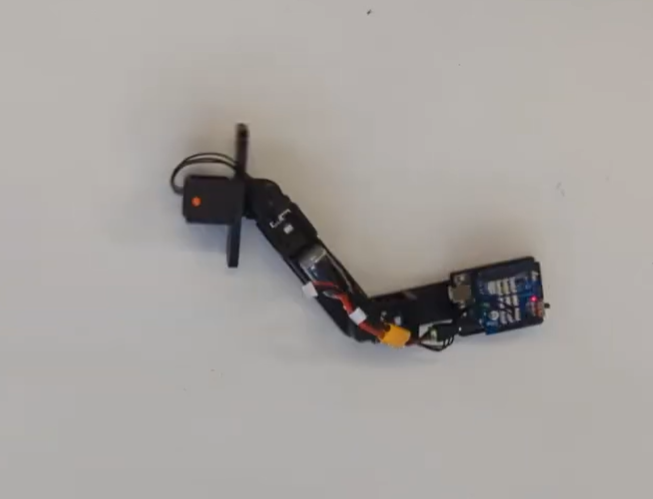
Michael Ishida and colleagues created a computer model based on the movements of the grey bichir (Polypterus senegalus) along with several other ‘walking fish’. Simulations from the model suggest that the species share the same basic movement principles, which involve anchoring the body with a front fin or head, while using the tail to push the body forward around that anchor point. The fastest and most efficient walking was seen under conditions closely matching the grey bichir. The authors then constructed a physical robot to validate these results, with both the computer and robot models showing that the gait remains functional across a wide range of body shapes. The results suggest that effective locomotion in fishes can arise from simple coordination between body bending and ground contact, without specialised limbs. The authors also suggest that this convergence in walking style reflects common mechanical constraints experienced across species, rather than shared ancestry.
The identification of common mechanical features across morphologically diverse species may have important implications for how we reconstruct the locomotion of the first terrestrial vertebrates.
Multimedia


