Was the age of dinosaurs illuminated by fireflies?

Publicly released:
International
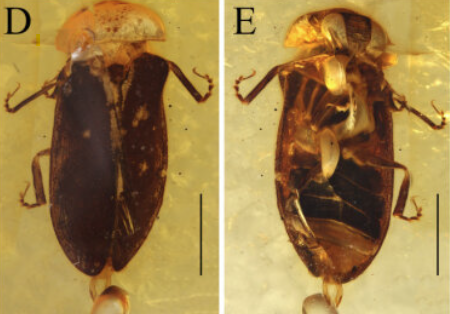
Figure from Yuan et al., Proceedings of the Royal Society B  (Screenshot from larger image)
Figure from Yuan et al., Proceedings of the Royal Society B (Screenshot from larger image)

The age of dinosaurs was probably illuminated by fireflies, according to international researchers who identified a 99-million-year-old firefly fossil preserved in amber. The finding, which is now the oldest known evidence of luminous beetles, was found in Myanmar. It has been assigned to a new species Cretoluciola birmana – and has large eyes, slender antennae, and a two-piece glowing light organ. The discovery suggests fireflies were more diverse in the ancient world than we thought, with complex survival and courtship behaviours already in place during the age of dinosaurs.

News release

From: The Royal Society

A true Luciolinae fossil from the mid-Cretaceous Burmese amber provides new insights into the early evolution of fireflies (Coleoptera: Lampyridae)

A 99-million-year-old firefly fossil has been discovered preserved in amber, providing the oldest known evidence of these luminous beetles. The specimen, named Cretoluciola birmana, features a distinct bipartite light organ on its abdomen, proving that ancient fireflies could produce light as the extant Luciolinae species during the Cretaceous period. This finding establishes a minimum age constraint of 99 million years for Luciolinae, the crown group of Lampyridae. The discovery also indicates that fireflies were more diverse in the ancient world, with complex survival and courtship behaviors already in place during the age of dinosaurs.

Attachments

Note: Not all attachments are visible to the general public. Research URLs will go live after the embargo ends.

Research The Royal Society, Web page The URL will go live after the embargo lifts.
Journal/
conference:
Proceedings of the Royal Society B
Research:Paper
Organisation/s: Hebei University, China
Funder: This work was supported by the National Natural Science Foundation of China (32270491), and the Interdisciplinary Research Program of Hebei University (DXK202302).
Media Contact/s
Contact details are only visible to registered journalists.