That's no moon... It might be the first discovered exomoon

Publicly released:
International
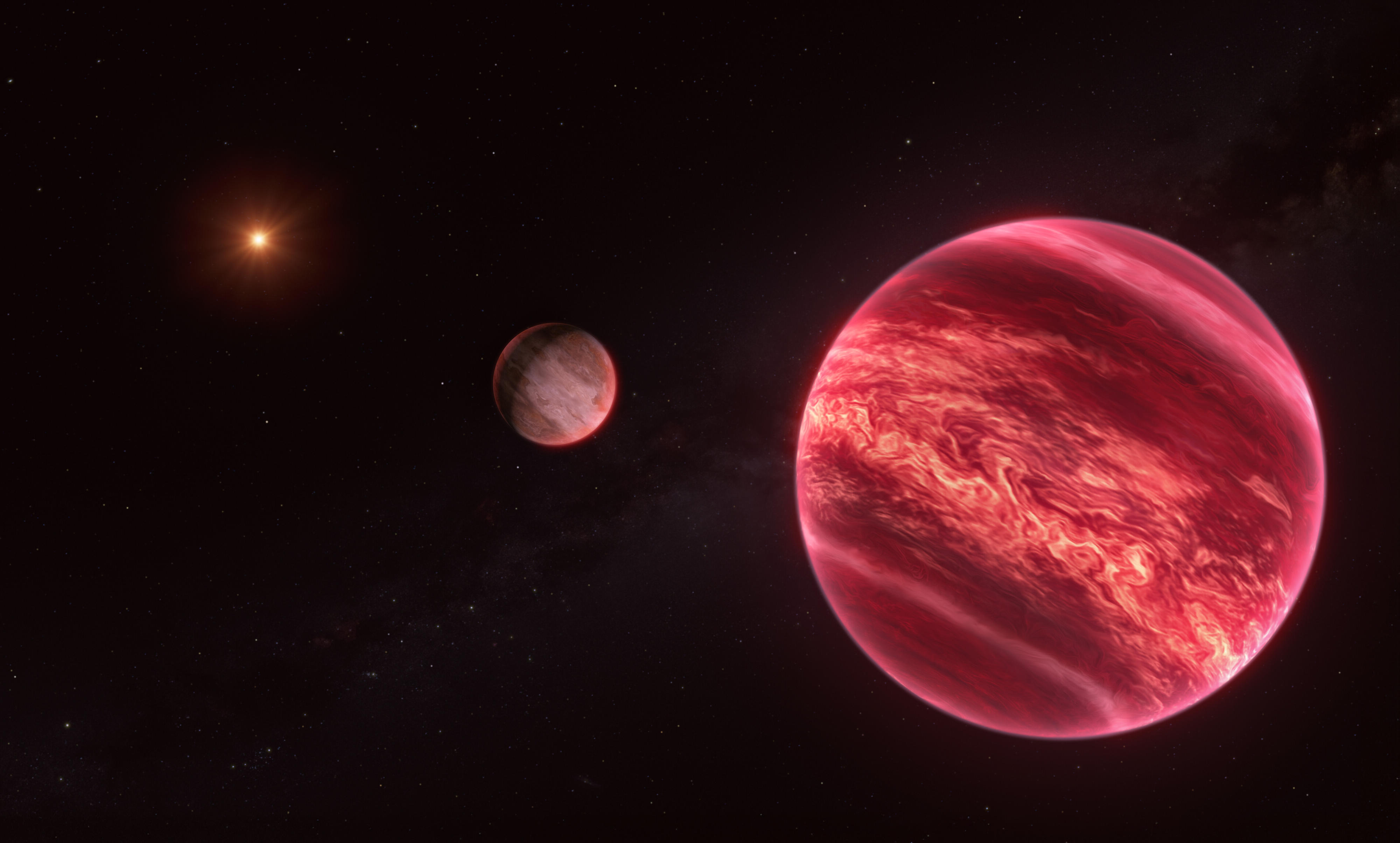
Artist’s impression of CD-35 2722, a system with a moon-like object This illustration shows the system around the star CD-35 2722, with the newly found moon-like object at the centre. The star –– the point source to the left –– has about half the mass of our Sun, and it is orbited by a brown dwarf, the reddish-brown object seen here in the foreground (right). The brown dwarf has about 37 times the mass of Jupiter: too massive to be a planet, but not massive enough to have sustained nuclear fusion like stars. This brown dwarf is, in turn, orbited by a newly discovered object at least as massive as Jupiter, seen at the centre of this image. This new object, found with ESO’s Very Large Telescope (VLT), is difficult to label. It behaves like a moon in the sense that it orbits an object that orbits a star. But this ‘moon’ is massive enough to be a planet, and the object it orbits, a brown dwarf, is neither a planet nor a star.  Credit: ESO/M. Kornmesser
Artist’s impression of CD-35 2722, a system with a moon-like object This illustration shows the system around the star CD-35 2722, with the newly found moon-like object at the centre. The star –– the point source to the left –– has about half the mass of our Sun, and it is orbited by a brown dwarf, the reddish-brown object seen here in the foreground (right). The brown dwarf has about 37 times the mass of Jupiter: too massive to be a planet, but not massive enough to have sustained nuclear fusion like stars. This brown dwarf is, in turn, orbited by a newly discovered object at least as massive as Jupiter, seen at the centre of this image. This new object, found with ESO’s Very Large Telescope (VLT), is difficult to label. It behaves like a moon in the sense that it orbits an object that orbits a star. But this ‘moon’ is massive enough to be a planet, and the object it orbits, a brown dwarf, is neither a planet nor a star. Credit: ESO/M. Kornmesser

International astronomers say they might have found a satellite object that is orbiting a brown dwarf, which in turn orbits a star. The researchers say these kinds of systems - that have three levels of hierarchy - have a third object that can be called an exosatellite, and exosatellites that orbit an exoplanet can be described as exomoons. The team say that they have found evidence of an exosatellite orbiting a brown dwarf companion called CD-35 2722 B, which has a mass just under that of Jupiter, and has a year pass in around 170 (Earth) days. Its naming is not all cut-and-dry, as the authors say the fact that it has an orbit around a brown dwarf rather than a planet might take away its exomoon title, potentially 'demoting' it to an exoplanet.

News release

From: Springer Nature

Observations of what may be the first known three-tiered hierarchical system — a satellite orbiting a brown dwarf, which in turn orbits a star — are presented in Nature this week. It remains unclear whether the satellite is an exoplanet or an exomoon, as conclusive classification systems for exomoons are lacking. However, the discovery of this object may mark a step towards the conclusive identification of exomoons in planetary systems, which have evaded confident detection to date.

In systems with three levels of hierarchy — a star with an orbiting companion (such as a planet or brown dwarf) and a third object orbiting the companion — the third object can be called an exosatellite. Exosatellites orbiting an exoplanet can be described as exomoons. However, there is uncertainty regarding whether a satellite orbiting a brown dwarf could also be described as an exomoon. More than 6,000 exoplanets have been discovered, but no exomoon has ever been definitively identified.

Kevin Hoy and colleagues present evidence of an exosatellite orbiting a brown dwarf companion called CD-35 2722 B. They use a method called radial velocity analysis — the same technique that was used to discover the first exoplanet around a Sun-like star — to monitor this brown dwarf between October 2023 and February 2026. The analysis reveals the signal of what appears to be at least one orbiting satellite, although models for two satellites are highly unstable. The authors modelled the properties of this system, which indicates an object with a mass just under that of Jupiter (around 0.9 Jupiter masses) orbiting the brown dwarf over a period of around 170 days.

The object’s position as the last component in a three-tiered hierarchical system might be seen to support a moon-like classification but, as the object is planet-sized and orbiting a brown dwarf rather than a planet, it is probably not apt to call it an exomoon, the authors note. The work demonstrates that radial velocity analysis could allow the conclusive detection of an exomoon in the future, but a clear classification system for exosatellites will be needed, the authors conclude.

Multimedia

Artist’s impression of the CD-35 2722 system
Wide-field view around the CD-35 2722 system
Animation of CD-35 2722, a system with a moon-like object
Detecting a moon-like object in the CD-35 2722 system

Attachments

Note: Not all attachments are visible to the general public. Research URLs will go live after the embargo ends.

Research Springer Nature, Web page The URL will go live after the embargo ends
Journal/
conference:
Nature
Research:Paper
Organisation/s: Universidad Diego Portales, Chile
Funder: We acknowledge funding from ANID–Millennium Science Initiative Program–Center Code NCN2024_001. A.Z. acknowledges funding from the Fondecyt Regular grant no. 1250249. J.K. acknowledges financial support from grant HA 3279/15-1 from the Deutsche Forschungsgemeinschaft (DFG). S.D. and C.L acknowledge support from the ‘Programma di Ricerca Fondamentale INAF 2023’ of the National Institute of Astrophysics (Large Grant 2023 NextSTEPS). S. Petrusʼs research was supported by an appointment to the NASA Postdoctoral Program at the NASA-Goddard Space Flight Center, administered by Oak Ridge Associated Universities under contract with NASA. V.d.O. acknowledges support from INAF Minigrant 2024 MUGS.
Media Contact/s
Contact details are only visible to registered journalists.