 Sign In



 Australia; International; WA
News release
From:
WA scientist helps crack black hole 'burp' mystery
An early career Western Australian astrophysicist has helped uncover a universal rule behind one of the most powerful behaviours in the Universe: when black holes launch jets.
The discovery, accepted for publication in the prestigious Nature Astronomy, shows black holes appear to fire off powerful jets at the same critical point in their feeding cycle – whether they are about 10 times the mass of the Sun or millions of times heavier.
The work was led by Dr Adelle Goodwin, an astrophysicist at Curtin University’s International Centre of Radio Astronomy Research (ICRAR) and Forrest Research Foundation Fellow, with co author Dr Andrew Mummery from the Institute for Advanced Study in Princeton.
The finding is the result of years spent piecing together observations from telescopes around the world, including Australia, America, India, South Africa, and in space – tracking rare events where stars are torn apart by supermassive black holes and watching what happens next, and why.
The moment the pattern clicked came not at a telescope console but in a bar in Madrid while attending a conference, where Dr Goodwin and Dr Mummery realised the same jet-launching rule seen in small black holes also appeared to hold true for supermassive ones.
Dr Goodwin said the breakthrough came from trying to answer the following question: why do some black holes produce radio jets soon after tearing apart a star, while others appear to switch on months or years later?
“We were looking at these events and asking why the timing was so different,” said Dr Goodwin.
“Then the pattern became clear. “The delayed jets were appearing when the black hole’s feeding rate dropped to the same critical point already known from much smaller black holes.
“That was the moment we realised this was not just a quirk of one type of black hole, but it looked like a rule that applied across the Universe.”
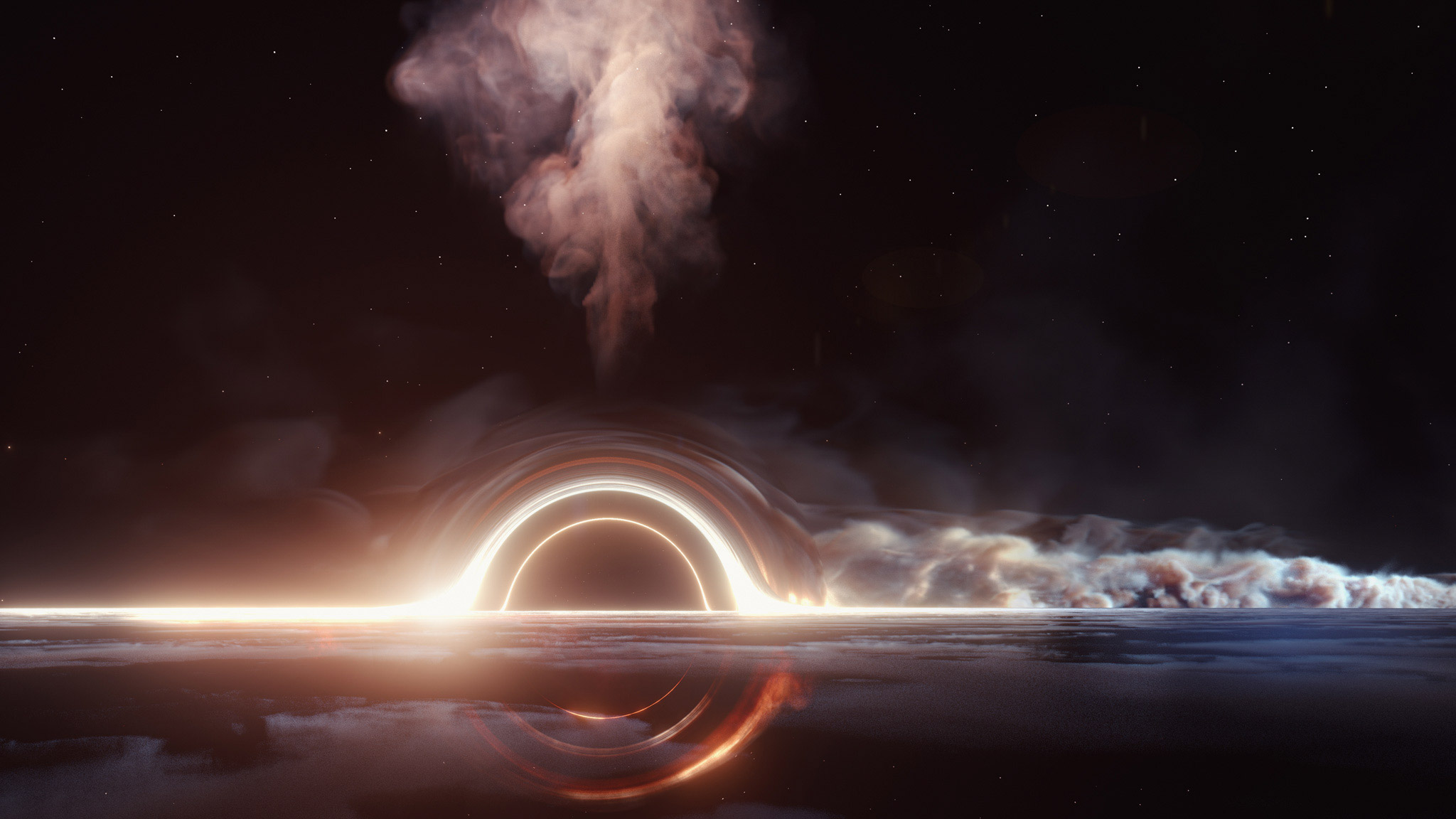
Black holes are often described as cosmic vacuum cleaners, but Dr Goodwin said they were more like messy eaters. “When a black hole tears apart a star, it does not swallow everything neatly,” Dr Goodwin said.
“Some of the material is consumed, and some is launched back into space in powerful jets and outflows.
“You can think of it as a black hole burp, except these burps can blast material across enormous distances and influence the galaxies around them.”
For decades, astronomers have suspected black holes might follow the same basic physics regardless of their size – but proving it has been difficult because supermassive black holes usually evolve over thousands of years.
Dr Goodwin found a way around that problem by studying tidal disruption events, which occur when a star strays too close to a supermassive black hole and is ripped apart.
These rare events compress a supermassive black hole feeding episode into years rather than millennia, giving astronomers a chance to watch the process unfold.
The researchers analysed 20 tidal disruption events using optical, ultraviolet, X-ray and radio observations, narrowing the sample to 10 events where they could reliably model both the black hole’s feeding rate and the timing of its radio outflows.
They found two distinct jet-launching phases. The first happens early, when the black hole is feeding at extreme rates. The second comes much later, hundreds to thousands of days after the star is first torn apart, when the black hole’s feeding rate drops to about two per cent of its Eddington limit – the point at which outward radiation pressure balances gravity. The same two per cent threshold is already known to trigger jet formation in much smaller black holes in our Galaxy.
“These black holes are separated by enormous differences in mass, but they appear to switch on their jets at the same point in the feeding process,” Dr Goodwin said.
“That tells us something fundamental about black holes: the physics does not seem to care how big they are.”
The discovery helps explain why some tidal disruption events produce radio jets quickly, while others appear to go quiet before suddenly lighting up much later. It could also help astronomers make better use of some of the world’s most expensive and in demand scientific instruments.
“Radio telescopes are incredibly powerful, but knowing when to look is just as important as knowing where to look,” said Dr Goodwin. “If we can anticipate when a black hole is more likely to launch a jet, we can run better targeted campaigns, waste fewer observations and improve our chances of catching these rare events at the moment they matter most.”
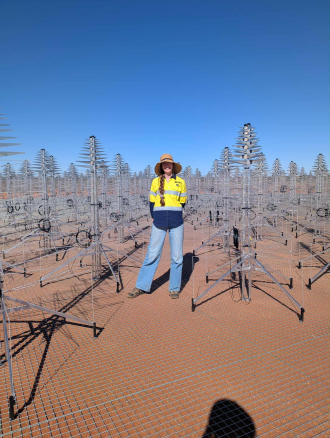
In addition to solving one of the mysteries of our universe, the finding could help reduce unnecessary follow-up observations and make future observing campaigns more efficient. The work is particularly relevant for Western Australia, which will host the low-frequency component of the Square Kilometre Array Observatory (SKA) – one of the most significant radio astronomy projects ever built.
This could save valuable time on major facilities such as the SKA, which the Australian Government has invested $387 million. With the total cost of the SKA exceeding $2 billion, improving how telescope time is used could deliver significant benefits for astronomers and the wider research community – meaning more frequent important discoveries about the cosmos.
As next-generation surveys discover far more tidal disruption events, astronomers will need better ways to decide which ones to follow and when. This research gives them a clearer physical signal for when the black hole jet is most likely to appear.
Forrest Research Foundation Director Professor James Arvanitakis said the discovery showed why backing early-career researchers to pursue ‘blue sky’ research mattered.
“The Forrest Research Foundation did not fund a predetermined answer, we backed an exceptional researcher with a difficult question,” Professor Arvanitakis said.
“That question has led to a discovery of international significance. “This is exactly why fundamental research matters – it expands what we know, sharpens how we use major scientific infrastructure and builds capability that reaches well beyond astronomy.
“The fact this discovery was driven from Western Australia speaks to the strength of our research ecosystem, and the value of giving outstanding people a reason to build their careers here.”
The paper, A universal critical accretion rate for black hole jet formation, was published in Nature Astronomy on Thursday, 17 September 2026.
Multimedia

Attachments
Note: Not all attachments are visible to the general public. Research URLs will go live after the embargo ends.


