 Sign In



 International
News release
From:
JWST investigates the surface of Pluto’s largest moon
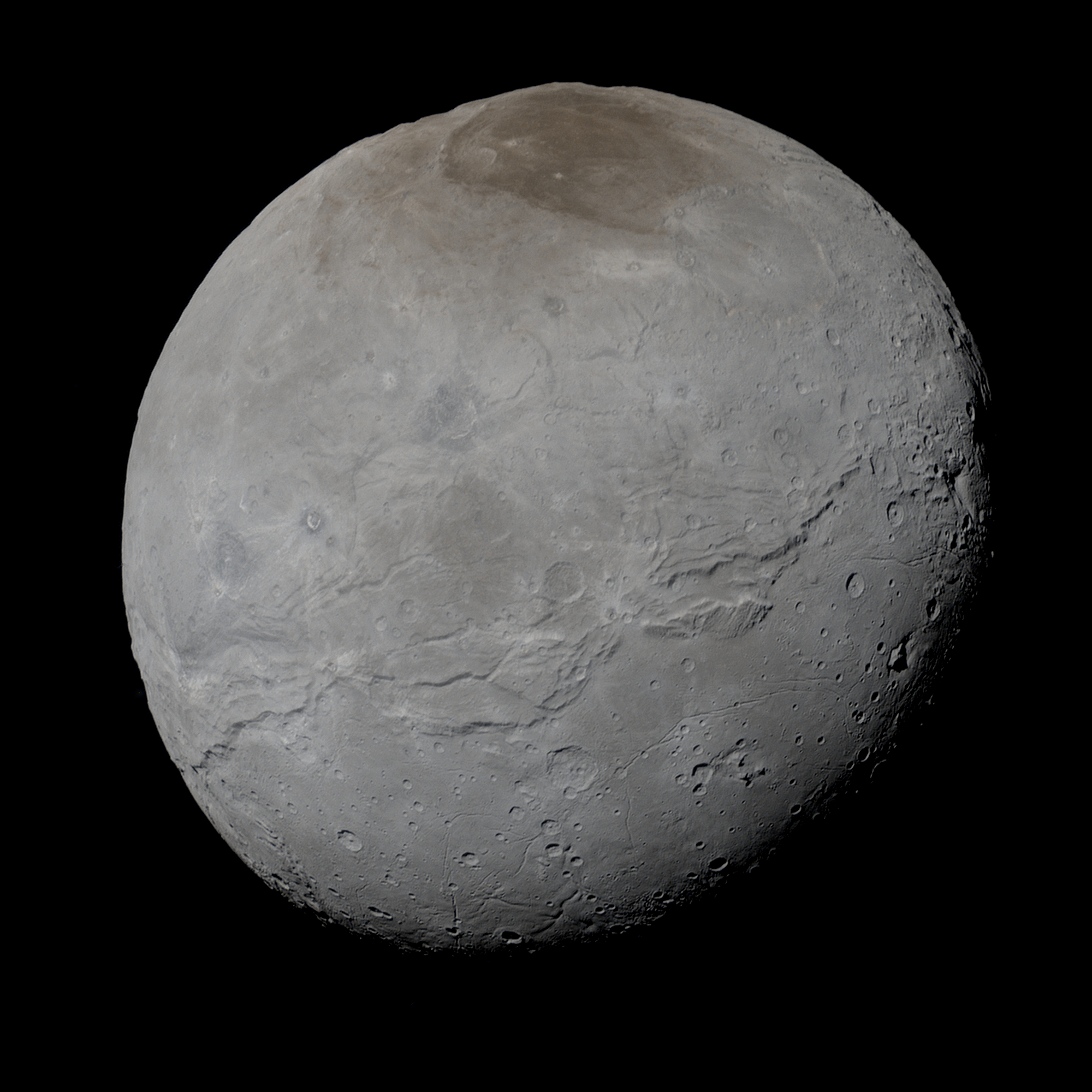
The detection of carbon dioxide (CO2) and hydrogen peroxide (H2O2) on the surface of Charon, Pluto's largest moon, is reported in a Nature Communications paper. The findings, based on data from the James Webb Space Telescope (JWST), provide new insights into the chemical processes and surface composition of Charon, which could help us understand the origin and evolution of icy bodies in the outer Solar System.
Charon has been extensively studied since its discovery in 1978, but previous spectral data were limited to wavelengths below 2.5 µm, leaving gaps in our understanding of its surface composition. The presence of water ice, ammonia-bearing species, and organic compounds has previously been noted, but the spectral range used was insufficient to detect other compounds, such as CO2 and H2O2. Understanding these compounds is important for studying the origin of icy bodies in the Kuiper Belt, home to Pluto and other dwarf planets, as well as the effects of irradiation and photolysis (the breakdown of molecules in the presence of light) on their surfaces.
Silvia Protopapa and colleagues used the JWST Near-Infrared Spectrograph to observe Charon at wavelengths from 1.0 to 5.2 µm. They conducted four observations at different longitudes and, together with laboratory experiments and spectral modelling, confirmed the presence of crystalline water ice and ammonia, and also identified CO2 and H2O2. The presence of H2O2 suggests active processing of water ice by irradiation and light on Charon's surface, while CO2 likely originates from subsurface CO2 reservoirs present since formation and exposed on the surface by impact events, the authors suggest.
The detection of CO2 and H2O2 on Charon represents a step forward in planetary science, offering insights into the moon's surface chemistry. This research may lay the groundwork for future studies to explore the dynamics of outer solar system bodies, their surface compositions, and the effects of solar radiation.
Multimedia

Attachments
Note: Not all attachments are visible to the general public. Research URLs will go live after the embargo ends.


