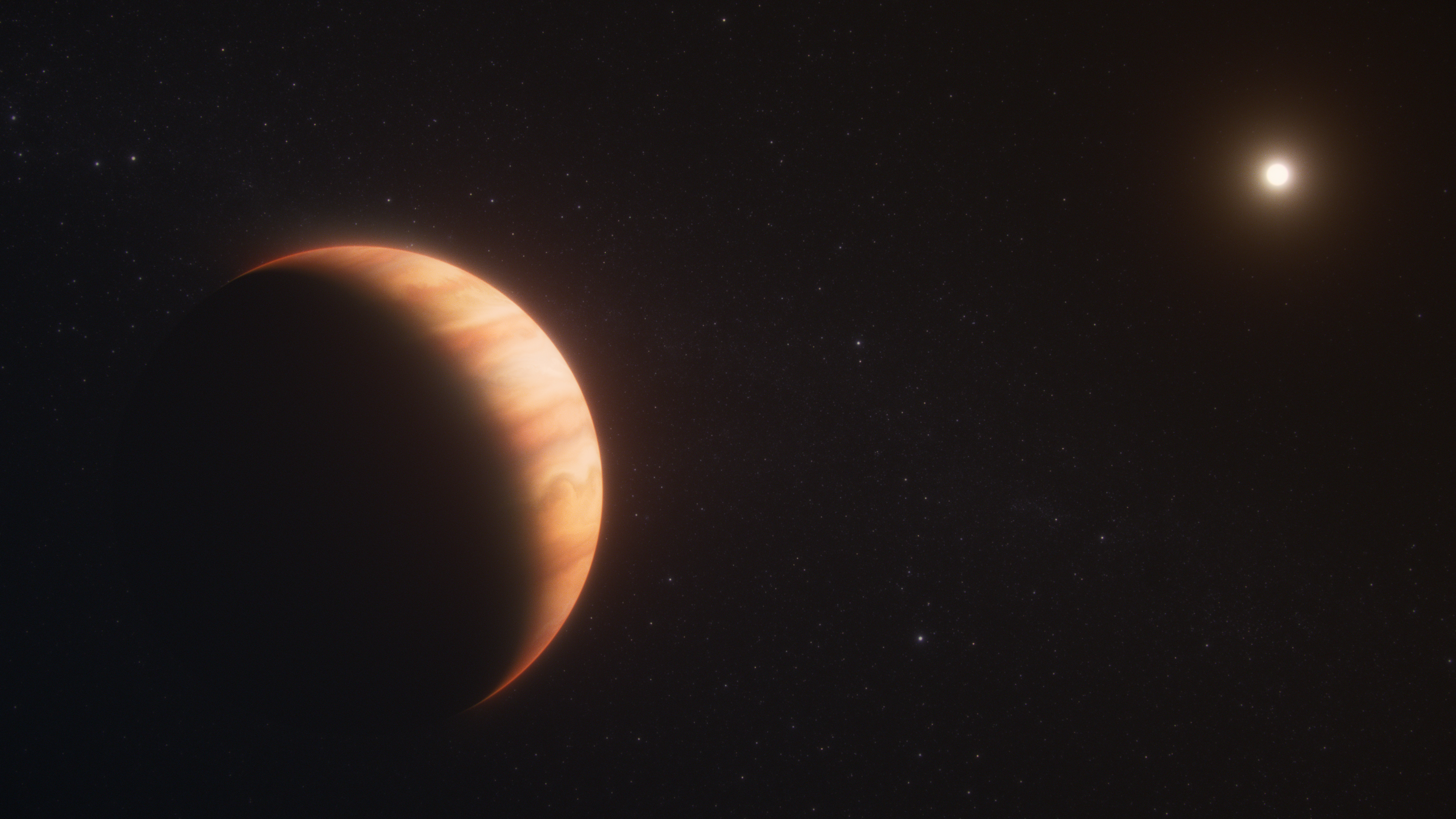
Planet with a white dwarf sun shows what might happen when our Sun dies

Publicly released:
International
Caption: Artist concept of the gas giant planet WD 1856 b orbiting a white dwarf star. The planet is 7 times larger than the Earth-sized white dwarf it orbits. WD 1856 b has methane and hazes in its atmosphere, which would give it a similar colour to Saturn's moon Titan. The white dwarf formed from a star that died 5 billion years ago, and has been cooling ever since, giving it an orange colour similar to the Sun. Credit: NASA, ESA, CSA, Ralf Crawford (STScI)

Our Sun will eventually die, leaving behind a white dwarf, and international researchers using the James Webb Space Telescope to look at a planet orbiting a distant white dwarf say they might know what will happen to our solar system after our Sun's inevitable demise. The team looked into the atmosphere of the creatively named WD 1856 B, a planet that orbits a roughly 10 billion-year-old white dwarf around 25 parsecs from Earth (or ~82 light-years), and say it's full of methane and aerosols. The planet is between 4.3 and 10.9 times Jupiter's mass and currently sits at a balmy 117°C to 139°C, which the authors say is quite a lot hotter than expected for planets this size.

News release

From: Springer Nature

The atmosphere of a white dwarf planet

JWST observations of a planet orbiting a white dwarf reveal details of the planet’s atmosphere, which may offer insights into the fate of our own Solar System when the Sun dies. The findings are published in Nature.

Most stars, including our Sun, will eventually die leaving behind a white dwarf. How this stellar evolution process might affect the planets orbiting these stars is not fully understood. Some planet candidates have been found orbiting white dwarfs, indicating that planets can survive the phase where stars evolve into red giants before becoming a white dwarf. However, little is known about the atmospheric composition of such planets.

Ryan MacDonald and colleagues report the detection of an atmosphere of WD 1856 b, a planet orbiting a white dwarf in a roughly 10-billion-year-old system located 25 parsecs from Earth, as measured by a spectrograph on the JWST. They find that the atmosphere is rich in methane and aerosols. The mass of WD 1856 b is estimated to be around 4.3–10.9 times the mass of Jupiter (MJ). The atmosphere was reheated in its migration to its currently close orbit of just 0.02 astronomical unit (approximately 3,000,000 km from its star). The authors also calculate the temperature of the planet’s atmosphere to be around 390–412 K, which exceeds temperatures expected for giant planets (160 K). This finding indicates that planetary reheating took place billions of years after the end of the red giant phase.

WD 1856 b represents the first well-characterized transiting planet orbiting a white dwarf, the authors propose. The observations of this planet’s migration, and evolution of the composition and temperature of its atmosphere, may help scientists to determine the fate of planetary systems after the death of their star.

Multimedia

Image 1
Image 1

Attachments

Note: Not all attachments are visible to the general public. Research URLs will go live after the embargo ends.

Research Springer Nature, Web page The URL will go live after the embargo ends
Journal/
conference:
Nature
Research:Paper
Organisation/s: University of St Andrews, UK
Funder: Support for Program no. 2358 was provided through a grant from STScI under NASA contract NAS5-03127. R.J.M. acknowledges support from NASA through the NASA Hubble Fellowship grant HST-HF2-51513.001, awarded by the Space Telescope Science Institute, which is operated by the Association of Universities for Research in Astronomy, Inc., for NASA, under contract NAS 5-26555. C.E.O. acknowledges support by the National Science Foundation under grant no. AST-2107796 (PI: Dong Lai). L.A.P. acknowledges research support from the NSF Graduate Research Fellowship. This material is based on work supported by the National Science Foundation Graduate Research Fellowship Program under grant no. DGE-1746060 and the NSF INTERN Program under grant no. DGE-2137419. T.O.F. acknowledges support from NASA through the NASA FINESST grant 80NSSC22K1893. S.B. acknowledges support from the Canadian Institute for Theoretical Astrophysics.
Media Contact/s
Contact details are only visible to registered journalists.