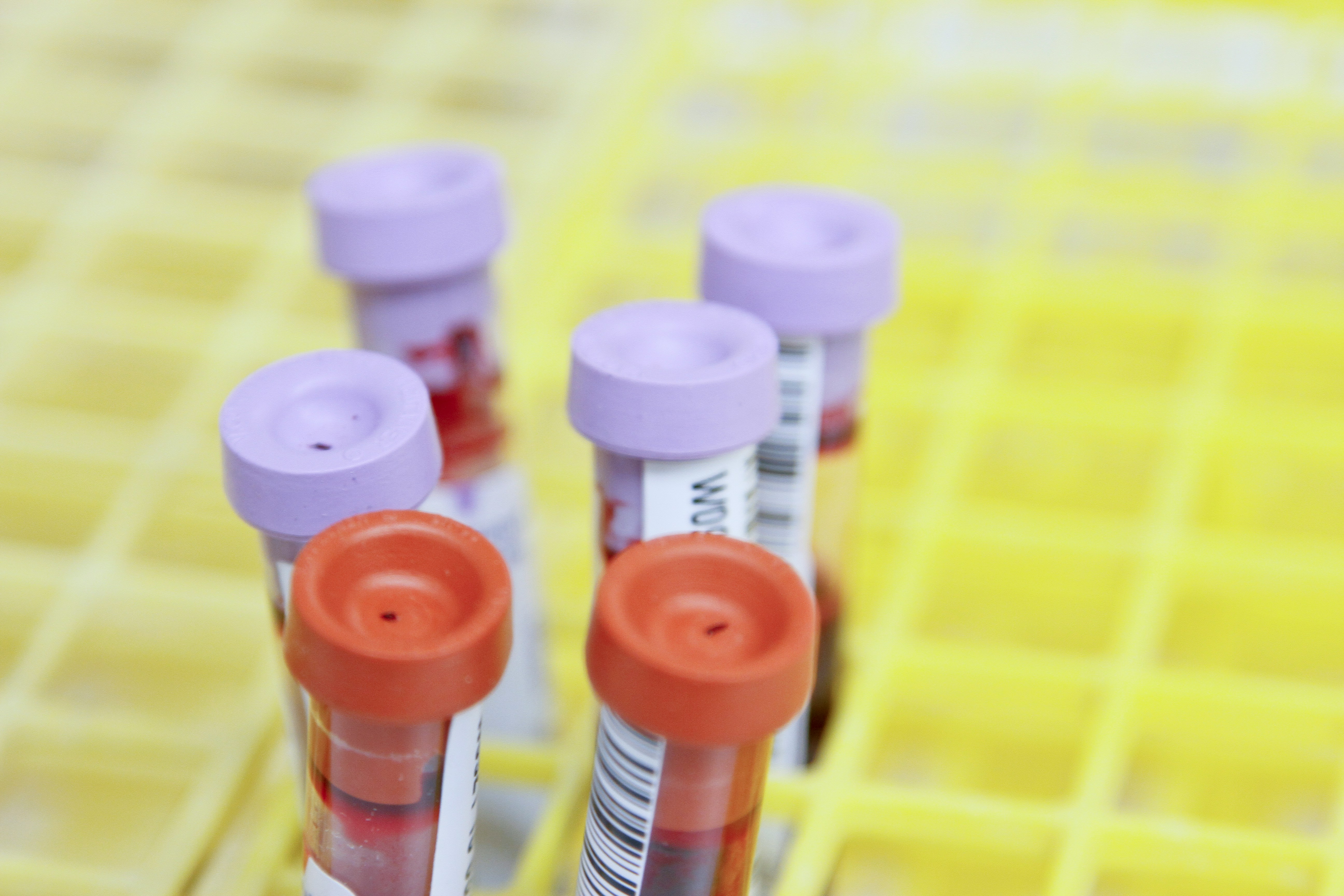
Picking up early stage cancer from proteins in blood samples

Publicly released:
Australia; VIC; QLD
Photo by National Cancer Institute on Unsplash

Small 'bubble-like' particles released by cells into the bloodstream may help us detect early-stage cancers, thanks to the proteins they contain, according to Australian research. The researchers compared the proteins in these particles from healthy cells and cancer cells and found a pattern of four proteins linked to cancer. They used this information to develop a test to pick up the same four proteins in cancer samples. When they checked their test's performance on samples from patients with nine different types of cancer or from healthy people, they found the test could differentiate healthy samples from cancer samples with a high level of accuracy. They then tested it on 68 samples from patients suspected of having lung cancer, and found that it could differentiate between harmless lung changes and early-stage lung cancer.

Attachments

Note: Not all attachments are visible to the general public. Research URLs will go live after the embargo ends.

Research Cell Press, Web page Please link to the article in online versions of your report (the URL will go live after the embargo ends).
Journal/
conference:
Cell Reports Medicine
Research:Paper
Organisation/s: The University of Queensland, QIMR Berghofer, Peter MacCallum Cancer Centre, The University of Melbourne, Olivia Newton-John Cancer Research Institute, La Trobe University
Funder: This work was sup ported by the National Health and Medical Research Council grant to A.M. and M.T. (APP1185907) and National Health and Medical Research Council grant to A.M. and K.M.F. (APP1164020). The Chinese University of Hong Kong provided funding for this work to A.M. and K.V. (IDBF23MED14). A.M. was supported by the Innovation and Technology Commission, Hong Kong SAR (PiH/048-050/22GS), the Global STEM scheme (GSP153), and the Hong Kong Jockey Club Charities Trust. M.T. acknowledges funding from the Australian Research Council (FL220100059). M.T., R.J.L., A.W., and A.M. acknowledge funding from Q13 Cancer Australia (2010799).
Media Contact/s
Contact details are only visible to registered journalists.