Pause in Antarctic ice sheet loss in 2021-2023 is likely temporary

Publicly released:
International
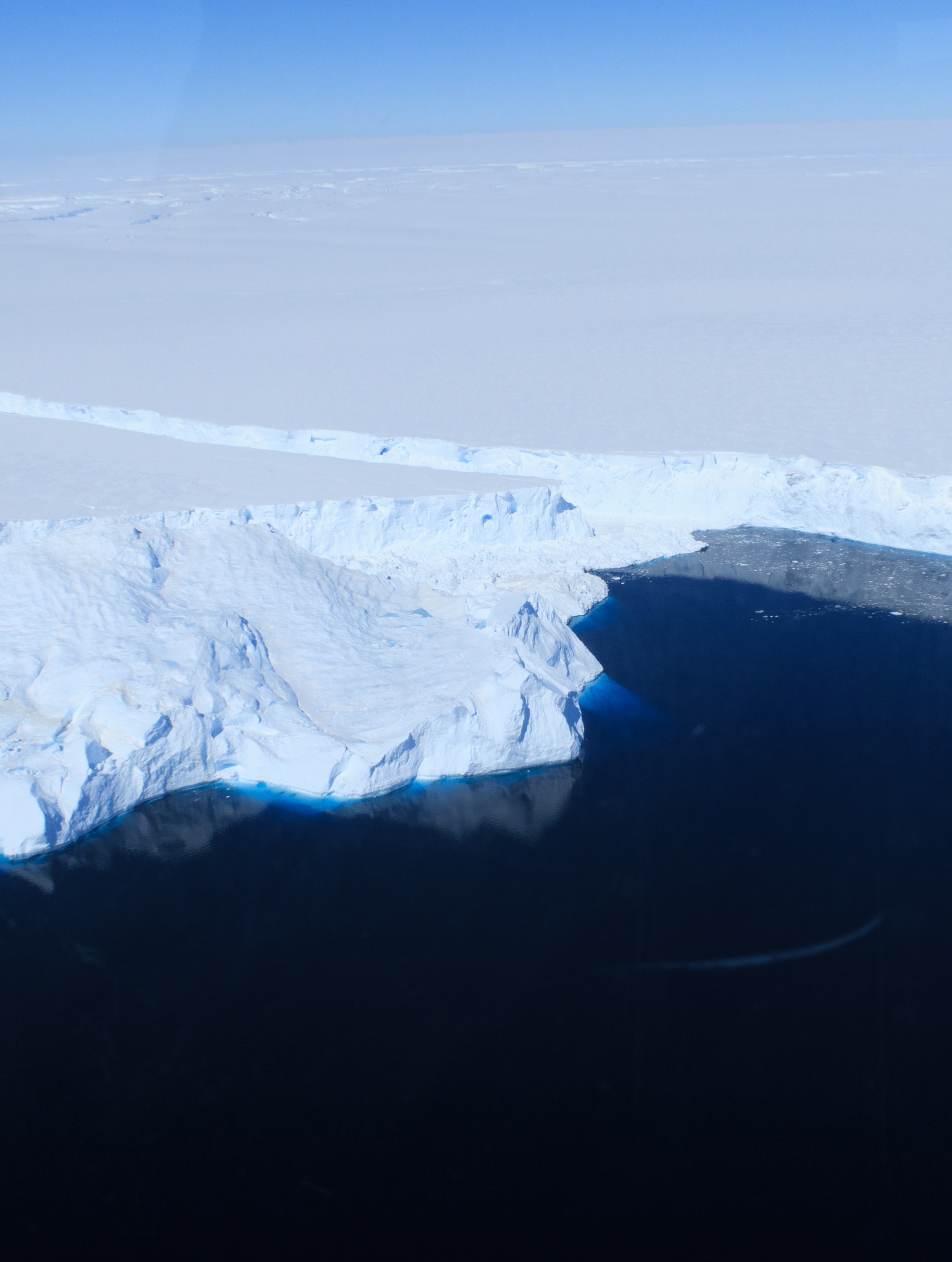
Caption: Aerial view of the Totten Ice Shelf during the 61st Japanese Antarctic Research Expedition in late 2019 and early 2020. Totten experienced East Antarctica’s most significant ice loss through 2021, followed by a marked slowdown during 2021–2023.  Credit: Dr. Yoshihiro Nakayama
Caption: Aerial view of the Totten Ice Shelf during the 61st Japanese Antarctic Research Expedition in late 2019 and early 2020. Totten experienced East Antarctica’s most significant ice loss through 2021, followed by a marked slowdown during 2021–2023. Credit: Dr. Yoshihiro Nakayama

A temporary slowing in the rate of Antarctic ice sheet mass loss in 2021-2023 may be explained by sea temperature rises thousands of miles away, according to international researchers who say the effects are likely temporary. The team used data from both observational and modelling experiments to link the event to surface temperature anomalies in the tropical warm pool (a region of ocean between the western Pacific and easter Indian Ocean). This area experienced unusually persistent warming between 2021 and 2023, which led to a series of alternating high- and low-pressure weather patterns called the Rossby-wave train. According to the team, this process eventually led to the formation of a high-pressure anomaly over East Antarctica, resulting in increased snowfall driving ice sheet mass gain. This is thought to occur around once a decade, meaning that the pause in total sheet ice loss is likely temporary and distinct from the effects of global warming.

News release

From: Springer Nature

Climate: Slowing of Antarctic ice sheet mass loss likely temporary

A temporary slowing in the rate of Antarctic ice sheet mass loss in 2021–2023 may be explained by sea temperature rises thousands of miles away in the subtropical ocean causing increased snowfall in the eastern Antarctic, according to research published in Nature. This event is thought to occur approximately once a decade, meaning that the pause in total sheet ice loss is likely temporary and distinct from the effects of global warming.

Changes in the mass of Antarctic ice sheets can be influenced by numerous factors, including climatic events thousands of miles away. Between 2021 and 2023, East Antarctica experienced an increase in ice sheet mass that outweighed losses in West Antarctica, leading to a slowdown in the rate of total ice sheet mass loss. Although previous studies have attempted to rationalize this observation, none has been conclusive.

Qinghua Ding and colleagues use data from both observational and model experiments to propose a new mechanism for this anomaly. They link the mass-gain event to surface temperature anomalies in the tropical warm pool, a region of ocean between the western Pacific and eastern Indian Ocean in which surface temperatures regularly exceed 28°C. This area was shown to have experienced unusually persistent warming between 2021 and 2023 in comparison to the previous two decades.

The authors posit that this warming induces a phenomenon called a Rossby-wave train (a series of alternating high- and low-pressure weather patterns). This process eventually leads to the formation of a high-pressure anomaly over East Antarctica, resulting in increased precipitation and driving ice sheet mass gain. Analysis of ice cores from the East Antarctic region suggest that this climate event, connecting changes in climate between two distant locations, may occur approximately once every ten years, meaning that any ice sheet mass gain is likely to be temporary.

Jonathan Wille, author of an accompanying News & Views article, stresses that “variability in the tropical climate must also be taken into account to understand the future of Antarctica and the rest of the planet”.

Multimedia
Image 1
Image 1

Attachments

Note: Not all attachments are visible to the general public. Research URLs will go live after the embargo ends.

Research Springer Nature, Web page The URL will go live after the embargo lifts.
Journal/
conference:
Nature
Research:Paper
Organisation/s: University of California, USA
Funder: Y.W. and X.L. are supported by the National Natural Science Foundation of China (grant nos. 42221005, 42576205) and the IOCAS Foundation (grant no. IOCASZZZX301). Q.D. is supported by the NSF Arctic System Science Program (award nos. OPP 2246601 and OPP 2438994) and the National Oceanic and Atmospheric Administration (NOAA) Climate Program Office’s Climate Variability & Predictability Program (grant no. NA23OAR4310273). T.B. is supported by the NSF Arctic System Science Program (award no. OPP 2246600). Y.N. is supported by the NASA Sea Level Change Team (grant no. 80NSSC24K1532), JST PRESTO, Japan (grant no. JPMJPR25G5) and Grants-in-Aid for Scientific Research of the Japanese Ministry of Education, Culture, Sports, Science and Technology (grant no. 24H02341). D.T. is supported by the János Bolyai Research Scholarship of the Hungarian Academy of Sciences. KITP at University of California, Santa Barbara is supported by NSF grant no. PHY-2309135.
Media Contact/s
Contact details are only visible to registered journalists.