 Sign In



 Australia; International; TAS
News release
From:
Sea ice creates hidden highways for young Antarctic krill
New research shows that larval Antarctic krill could be carried far from their birthplace by drifting sea ice, linking distant ecosystems in ways conventional models may miss.
Published in Global Change Biology Communications, the study models how ocean circulation, sea ice drift, and vertical migration influence the overwinter transport of Antarctic krill in the south-west Atlantic sector of the Southern Ocean.
Lead author Aditya Sharma, PhD student with the Australian Antarctic Program Partnership at the University of Tasmania, said that krill don’t simply drift wherever the ocean currents take them.
“Krill are spending time sheltering in sea ice and use the ice as an extra transport system that moves and connects populations more widely than ocean currents alone.”
“Krill migrate vertically between ocean and ice habitats as well as swimming horizontally while in the ocean.”
“Their vertical migration changes the pathways they follow, and spending more time associated with sea ice allows them to travel farther and reach more distant regions,” he said.
The primary driver of interannual krill abundance and population dynamics is krill recruitment, defined as the survival of krill to a year old.
Krill larvae depend upon sea-ice habitats for food and shelter to survive the winter and then recruit to the population in the following spring.
“Understanding where krill go during winter could be just as important as understanding where they are found in summer.”
“Year to year, the same starting population of krill can experience very different transport pathways, highlighting how variable the Southern Ocean can be,” said Mr Sharma.
Sea-ice expressways
Using 32 years of high-resolution ocean current and sea ice simulations, the modelling shows that greater exposure to sea ice drift reduces krill retention near the Antarctic Peninsula while increasing northward transport towards the Scotia Sea and South Georgia.
With a particle tracking scheme, virtual ‘krill’ were ‘released’ in the south-west Atlantic sector of the Southern Ocean and tracked from April to October, a key period for the survival of juvenile krill, and interannual krill abundance more generally.
“By including extreme cases, where simulated krill spend all their time either in sea ice or in the open ocean, we could assess the maximum possible influence of behaviour on transport pathways and distribution,” Mr Sharma said.
The model indicates a strong tendency for krill to move eastwards away from the Antarctic Peninsula, largely due to the prevailing Antarctic Circumpolar Current.
With ocean currents alone, 4% moved west and 17% moved east into the open ocean.
But when particles spent all available time associated with sea ice, 21% moved west and 48% moved east away from the peninsula.
Implications for fishery management
Antarctic krill are integral to the marine ecosystem and food web, and play an important role in nutrient cycling and carbon storage. Krill populations are also the target of the Southern Ocean's largest fishery.
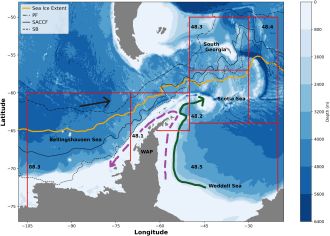
The commercial krill fishery is currently limited to the south-west Atlantic sector of the Southern Ocean, managed by the Commission for the Conservation of Antarctic Marine Living Resources (CCAMLR). CCAMLR divide this region into six Sub-areas (see map).
The tip of the Antarctic Peninsula has been identified as the main recruitment hotspot for krill in the south-west Atlantic sector.
The simulations show that krill originating there can be transported into all the other management areas of the southwest Atlantic study region, as well as moving west into the neighbouring Bellingshausen Sea.
But the traffic isn't equal in both directions.
The Antarctic Peninsula appears to be much more of a source of krill than a destination: it exports simulated krill widely, while receiving substantial inputs mainly from the Bellingshausen and Weddell Sea.
“That matters for fisheries because it suggests that what happens to krill in one management area can potentially affect krill availability somewhere else,” said Mr Sharma.
“And as Antarctic sea ice declines, the pathways that transport young krill across the Southern Ocean may also change, potentially reshaping connectivity between krill populations and fishing regions.”
“Where krill are transported matters not only for the ecosystem, but also for determining how fishing in one region may impact krill populations elsewhere in the Southern Ocean.”
“By improving our understanding of the connectivity between regions we can improve stock assessment and support sustainable management of the krill fishery,” he concluded.
Multimedia

Attachments
Note: Not all attachments are visible to the general public. Research URLs will go live after the embargo ends.


