Sign In



 Australia; NSW; SA
News release
From:
Like disease in humans, parasites can wage a deadly evolutionary 'arms race' against their hosts, even driving small populations to extinction if they mutate more quickly and gain the upper hand.
Now a new study led by Flinders University describes how Australian native parasite bee populations have been able to compete in a race with their adaptive social hosts by evolving at similar rates.
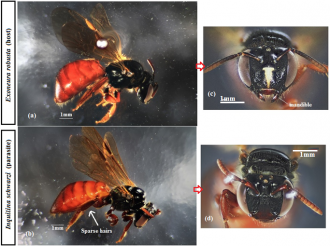
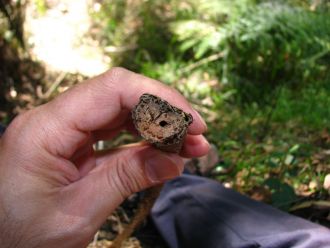
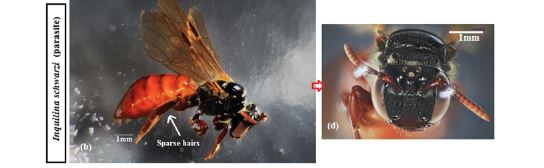
The research focused on bees collected in Victoria’s Dandenong Ranges, notably the social parasite bee species (genus Inquilina) which rarely infests more than 5% of host colonies (genus Exoneura).
“These parasitic species spend almost their entire life cycle within the nest of the host species and have extreme adaptations to social parasitism, including strongly reduced mouth parts and pollen-collecting scopae. They are not able to survive without their hosts,” says first author Dr Nahid Shokri Bousjien in an article in Ecology and Evolution.
“In our previous studies, we found that the population sizes of the parasite species are an order of magnitude lower than their host,” Dr Shokri-Bousjein says. "However, this case study shows that they have been able to persist for long periods of evolutionary time, about 15 million years, presumably following their hosts through multiple speciation events."
“They are completely dependent on their host’s colony for brood rearing, with Allodapine host and parasite life history having similar traits such as body size and generate times.
The new study tests the idea that the long-term evolutionary persistence of these parasites might be due to an accelerated rate of molecular evolution, despite their reduced population sizes.
“Surprisingly, our analysis of molecular data showed that rates of evolution were similar between host and parasite.”
Flinders University Associate Professor Mike Schwarz says that “evolutionary wars between species and their enemies may be much more complex that we thought”.
“Large population sizes might allow more strategies to arise but maybe the critical issue is how effective those strategies are.
“Species like these bee social parasites are on the very edge of survival. They might tell us something about how you can survive when your very existence is under threat.”
The researchers conclude that other scenarios should be considered – including the evolution of high-stake arms races into more benign relationships such as symbiosis or mildly deleterious association.
“The ability of species to adapt to existential challenges depends on the host’s ability to ‘discover’ new strategies via random mutations, and the greater the number of individuals in a species, the greater the likelihood that a favourable mutation will arise from them,” Associate Professor Schwarz says.
“Around us today, we see this in terms of new COVID-19 variants emerging and then spreading at ever increasing levels.”
"If the parasite is too successful it will wipe out its host, and therefore lose its only means of surviving. At the same time, evolutionary 'wars' between hosts and their parasites depend on their rates of evolution; we can think of that as their ability to ‘upgrade their weapons’. But can hosts and parasites upgrade their weapons at the same rate?"
The article, ‘Does effective population size affect rates of molecular evolution: Mitochondrial data for host/parasite species pairs in bees suggests not’ (2022) by Nahid Shokri Bousjein, Simon M Tierney, Michael G Gardner and Michael P Schwarz has been published in Ecology and Evolution DOI: 10.1002/ece3.8562.
Multimedia