Neutrinos found to have a mass more than one-million times smaller than an electron

Publicly released:
International
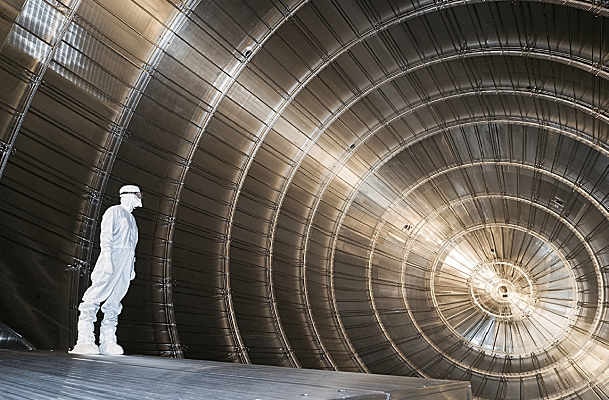
Main Spectrometer Credit: Karlsruhe/KIT Katrin

Neutrinos are the most abundant subatomic particle in the universe, they are also the only fundamental particle whose mass is still unknown. Now German scientists have put a maximum limit on their mass, finding it can be no more than 0.45 electron volts (eV), or less than one-millionth the mass of an electron. The findings can further develop the Standard Model of particle physics, which is our best description of the subatomic world, and help us better understand the Universe. The researchers determined the neutrino’s mass by analysing the decay of tritium, a rare and radioactive version of hydrogen.

Media release

From: AAAS

KATRIN experiment sets most precise upper limit on neutrino mass: 0.45 eV
Science

Researchers from the KATRIN (Karlsruhe Tritium Neutrino) experiment report the most precise measurement of the upper mass limit of the neutrino to date, establishing it as 0.45 electron volts (eV) – less than one-millionth the mass of an electron. The findings tighten the constraints on one of the universe’s most elusive fundamental particles and push the boundaries of physics beyond the Standard Model. Neutrinos – electrically neutral elementary particles – are the most abundant particles in the universe and exist as three distinct types or “flavors”: electron neutrino, muon neutrino, and tau neutrino. These flavors oscillate, meaning a single neutron can transform into each type as it travels, providing compelling evidence that neutrinos possess mass that contradicts the Standard Model’s original assumption of massless neutrinos. However, their exact mass remains one of the great mysteries of particle physics. Here, Max Aker and the KATRIN Collaboration present the results of the first five measurement campaigns of the KATRIN experiment. The KATRIN experiment determines the neutrino’s mass by analyzing the beta decay of tritium. During this decay, a neutron transforms into a proton, emitting both an electron and an electron antineutrino – the latter being the neutrino’s antiparticle. By analyzing the distribution of total decay energy between the emitted electron and the electron antineutrino, the neutrino’s mass can be inferred. Over 259 days between 2019 and 2021, the KATRIN Collaboration measured the energy of approximately 36 million electrons – a dataset six times larger than previous runs. The findings establish the most stringent laboratory-based upper limit on the effective electron neutrino mass, placing it at < 0.45 eV with a 90% confidence level. This result marks the third refinement of the neutrino mass limit and improves upon the previous limit by a factor of 2. “The neutrino mass measuring campaign of the KATRIN experiment will end in 2025 after reaching 1000 days of data acquisition,” writes Loredana Gastaldo in a related Perspective. “Analysis of the full data set gained from this grand project will allow for estimating the effective electron neutrino mass close to the projected value of 0.3 eV at 90% confidence level.”

Attachments

Note: Not all attachments are visible to the general public. Research URLs will go live after the embargo ends.

Research AAAS, Web page Please link to the article in online versions of your report (the URL will go live after the embargo ends).
Journal/
conference:
Science
Research:Paper
Organisation/s: Karlsruhe Institute of Technology, Technical University of Munich/Max Planck Institute for Physics, Germany
Funder: We acknowledge the support of the Helmholtz Association (HGF), Ministry for Education and Research BMBF (05A23PMA, 05A23PX2, 05A23VK2, and 05A23WO6), the doctoral school KSETA at KIT, Helmholtz Initiative and Networking Fund (grant agreement W2/W3-118), Max Planck Research Group (MaxPlanck@TUM), and Deutsche Forschungsgemeinschaft (DFG) (GRK 2149 and SFB-1258 and under Germany’s Excellence Strategy EXC 2094–390783311) in Germany; the Ministry of Education, Youth, and Sport (CANAM-LM2015056, LTT19005) in the Czech Republic; Istituto Nazionale di Fisica Nucleare (INFN) in Italy; the National Science, Research, and Innovation Fund through the Program Management Unit for Human Resources & Institutional Development, Research and Innovation (grant B37G660014) in Thailand; and the US Department of Energy through awards DE-FG02-97ER41020, DE-FG02-94ER40818, DE-SC0004036, DE-FG02-97ER41033, DE-FG02-97ER41041, DE-SC0011091, and DE-SC0019304 and the Federal Prime Agreement DE-AC02-05CH11231 in the United States. This project has received funding from the European Research Council (ERC) under the European Union Horizon 2020 research and innovation program (grant agreement 852845). We thank the computing cluster support at the Institute for Astroparticle Physics at Karlsruhe Institute of Technology, Max Planck Computing and Data Facility (MPCDF), and the National Energy Research Scientific Computing Center (NERSC) at Lawrence Berkeley National Laboratory.
Media Contact/s
Contact details are only visible to registered journalists.