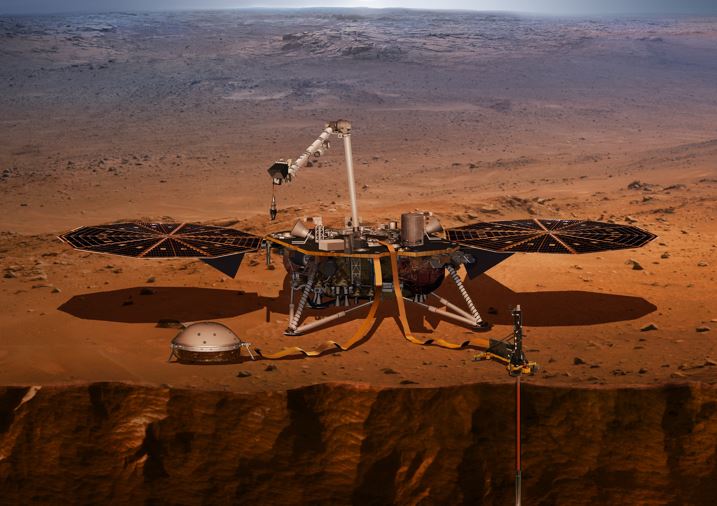
NASA's Mars InSight lander can detect Martian meteoroid impacts and find their craters

Publicly released:
Australia; International; WA
NASA/JPL-Caltech
NASA/JPL-Caltech

NASA's Mars InSight lander can detect meteoroids as they enter the Martian atmosphere and crash into the red planet. With a little help from the Mars Reconnaissance Orbiter (MRO), experts were able to triangulate the exact impact crater that these meteors made, which is a first for impacts on a planet other than Earth. Meteors create shockwaves when they enter Mars' atmosphere and crash at high speeds, and the researchers analysed the seismic and acoustic waves created by four meteoroid impacts and estimated a crash site, which was then confirmed by the MRO. The researchers say these kinds of impacts can be used to study the structure of the planet's atmosphere and interior.

News release

From: Springer Nature

Mars InSight lander records impact of meteoroids

Seismic waves produced by meteoroid impact events on Mars have been detected by NASA’s InSight lander and traced to the associated, newly formed impact craters by NASA’s Mars Reconnaissance Orbiter, according to a study published in Nature Geoscience. The study presents the first detections of seismic and acoustic waves from impacts on another planet that have been linked to the source craters.

The atmospheric entry and surface collision of a meteoroid at high speeds generates shock waves. These decay into seismic and acoustic waves that can be detected by seismometers. Such waves have been recorded for airburst events — where the impactor breaks up before reaching the surface — in Earth’s atmosphere, and for the formation of a single small impact crater on Earth. However, geophysical observations of new crater formation on other planets have been limited.

Raphael Garcia and colleagues analysed seismometer data from the InSight lander and identified seismic and acoustic waves from four events. The authors used the arrival times of the waves to calculate the location of each of these four events, and then requested imaging from the Mars Reconnaissance Orbiter to confirm the impact sites for three of them (the fourth was a seismic event associated to an impact previously detected by imaging). With the source craters known, the impact-induced waves can be used to provide information about the cratering process and the properties of the Martian atmosphere and crust.

The authors conclude that these findings demonstrate the value of planetary seismology for studying impact processes on other worlds.

Attachments

Note: Not all attachments are visible to the general public. Research URLs will go live after the embargo ends.

Research Springer Nature, Web page The URL will go live after the embargo ends
Journal/
conference:
Nature Geoscience
Research:Paper
Organisation/s: Curtin University, Université de Toulouse, France
Funder: This study is InSight contribution number 241 and LA-UR-22-25144. The French authors acknowledge the French Space Agency CNES and ANR (ANR-14-CE36-0012-02 and ANR-19-CE31-0008-08) for funding the InSight Science analysis. I.J.D. was supported by NASA grant 80NSSC20K0971. P.L., Z.X., S.M., M.F., T.K. and M. Plasman acknowledge IdEx Université de Paris ANR-18-IDEX-0001. N.W. and G.S.C. are funded by the UK Space Agency (Grants ST/S001514/1 and ST/T002026/1). N.A.T. and A.H. are funded by the UK Space Agency (grants ST/R002096/1 and ST/W002523/1). M.F. is funded by the Center for Space and Earth Science of Los Alamos National Laboratory. S.C.S., N.L.D., C.D. and G.Z., acknowledge support from ETHZ through the ETH+ funding scheme (ETH+2 19-1: ‘Planet MARS’). A.R., K.M., E.K.S. and T.N. are funded by the Australian Research Council (DE180100584, DP180100661 and DP180100661). W.B.B., M. Panning, and L. Martire were supported by the NASA InSight mission and funds from the Jet Propulsion Laboratory, California Institute of Technology, under a contract with the National Aeronautics and Space Administration (grant 80NM0018D0004). N.C.S. was supported by funds from the National Aeronautics and Space Administration (grant 80NSSC18K1628). The authors thank CALMIP (Toulouse, France, project #p1404) computing centre for HPC resources. We acknowledge NASA, CNES, their partner agencies and institutions (UKSA, SSO, DLR, JPL, IPGP-CNRS, ETHZ, IC and MPS-MPG) and the flight operations team at JPL, SISMOC, MSDS, IRIS-DMC and PDS for providing SEED SEIS data. We are grateful to the CTX and HiRISE operations teams who planned and acquired the orbital images of the new impacts.
Media Contact/s
Contact details are only visible to registered journalists.