Million-year-old human face the oldest ever found in Europe

Publicly released:
Australia; International; VIC
Maria D. Guillén / IPHES-CERCA / Elena Santos / CENIEH.

International and Australian researchers have found the earliest reported fossil of a human face found in Western Europe, a discovery they say will help us better understand the lives of the first Europeans. The fossil, found at a site in Spain, has preserved part of a human face that dates back between 1.4-1.1 million years, and was buried two metres deeper than a similar fossil previously discovered at the site. They say it's unclear what species of human the face is, though it bears some resemblance to Homo erectus. Stone tools and animal bones with cut marks were discovered near this fossil, the researchers say, which gives an indication of the life the person lived.

Media release

From: Springer Nature

Archaeology: Earliest-known partial human face from Western Europe

The discovery of the oldest known facial bones from a hominin from western Europe, approximately 1.4–1.1 million years old, is reported in Nature.

It is suggested that Eurasia was first settled by hominins at least 1.8 million years ago. Evidence of early hominin settlement in Western Europe has been limited to extremely fragmented fossil samples from the Iberian Peninsula, providing few clues about the appearance and taxonomy of these hominins. Fossils from a Spanish site, dated from approximately 850,000 years ago, were determined to be from Homo antecessor, a species of early people with a slender midface resembling modern humans. In 2007, a 1.2 to 1.1-million-year-old hominin jawbone (named ATE9-1) was found in the Sima del Elefante site in northern Spain but could not be conclusively assigned to H. antecessor.

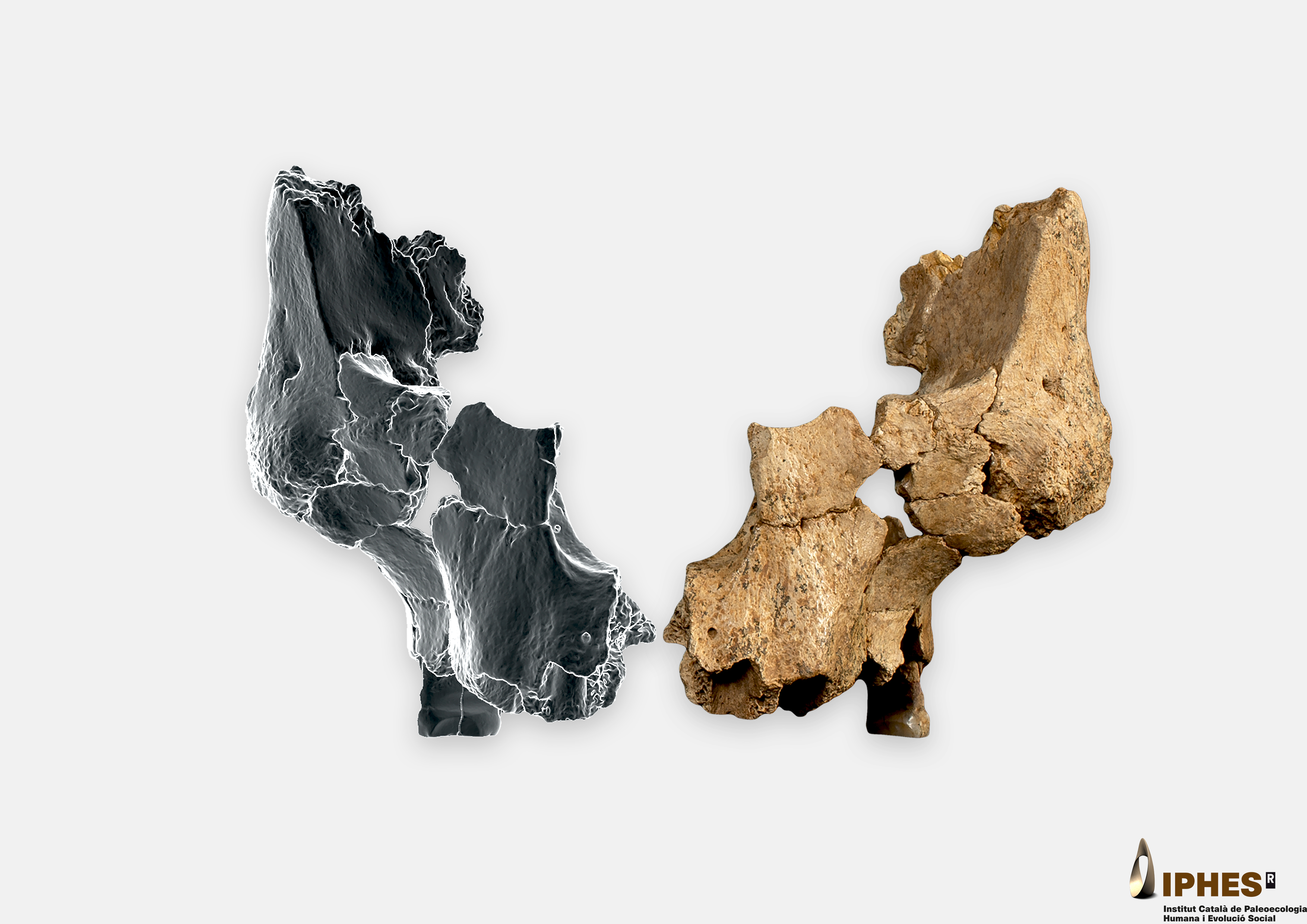
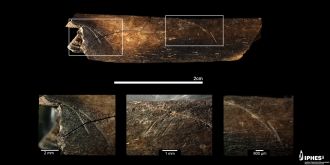
In 2022, Rosa Huguet and colleagues uncovered the fossil remains of a partial hominin midface at the Sima del Elefante site. The fragments (dubbed ATE7-1 collectively) consist of a substantial part of the maxilla and the zygomatic bone from the left side of an adult individual. The authors used both physical evidence and 3D imaging techniques to reconstruct the fossil fragments, estimating their age to be between 1.4 and 1.1 million-years-old. The age of the newly discovered fossils is indistinguishable from the jawbone (ATE9-1) found at the site previously, although the ATE7-1 fossils were found two metres deeper, leading the authors to assume that the new fossils are older. The recovery of additional archaeological remains (stone tools and animal bones with cut marks) and paleocological remains from the site offer insights into the environment in which this hominin lived and their lifestyle, the authors note.

The authors observe that the hominin bone fragments do not display ‘modern’ mid-face features found in H. antecessor fossils. Additionally, although the remains bear some resemblance to the Homo erectus lineage, they are unable to conclusively assign it to this group either. Therefore, the authors provisionally assigned the fossils to H. aff. erectus, indicating an affinity to H. erectus, pending further evidence. This discovery could suggest that Western Europe was populated by at least two Homo species during the Early Pleistocene period: H. aff. erectus, and later H. antecessor. Further research and fossil samples are needed to investigate the relationship between these populations and further refine their classifications.

Multimedia
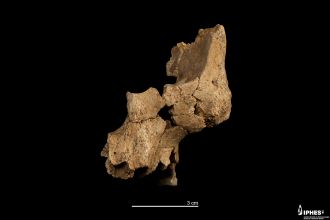
Original fossil (ATE7-1)
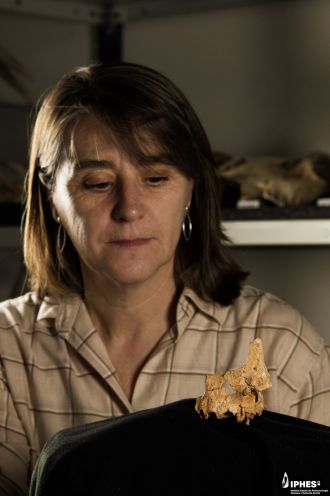
Dr. Rosa Huguet
Dr. Rosa Huguet
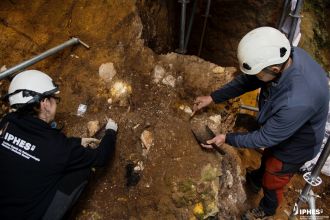
Archaeological excavation work
Original fossil (ATE7-1) alongside the mirrored right side by virtual 3D imaging
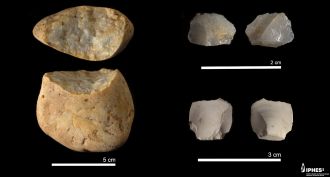
Lithic industry recovered at level TE7 of the Sima del Elefante
Rib of a small animal with cut marks

Attachments

Note: Not all attachments are visible to the general public. Research URLs will go live after the embargo ends.

Research Springer Nature, Web page The URL will go live after the embargo ends
Journal/
conference:
Nature
Research:Paper
Organisation/s: Monash University, Universitat Rovira i Virgili, Spain
Funder: The research of the Atapuerca sites is founding by the Spanish Ministry of Science and Innovation and European Regional Development Fund “ERDF A way of making Europe” (projects PID2021-122355NB-C31, PID2021-122355NB-C32, PID2021-22355NB-C33). Fieldwork at Sima del Elefante is supported by the Junta de Castilla y León and the Fundación Atapuerca. The Institut Català de Paleoecologia Humana i Evolució Social (IPHES-CERCA) has received financial support from the Spanish Ministry of Science and Innovation through the María de Maeztu program for Units of Excellence (CEX2019-000945-M). We acknowledge support from the Catalan Government (AGAUR, projects 2021-SGR-01237, 2021-SGR-01238 and 2021-SGR-01239) and Universitat Rovira i Virgili (2023PFR-URV-01239). M.M.-T. receives funding from The Leakey Foundation through the personal support of D. Crook. Part of the hominin analyses were carried out at the laboratories of the CENIEH-ICTS with the support of the CENIEH staff. The research of J.M.L.-G. was funded by the Spanish Ministry of Science and Innovation and European Regional Development Fund (project PID2021-122533NB-I00). E.S. received funding from Fundación Atapuerca. C.N.-L. was supported by a Juan de la Cierva formation contract (FJC2020-044561-l; MCIN cofinanced by the NextGeneration EU/PRTR). L.M.-F. is supported by Horizon Program-Marie Sklodowska-Curie Actions of the EU Ninth programme (2021–2027) under the HORIZON-MSCA-2021-PF-01-Project: 101060482 and MCIN/AEI/10.13039/501100011033 and “ERDF A way of making Europe”. J.G. is the beneficiary of a Postdoctoral Fellowship from the Alexander von Humboldt Foundation (ESP-1235332-HFST-P). J.v.d.M. benefited from grant Synthesys AT-TAF-3663. The research of A.R.-H. is supported by the grant RYC2022-037802-I funded by MCIN/AEI/10.13039/501100011033 and by the FSE invests in your future. A.B. was supported by a Juan de la Cierva—Incorporación contract IJC2019-041546-I and by the grant RYC2022-037783-I. A.P. is supported by the LATEUROPE project (ERC Consolidator Grant ID101052653). A.M. acknowledges the Shota Rustaveli Georgian National Science Foundation (grant YS-21-1595).
Media Contact/s
Contact details are only visible to registered journalists.