 Sign In



 International
News release
From:
Technology: This robot can take a tumble
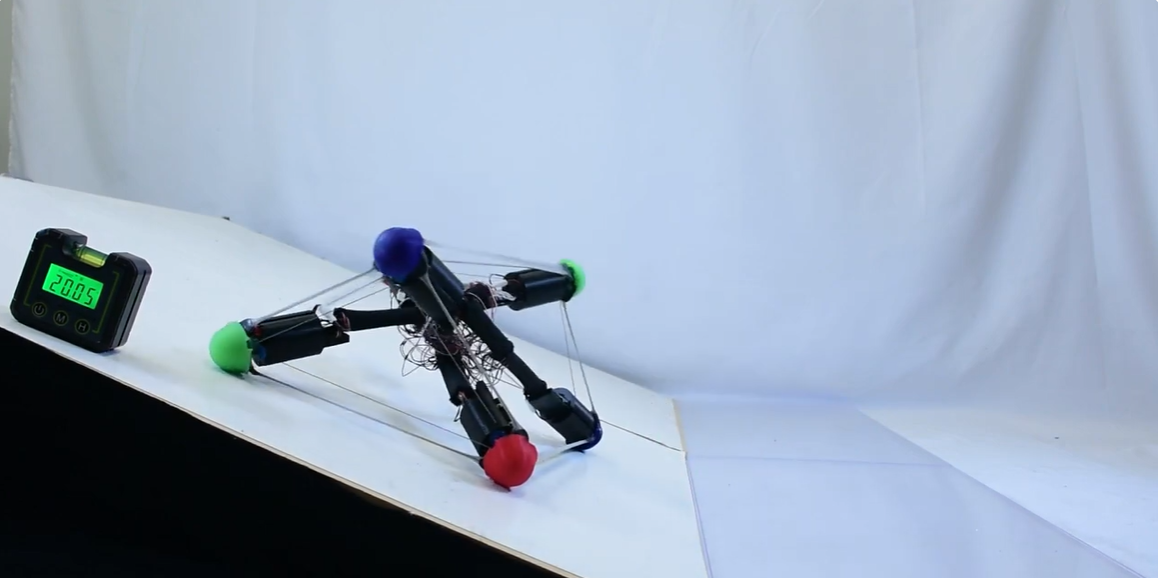
A rolling robot called Tribar that can survive high-impact landings and continue moving across rough terrain is reported in Nature Machine Intelligence. The findings could support the development of robots for hazardous or remote environments, including planetary surfaces and disaster zones.
Tensegrity robots are made from rigid struts suspended in a network of elastic cables, which gives them flexible, lightweight structures that can absorb large external loads. They have been proposed as future planetary rovers and disaster-response platforms. However, developing an autonomous robot that can both survive a severe impact and function afterwards has been challenging.
Rebecca Kramer-Bottiglio and colleagues present Tribar, a three-bar tensegrity robot designed to combine impact resistance with autonomous control. The robot uses stretchable sensor tendons and on-board motion sensors to estimate its shape and orientation. The authors tested its movement across grass, ice, pebbles and sand, up inclines of up to 28 degrees, and along straight, curved, and triangular paths. It also survived a 5.7 metre drop from a bridge onto asphalt — described by the authors as the highest recorded drop for a tensegrity robot — and continued moving afterwards.
The authors suggest that this combination of impact resistance, sensing, and control could help future robots navigate environments that are inaccessible for conventional robots, such as cliffs, craters, or disaster areas. They suggest this design can serve as a benchmark for further development of high-survivability robots.
Multimedia

Attachments
Note: Not all attachments are visible to the general public. Research URLs will go live after the embargo ends.


