Jellyfish nebula may be the scene of two stars going supernova

Publicly released:
International
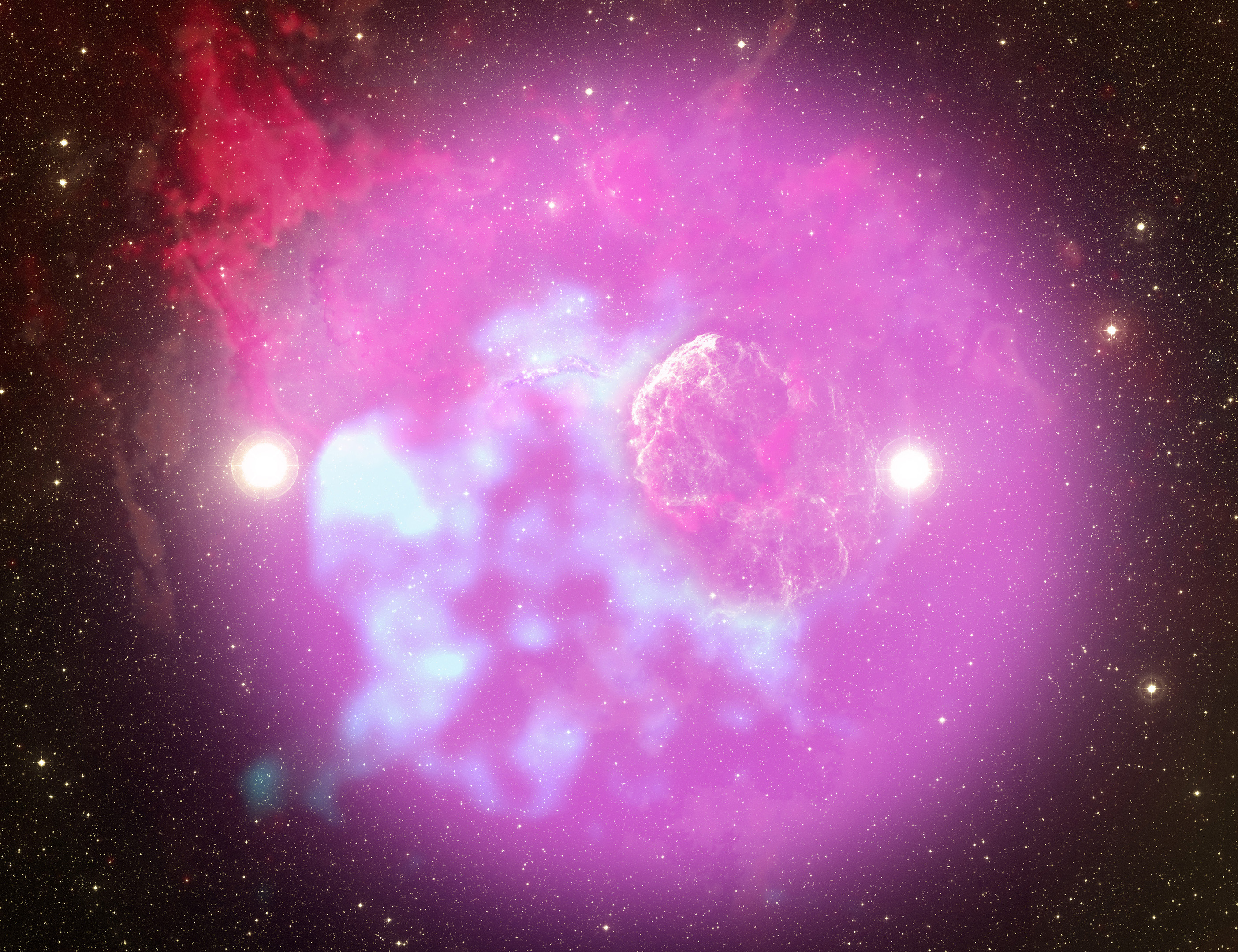
Credit: NASA Goddard Space Flight Center and M. Michailidis et al. 2026; orange, brown: radio, ESA/Planck and MWISP; yellow: optical, DSS; red: infrared, NASA/WISE; violet: ultraviolet, NASA/Swift; teal: X-rays, SRG/eROSITA; magenta: gamma rays, NASA/DOE/Fermi LAT Collaboration

The star that formed the Jellyfish nebula may have had a partner star that exploded 100,000 years earlier, according to international researchers, who say that this may be the first known discovery of a binary star system in which both stars have gone supernova. The Jellyfish nebula, known as IC 443, is the remnant of a star exploding in a supernova and leaving behind an expanding cloud of debris. IC 443 is located in the Gemini constellation, approximately 6,000 light-years from Earth, and researchers have now discovered that it occupies the same physical environment as another supernova remnant called G189.6+3.3. They suggest that the parent star of this newly discovered supernova remnant exploded approximately 20-100,000 years before the explosion that created the Jellyfish Nebula, and that it is highly likely that the two stars that created these remnants were born together in a binary system.

News release

From:

Astronomy: Possible binary supernova system *IMAGES*

The detection of what may be the remnants of a companion to the star that exploded to form IC 443 (also known as the Jellyfish nebula) is reported in Nature Communications. The findings, supported by multiple lines of evidence, indicate that this is the first known candidate binary star system in which both stars have undergone supernova events.

Supernova remnants are expanding clouds of debris left behind after supernova (stellar explosions). While hundreds of such remnants are known in our galaxy, identifying relationships between them is difficult, particularly in crowded regions of the Milky Way. One well-studied example is IC 443, a remnant located in the constellation Gemini approximately 6,000 light-years from Earth. It sits close to other astronomical structures and within a complex cloud of gas and dust, making its surrounding region difficult to study.

Miltiadis Michailidis and colleagues combined 16 years of observations from the Fermi Large Area Telescope gamma-ray observations with eROSITA X-ray and complementary multiwavelength data. Using this data, the authors are able to establish that the recently-discovered supernova remnant G189.6+3.3 occupies the same physical environment as IC 443, indicating that the two exist in close proximity and at approximately the same distance from Earth. The age estimates suggest that the parent star of G189.6+3.3 exploded between approximately 20-100,000 years before the explosion that created IC 443. Validation of these measurements using statistical analysis and simulations suggest that this configuration is highly unlikely to be a chance alignment, suggesting that the two stars that preceded these remnants were born together in a binary system.

This discovery has the potential to provide new insights into our understanding of both supernova and binary star systems.

Multimedia
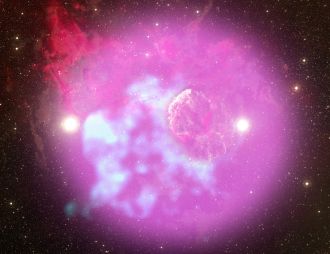
Composite multiwavelength view of the IC 443 region
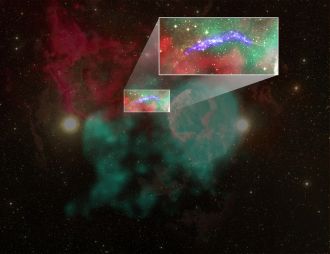
Composite multiwavelength view of the IC 443 region - 2
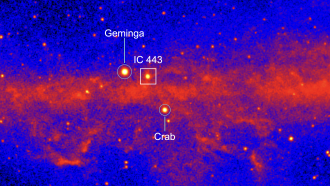
Zoomed-in gamma-ray view of the Galactic anticenter region
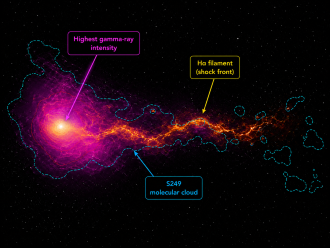
Artist's illustration marking the northern boundary of G189.6+3.3

Attachments

Note: Not all attachments are visible to the general public. Research URLs will go live after the embargo ends.

Research Springer Nature, Web page
Journal/
conference:
Nature Communications
Research:Paper
Organisation/s: W.W.Hansen Experimental Physics Laboratory, USA
Funder: MLG acknowledges support from the Alexander von Humboldt Foundation. RW acknowledges support from the KU Leuven Research Council through grant iBOF/21/084.
Media Contact/s
Contact details are only visible to registered journalists.