It takes more than just royal jelly to make a queen bee

Publicly released:
International
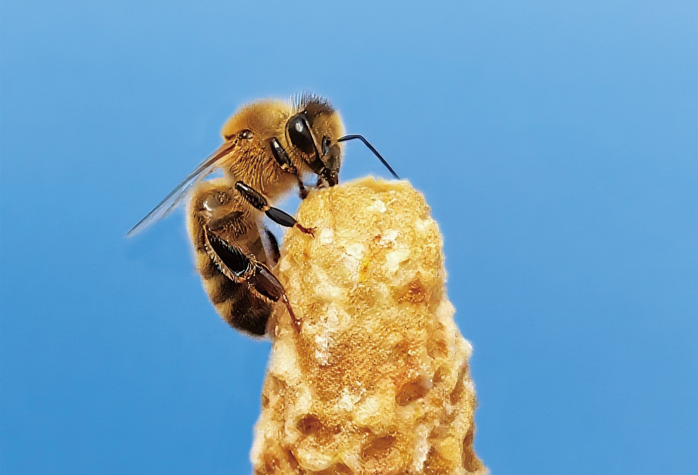
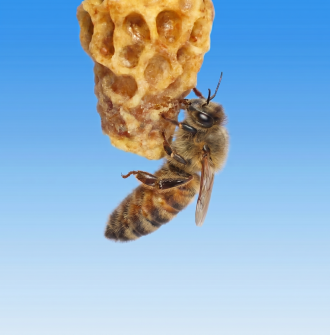
An artistic rendering illustrating the unique architecture of the honey bee queen cell with worker bees nearby. Yu Fang / Chinese Academy of Agricultural Sciences

It's not just the royal jelly that makes the queen bee, according to international researchers who looked at the physical and chemical structure of the wax cells in bee hives to see if they impact the development of new queens. The team used microscopes to study the queen cell wax, finding that it has distinct physical and chemical properties: it is less dense, more pliable and has a higher melting point than worker cell wax. They tested the influence of this environment by rearing queen larvae in 172 cells capped with either queen wax or worker wax for seven days. They found that queens developing in worker wax cells had higher death rates and were smaller than those developing in queen wax cells, which they say suggests the queen cells’ particular biochemical environment is crucial for developing larvae. The authors also found that there is a unique type of worker bee, dubbed ‘queen cell builders’, that are typically younger and hotter (in temperature), with distinct metabolic activity, that help to build the special queen wax cells.

News release

From: Springer Nature

Biology: Newly identified ‘queen cell builders’ shape honeybee royalty (N&V) *IMAGES*

A previously unrecognised group of young worker honeybees who are responsible for raising their queen in physicochemically unique peanut-shaped wax cells are described this week in Nature. The paper finds that queen cells are not simply structural containers but engineered microenvironments that have a critical role in queen development.

So-called royal jelly — the glandular substance secreted by worker honeybees and fed to young larvae — has long been thought to be the key factor in the development of queen bees. Despite differing greatly in shape compared with neighbouring hexagonal cells, queen cells (where these larvae develop) are regarded simply as a passive shelter, and their influence on queen development remains unclear.

Kai Wang, Boris Baer, Xiaofeng Xue, and colleagues conducted a series of experiments on the composition of queen cell wax. Using scanning electron microscopy, the authors found that queen cell wax has distinct physical and chemical properties: it is less dense, more pliable and has a higher melting point than worker cell wax. The authors tested the influence of this environment by rearing queen larvae in 172 cells capped with either queen wax or worker wax for 7 days. They found that queens developing in worker wax cells had higher mortality rates and were smaller in size, suggesting that the queen cells’ particular biochemical environment were crucial for developing larvae. The authors also identify a unique type of worker bee, dubbed ‘queen cell builders’, with specialized physiological adaptations.

Compared with worker cell builders, queen cell builders are typically younger and have higher thoracic temperatures and distinct metabolic activity. Behavioural tracking showed that they actively modify, enrich and dilute queen cell wax during construction, rather than simply recycling existing material.

These findings challenge current understanding of honeybee differentiation and nest architecture, redefining queen cells as specially engineered microenvironments and key determiners of bee type. The authors find this to be consistent in Asian and European honeybees.

Multimedia
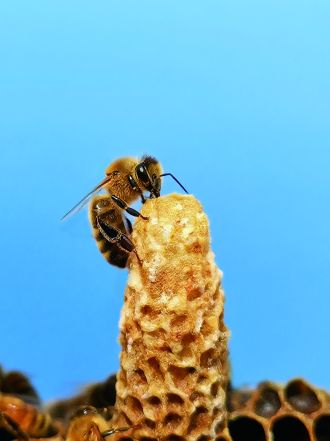
An artistic rendering illustrating the honey bee queen cell with worker bees
A newly emerged virgin honey bee queen exiting her cell

Attachments

Note: Not all attachments are visible to the general public. Research URLs will go live after the embargo ends.

Research Springer Nature, Web page The URL will go live after the embargo ends
Journal/
conference:
Nature
Research:Paper
Organisation/s: Chinese Academy of Agricultural Sciences, China
Funder: This work is supported by the National Natural Science Foundation of China 32322079 (K.W.) and 32502980 (X.J.); the Beijing Nova Program 20220484101 (K.W.); the Modern Agro-Industry Technology Research System CARS-44 (Y.F.); the Agricultural Science and Technology Innovation Program CAAS-ASTIP-2024-IAR (K.W. and X.X.); the Basic Research Centre, Innovation Program of Chinese Academy of Agricultural Sciences CAAS-BRC-FNH-2025-03 (K.W.); and Youth Innovation Program of Chinese Academy of Agricultural Sciences (K.W. and Y.Z.). A.B. is supported by the German Research Foundation (Deutsche Forschungsgemeinschaft, DFG, project number 534955761).
Media Contact/s
Contact details are only visible to registered journalists.