News release
From:
Springer Nature
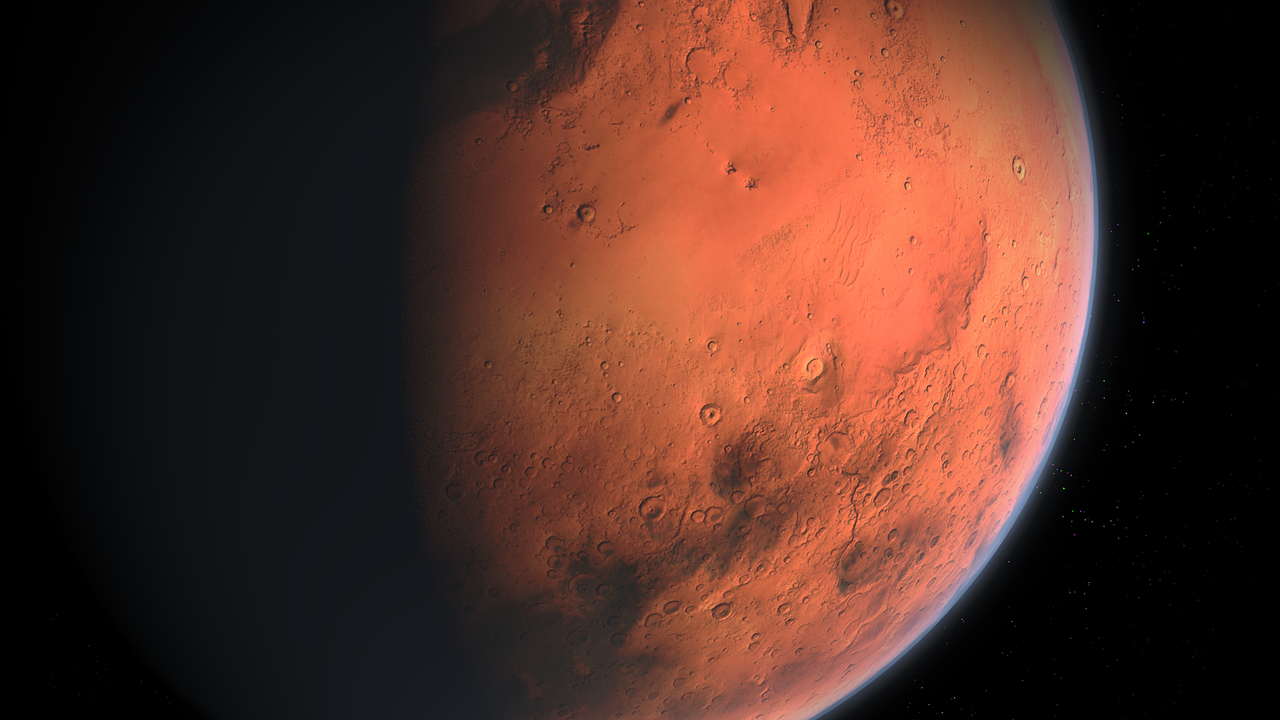
Challenges for detecting life on Mars (N&V) *IMAGES & VIDEO*
Scientific instruments currently deployed on Mars may lack the sensitivity to identify possible traces of life in this environment, suggests a Nature Communications paper.
Since the Viking missions in the 1970s, there have been multiple attempts to search for signs of life on Mars. Now, half a century later, even the most recent, highly sophisticated instruments of NASA’s Curiosity and Perseverance rovers have only identified low levels of simple organic molecules. These results raise questions about whether our ability to detect evidence of life is hindered by current instrument limitations or the nature of materials within martian rocks.
Armando Azua-Bustos and colleagues tested instruments that are currently, or may be, sent to Mars alongside state-of-the-art laboratory equipment to analyse samples from Red Stone, the sedimentary fossils remains of a river delta located in the Atacama Desert, Chile. These deposits formed under highly arid conditions around 160–100 million years ago and are geologically similar to the Jezero crater on Mars currently being studied by Perseverance. Using highly sensitive laboratory-based techniques, the authors found a mixture of biosignatures of both extinct and living microorganisms. Microbial culturing and gene sequencing showed many of the DNA sequences found primarily came from an unidentifiable ‘dark microbiome’, with most of the genetic material coming from previously undescribed microorganisms. However, analyses of testbed instruments used on Mars reveal that they were barely able to detect molecular fossil signatures at the limits of detection.
The findings indicate that similarly low levels of organic matter, expected to be present if there was life on Mars billions of years ago, will be difficult if not impossible to detect with the technology currently used on Mars. The authors stress the importance of returning samples to Earth to conclusively address whether life ever existed on the red planet.
Journal/
conference:
Nature Communications
Organisation/s:
Centro de Astrobiología (CAB) (CSIC-INTA), Madrid, Spain
Funder:
The research leading to these results is a contribution from the Project
“MarsFirstWater”, funded by the European Research Council, Consolidator
Grant no 818602 to AGF, and by the Human Frontiers Science
Program grant n° RGY0066/2018 to A.A.-B. Additional funding provided
was provided by MINECO grant PID2019-107442RB-C32 (O.P.-B. and
A.M.), Grants-in-Aid for Scientific Research from the Japan Society for Promotion of Science grant numbers 17H06458 and 21H04515 (K.F.),
grant numbers 17H06456, 17H06458, 20H00195, and 21H04515 (K.F. and
Y.S.), Consejería de Educación e Investigación, Comunidad Autónoma de
Madrid/European Social Fund program (MAFM), grant n° ESP2017-87690-
C3-3-R (DC), Ramón y Cajal grant n° RYC2018-023943-I (L.S.-G.), AEI
grant MDM-2017-0737 and MCIN/AEI grant PID2019-107442RB-C32
(V.M.-I.), MCIU/AEI (Spain) and FEDER (UE) grant n° PGC2018-094076-BI00
(J.W. and C.A.), Italian Space Agency agreement 2017-48-H.0 (T.F.,
J.R.B. andG.P.), the Ministry of Science of Spain grant PID2019-107442RBC31
(J.A.M.,M.V., G.L.R., A.A. and F.R.),María Zambrano’ excellence grant
program (CA3/RSUE/2021-00405), funded by the Spanish Ministry of
Universities (MFM), NASA Mars Exploration Program contracts
NNH13ZDA018O, NNH15AZ24I, NNH13ZDA018O and LANL Laboratory
Directed Research and Development (LDRD) funding XX5V (A.M.O,
R.C.W., A.R. and S.M.C.), NASA-GSFC grant NNX17AJ68G (M.M. and
S.S.J.), NES focused on Sample Analysis at Mars of the Mars Science
Laboratorymission, and Mars OrganicMolecules Analyzer of the Exomars
2022 mission (O.M., C.S., and C.F.), and grants RTI2018-094368-B-I00
andMDM-2017-0737 Unidad de Excelencia “Maria deMaeztu”- Centrode
Astrobiología (INTA-CSIC) by the Spanish Ministry of Science and Innovation/
State Agency of ResearchMCIN/AEI/ 10.13039/501100011033 and
by “ERDFAway of making Europe” (C.E., M.G.V.,M.M.-P., and V.P.). R.C.W.
thanks Dot Delapp for performing pre-processing of the LIBS data. The
authors also thanks USGS earth explorer for providing the satellite data of
Sentinel 2020.
 Sign In



 International