 Sign In



 Australia; NSW
News release
From:
ANSTO researchers have demonstrated longstanding expertise in the study of radioactive waste, nuclear fuel and nuclear waste forms.
In a paper from Prof Brendan Kennedy of the University of Sydney and his associates, including Prof Gordon Thorogood and others at ANSTO in Frontiers in Chemistry, the authors provide the first report of a stable valence 5 technetium oxide.
The lead technetium pyrochlore investigated in the research is found in nuclear fuel and nuclear waste.
The migration of 99Tc is a significant challenge in nuclear waste management.
"As well as the fact that no stable valence 5+ oxide of technetium exists, no one previously has been able to make technetium oxide with a stable valence state,” said Prof Thorogood.
”People made the assumption that if you had 5+ technetium oxides, they would break down into 4+ which is stable and then 7+ which is unstable.
“However, if a stable 5+ technetium oxide is formed in a nuclear waste form, it is probably good news,” said Prof Thorogood.
There was some confusion previously as to whether the compound was a pyrochlore or perovskite. Some of the perovskite chemistry reported a decade ago that was first noticed by Prof Kennedy, seemed inconsistent with a pyrochlore structure.
Thorogood and Kennedy and associates decided to investigate in an effort that took a number of years.
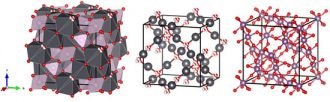
The team combined synchrotron powder diffraction and Neutron powder diffraction to determine the structure of the lead-technetium pyrochlore Pb2Tc2O7-d, X-ray absorption spectroscopy to confirm the valence state was greater than 4+ and Raman spectroscopy to confirm a change in local structure and coordination of the ions.
“The disorder appeared to allow for larger bond lengths for the technetium, resulting in it being in the higher valence state,” said Prof Thorogood.
The unique facilities at ANSTO that are designed for the handling of radioactive materials, were the only place that the research could be undertaken in Australia.
“Not only do we have the infrastructure that allows us to look work on radioactive materials, we also have the knowledge to make the materials safe so that they can be studied off-site as well.”
ANSTO technical specialist Kevin Thorogood built a special sample holder to contain the material for safe handling during the Raman spectroscopy measurements at the UNSW.
Other ANSTO scientists contributed to the study, including Dr Max Avdeev, Dr Zhaoming Zhang, Dr Hanliang Zhu and former staff member Dr Kia Wallwork.
Multimedia

Attachments
Note: Not all attachments are visible to the general public. Research URLs will go live after the embargo ends.


