 Sign In



 Australia; Pacific; VIC
News release
From:
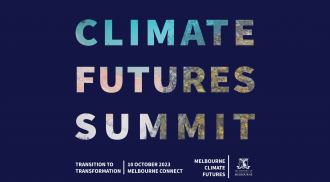
On Tuesday 10 October 2022, Melbourne Climate Futures, the University of Melbourne’s climate change research initiative, will host its second annual Climate Futures Summit, a full-day conference that will bring leading climate experts together for a day of unflinching discussion, with the goal of sharing and developing the solutions we need to transition speedily to a positive climate future.
To achieve the significant task of transforming our energy systems, we must address issues of law, economy, land use, and more, to ensure the shift is made justly, safely, and equitably.
Furthermore, with extreme weather events occurring with more frequency and severity, we need to put in place the systems and resources to address the oncoming challenges – as well as those already on our doorstep – of a changed and changing climate.
With notable speakers including Melbourne Lord Mayor Sally Capp, entrepreneur and philanthropist Alan Schwartz, and Greenpeace Australia CEO David Ritter, at the 2023 Climate Futures Summit, we put the challenges of transition front and centre.
We invite our colleagues in media to attend in person or online. There will be the opportunity for questions and comments, facilitated by Melbourne Climate Futures communication staff.
Upon request, recordings and photographs can be provided within 24 hours of the event.
Climate Futures Summit 2023 program
9.30am–10.30am: Biodiversity, oceans and climate
The climate crisis is a complex puzzle. While disparate, biodiversity, water systems and the climate are inextricably related to each other and to our planet’s health. If each area is addressed effectively, the combined result has the potential to be greater than the sum of its parts. How can the solutions to these distinct, but connected, issues complement each other to create robust sustainable solutions?
- David Karoly (Moderator), Professor Emeritus in the School of Geography, Earth and Atmospheric Sciences, Senior Research Fellow in Melbourne Climate Futures
- David Ritter, CEO, Greenpeace Australia Pacific
- Rachel Morgain, Deputy Director, Melbourne Biodiversity Institute
- Rebecca Runting, ARC DECRA Senior Research Fellow, Geography, Earth and Atmospheric Sciences
11.15am–12.15pm: Paying for the climate crisis
As discussions around addressing the cost of the climate crisis develop, the balance between public and private-sector responsibilities is under greater scrutiny. What role should the public and private sectors play in financing our response to and mitigation of the climate crisis? Should geography factor into financial obligations? What does an effective climate finance framework look like?
- Alan Schwartz, Managing Director, Trawalla Group
- David G Victor, Professor of Innovation and Public Policy and Co-director, Deep Decarbonization Initiative
- Janine Felson, Enterprise Fellow, Melbourne Climate Futures
- Adam Bumpus (moderator), Entrepreneur-in-residence, MCF
12.30pm–1.30pm: The human cost of a warming world
The climate crisis will intensify a range of health and wellbeing concerns, which will bear economic, as well as human, costs. Gender, age, culture, wealth and a range of other factors all play a significant part in our individual experiences of climate change. How can we protect our physical and mental health in a warming world?
- Saleemul Huq, Director, International Centre for Climate Change & Development (ICCCAD)
- Michelle Foster, Director, Peter McMullin Centre on Statelessness
- Nabreesa Murphy, PhD candidate, University of Melbourne
- Rob Moodie (moderator), Professor of Public Health, University of Melbourne
2.30pm–3.30pm: Envisioning Australia and the region’s energy future
We know the transition away from fossil fuels is fundamental to the climate solution. As we urgently move away from carbon-producing energy, where can Australians expect their energy to be sourced in five years… ten years… or fifty? With green energy fundamentally connected with land use, what ethics must we navigate to responsibly, justly and equitably transition to green energy?
- Rebecca Huntley, Director of Research, 89 Degrees
- Rowan Foley, CEO, Aboriginal Carbon Foundation
- Namrata Inamdar, Vice Presidents of Initiatives at Melbourne Microfinance Initiative
- Michael Brear (moderator), Director, Melbourne Energy Institute
3.45pm–4.45pm: Leadership, government and climate governance
Amid the complexity of dismantling decades-old energy production systems, governments must navigate necessary seismic shifts to economic and tax systems, judicial structures, and foreign relations. As we approach COP28, how do we ensure they ethically and transparently meet our challenges and commitments under the Paris Agreement? How do we suggest our leaders justly resolve the vast range of conflicting national needs while ensuring a swift transition to a positive climate future?
- Sally Capp, Lord Mayor of Melbourne
- Ellen Sandell, Victorian Deputy Leader for the Greens
- Ayisha Siddiqa, Human rights and environmental justice activist
- Robyn Eckersley (moderator), Redmond Barry Distinguished Professor in Political Science, University of Melbourne
Multimedia

Attachments
Note: Not all attachments are visible to the general public. Research URLs will go live after the embargo ends.


