Sign In



 Australia; QLD
News release
From:
If you thought all boomerangs were used solely for throwing and – hopefully - returning then think again, because new research by a team of Griffith University archaeologists suggests that Aboriginal Australians employed the traditional curved wooden objects for so many more purposes.
The team from Griffith’s Australian Research Centre for Human Evolution (ARCHE) analysed microscopic traces on the surfaces of 100 boomerangs from across each state and territory curated by the Australian Museum in Sydney.
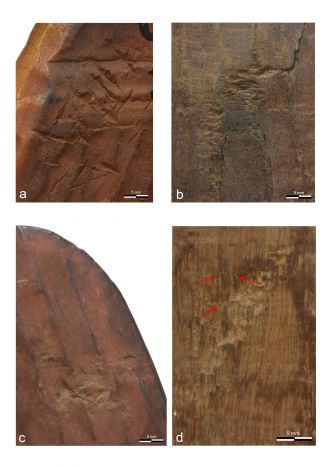
The findings constitute the first traceological identification of hardwood boomerangs being used for shaping stone tools in various Aboriginal Australian contexts and have been published in Journal of Archaeological Science – Reports.
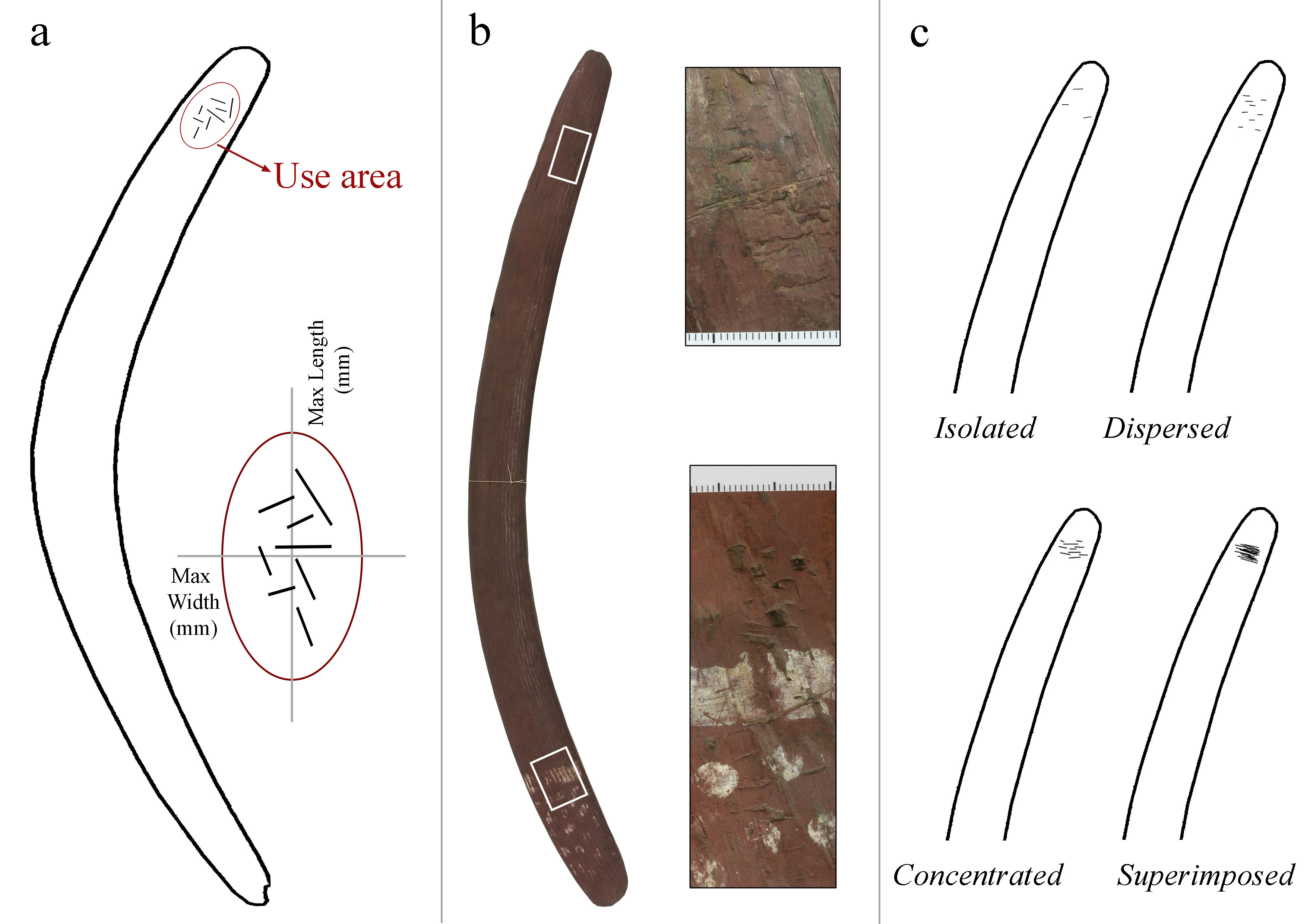
PhD candidate Eva Martellotta worked with ARCHE’s Dr Michelle Langley (also Forensics & Archaeology, School of Environment and Science), Professor Adam Brumm and Dr Jayne Wilkins to examine microscopioc marks on the surface of the boomerangs using a traceological method.
By using this method, the researchers were able to more clearly see what tasks the boomerangs were used for by Aboriginal Australians in the past.
“Not all boomerangs come back. Most are used for hunting and fighting purposes, whereas the returning ones are often children’s toys or used for games and learning purposes,” Ms Martellotta said.
“We found specific marks related to the shaping of stone tools. These marks are not new in archaeology – they are also identified on bone fragments in archaeological sites in Europe. Here, the Neanderthals used them to modify the shape of stone tools, starting 500,000 years ago.
“Our findings constitute the first traceological identification of hardwood boomerangs being used for shaping stone tools in various Aboriginal Australian contexts and emphasises the multipurpose nature of daily tools like boomerangs in Aboriginal culture.”
The research ‘New data from old collections: Retouch-induced marks on Australian hardwood boomerangs’ has been published in Journal of Archaeological Science – Reports.
Multimedia