 Sign In



 Australia; QLD; TAS
News release
From:
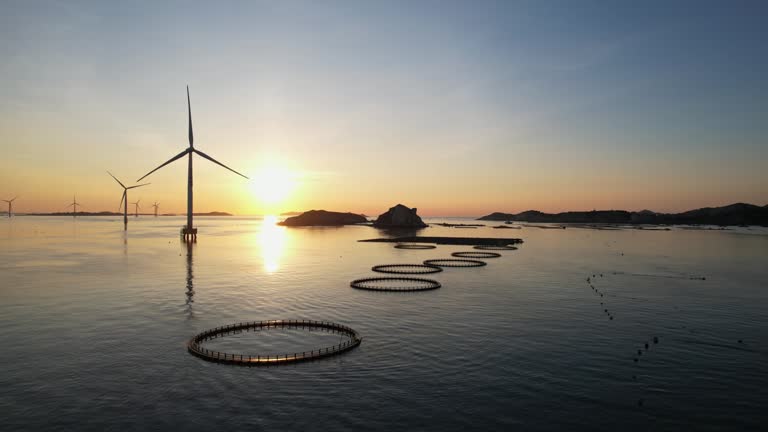
A new study led by Griffith University reveals great potential for co-locating offshore industries which can ease ocean congestion and foster sustainable economic growth.
Researchers from the Australian Rivers Institute identified nearly 3 million km² of ocean space across 97 countries where offshore wind energy and aquaculture could be developed together, enhancing efficiency and sustainability.
Making the most of ocean space
Lead researchers Dr Jackson Stockbridge and Dr Caitie Kuempel said as the demand for ocean resources grows, strategic co-location of industries offers a way to reduce environmental impacts, cut costs, and create new economic opportunities.
“However, financial concerns and liability risks have hindered widespread implementation,” Dr Stockbridge said.
“This study provides critical insights to help policymakers, industry leaders, and investors see what is possible and navigate these challenges.”
Global co-location potential
By combining suitability data for offshore wind energy and aquaculture (finfish, bivalve, and seaweed farming), the researchers identified extensive opportunities for co-location worldwide.
The study found potential co-location areas of:
- 1,337,874 km² for wind and finfish farming
- 1,143,643 km² for wind and seaweed farming
- 395,042 km² for wind and bivalve farming
Argentina, Australia, and Russia had the largest potential co-location areas, while Uruguay, Lithuania, and Belgium showed the highest proportion of their Exclusive Economic Zones (EEZ) suited for co-location.
The research further examined existing socio-economic and governance factors to identify nations best positioned to implement co-location successfully.
Denmark, Canada, and Finland emerged as leaders, possessing both significant co-location potential and strong blue economy development capacity.
Spotlight on Australia’s Bass Strait
To demonstrate the practical application of this research at a regional level, the study examined Australia’s Bass Strait – a hotspot of proposed Blue Economy development.
Findings indicated the Bass Strait held high potential for co-locating offshore wind with finfish farming, presenting an opportunity for Australia to expand its blue economy while optimising ocean space.
Co-locating offshore wind and aquaculture could:
- Reduce operational costs by sharing infrastructure and resources
- Enhance environmental sustainability by optimising ocean use
- Support economic growth by unlocking new investment and job opportunities
“This research provides a first look into what is possible for nations and industries looking to share ocean resources through co-location,” Dr Kuempel said.
“Streamlining marine spatial planning and addressing co-location feasibility will pave the way for co-location in the real world for a more sustainable and prosperous blue economy.”
The findings ‘Mapping the global co-location potential of offshore wind energy and aquaculture production’ has been published in Ocean and Coastal Management.

