Sign In



 Australia; Pacific; NSW; QLD
News release
From:
Speakers:
- Professor Maxime Aubert, Griffith University
- Professor Adam Brumm, Griffith University
- Adhi Agus Oktaviana, Indonesia’s national research and innovation agency (BRIN) and a former Griffith PhD student
- Professor Renaud Joannes-Boyau, Southern Cross University
Date: Wed 21 Jan 2026
Start Time: 10:30am AEDT
Duration: Approx 45 min
Venue: Online - Zoom
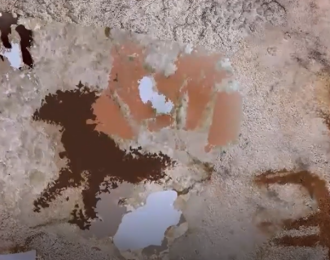
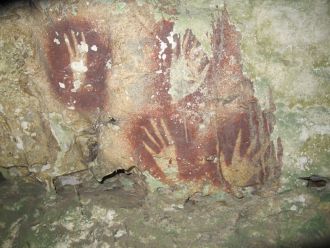
A hand stencil on the wall of a cave in Indonesia has become the oldest known rock art in the world, exceeding the archaeologists’ previous discovery in the same region by 15,000 years or more.
An international team, co-led by Griffith University researchers, Indonesia’s national research and innovation agency (BRIN) and Southern Cross University, discovered and dated cave paintings made by our species on the island of Sulawesi at least 67,800 years ago.
The research team said the findings advance our understanding of how and when Australia first came to be settled, with the Sulawesi art very likely created by a population closely linked to the ancestors of Indigenous Australians.
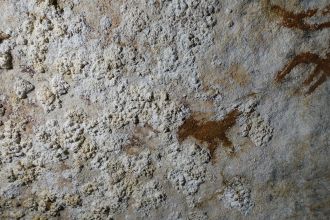
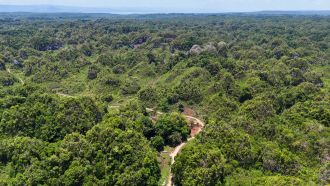
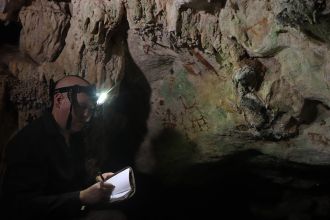
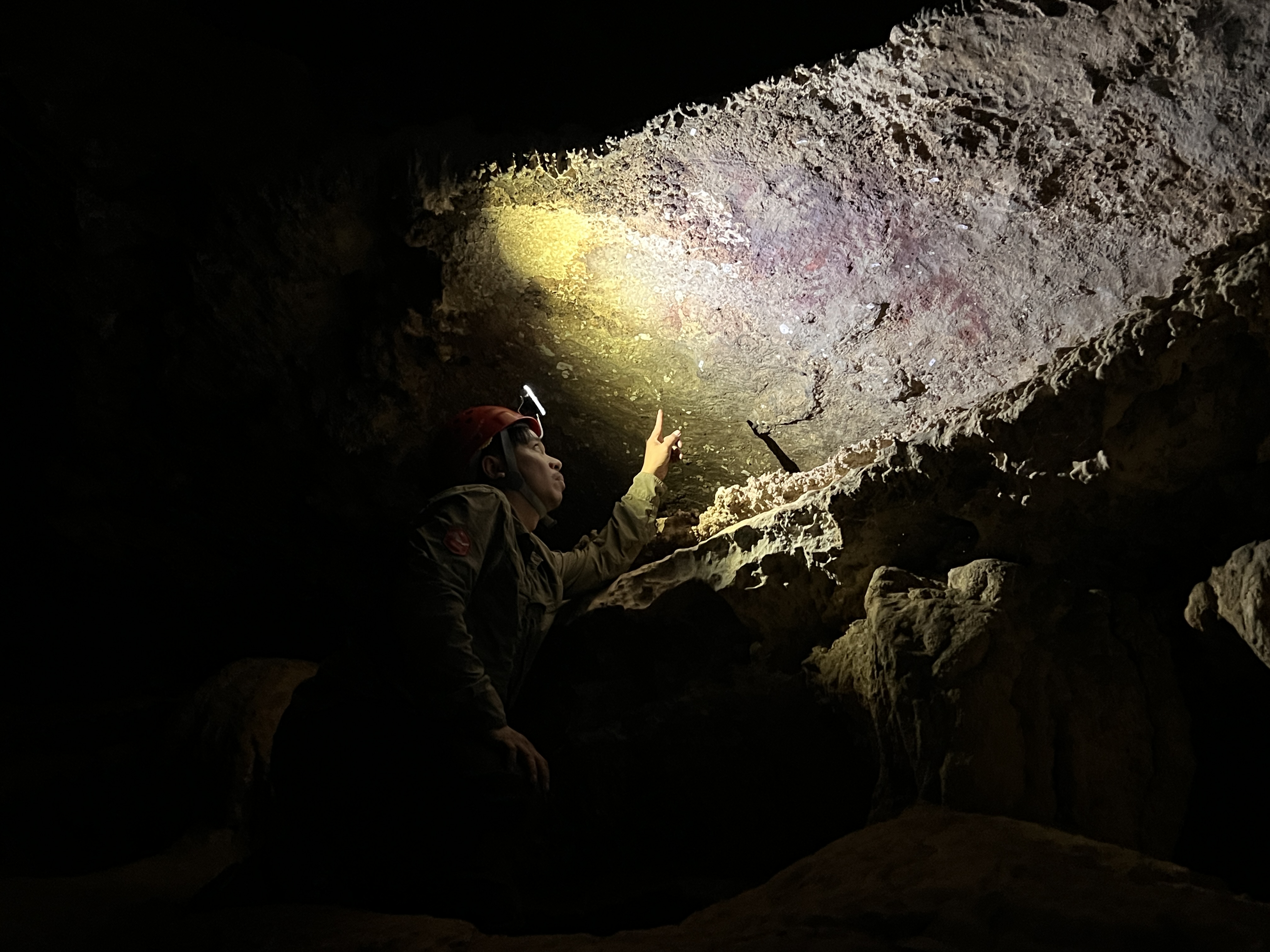
Preserved in limestone caves in southeastern Sulawesi on the satellite island of Muna, a fragmentary hand stencil was found surrounded by painted art of a much more recent origin.
The team applied advanced uranium-series dating techniques, analysing microscopic mineral deposits that formed both on top of and, in some cases, beneath the paintings from Liang Metanduno, providing a time period during which the art was made.
The hand stencil was dated to a minimum of 67,800 years ago, making it the oldest reliably dated cave art yet discovered, significantly older than the rock painting found in Sulawesi by the same researchers in 2024.
The new finding also revealed the Muna cave was used for making art over an exceptionally long period, with paintings produced repeatedly for at least 35,000 years, continuing until about 20,000 years ago.
“It is now evident from our new phase of research that Sulawesi was home to one of the world’s richest and most longstanding artistic cultures, one with origins in the earliest history of human occupation of the island at least 67,800 years ago,” said Professor Maxime Aubert, an archaeologist and geochemist from the Griffith Centre for Social and Cultural Research (GCSCR), who co-led the study.
The team also observed the hand stencil was a globally unique variant of this motif.
After the stencil was created, it was altered to deliberately narrow the negative outlines of the fingers, creating the overall impression of a claw-like hand.
Professor Adam Brumm, from Griffith University’s Australian Research Centre for Human Evolution (ARCHE), who co-led the study, said the symbolic meaning of the narrowed fingers was a matter for speculation.
“This art could symbolise the idea that humans and animals were closely connected, something we already seem to see in the very early painted art of Sulawesi, with at least one instance of a scene portraying figures that we interpret as representations of part-human, part-animal beings,” Professor Brumm said.
Dr Adhi Agus Oktaviana, a rock art specialist in BRIN and a team lead, whose doctoral research at Griffith University formed part of this study, said the paintings had far-reaching implications for our understanding of the deep-time history of Australian Aboriginal culture.
“It is very likely that the people who made these paintings in Sulawesi were part of the broader population that would later spread through the region and ultimately reach Australia,” Dr Oktaviana said.
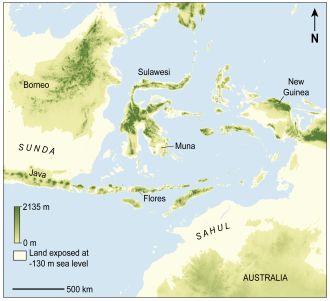
There had been considerable archaeological debate about the timing of initial human occupation of the Pleistocene-era landmass that encompassed what is now Australia, Tasmania and New Guinea, known as Sahul.
Scholarly opinion was divided between the so-named short chronology model, whereby the first people entered the Sahul ‘supercontinent’ about 50,000 years ago, and the opposing long chronology model, in which they arrived at least 65,000 years ago.
“This discovery strongly supports the idea that the ancestors of the First Australians were in Sahul by 65,000 years ago,” Dr Oktaviana said.
There were two main migration routes into Sahul proposed by researchers: a northern route to the New Guinea portion of this landmass via Sulawesi and the ‘Spice Islands’ and a more southerly route that took the sea voyagers directly to the Australian mainland via Timor or adjacent islands.
Professor Renaud Joannes-Boyau from the Geoarchaeology and Archaeometry Research Group (GARG) at Southern Cross University, who co-led the research, said the discovery sheds light on the most likely course of humans’ ancient island-hopping journey from mainland Asia to Sahul via the northern route.
“With the dating of this extremely ancient rock art in Sulawesi, we now have the oldest direct evidence for the presence of modern humans along this northern migration corridor into Sahul,” Professor Joannes-Boyau said.
“These discoveries underscore the archaeological importance of the many other Indonesian islands between Sulawesi and westernmost New Guinea,” said Professor Aubert, who, together with professors Brumm and Joannes-Boyau, continues to search for more evidence of early human art and occupation along the northern route with funding from the Australian Research Council (ARC).
The ARC’s backing forms part of a broader investment in human origins research, including the recently awarded ARC Centre of Excellence for Transforming Human Origins Research, with Griffith University as lead institution, and the ARC Training Centre for Advancing Archaeology in the Resources Sector at Southern Cross University, aiming at advancing our global understanding of human evolution and preserving our heritage.
The research was also supported by Google Arts & Culture and the National Geographic Society.
The research on early rock art in Sulawesi has been featured in a documentary film, ‘Sulawesi l'île des premières images’ produced by ARTE, released in Europe today.
The study titled ‘Rock art from at least 67,800 years ago in Sulawesi’ has been published in Nature.
Multimedia