 Sign In



 Australia; International; QLD
News release
From:
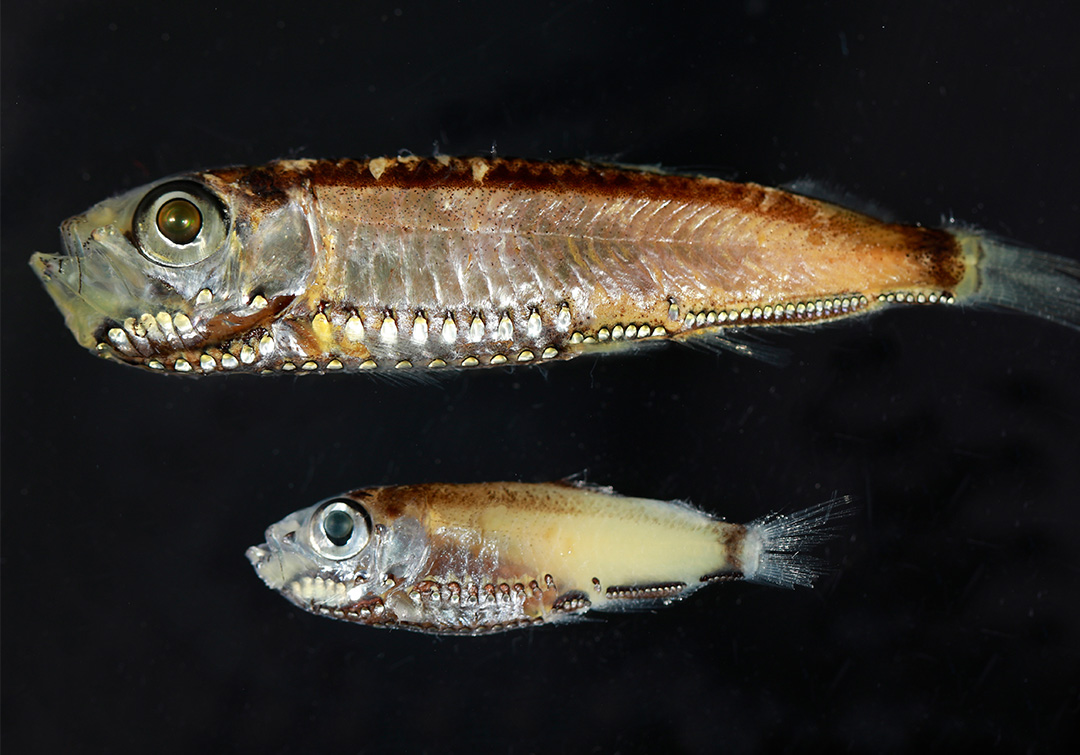
Researchers have identified a new type of visual cell in deep-sea fish larvae that challenges a century of knowledge about vertebrate visual systems.
Dr Fabio Cortesi from The University of Queensland’s School of the Environment said the finding could lead to new camera technology and medical treatments.
“For more than 150 years, textbooks have taught that vision in most vertebrates is made of cones and rods – cones which work in bright light and rods for dark situations,” Dr Cortesi said.
“But our study of deep-sea fish larvae revealed a new cell type – a photoreceptor that optimises vision in gloomy or twilight conditions.
“It combines the molecular machinery and genes of cones with the shape and form of rods.
“This hybrid cell has the best bits of both the bright light and dark light systems to be something new that's really efficient for twilight vision.”
The research team, which also included Dr Lily Fogg and Dr Fanny de Busserolles, examined the retinas of fish larvae caught at depths between 20 and 200 metres in the Red Sea during a series of marine exploration voyages.
“It was very tricky because the larvae are only half a centimetre long and their eyes are smaller than a millimetre,” Dr Fogg said.
“We know in adulthood some of these fish descend to live up to 1 kilometre below the surface where they optimise their vision to see in the dark.
“We wanted to investigate how their early vision develops in half-light closer to the surface, where they feed and grow before descending into one of the dimmest and largest habitats on Earth.”
Dr Cortesi says the team hoped the discovery would serve as inspiration for several fields of applied science.
“This finding is fascinating because it builds on the little we know about the deep sea, but there are also practical applications for this knowledge,” he said.
“In technology, creating sensors based on this unique cell structure could lead to more efficient cameras or goggles for low-light situations without sacrificing image sharpness.
“In medicine, learning how these fish build this type of visual cell in the high-pressure environment of the deep ocean could unlock new biological pathways relevant to human eye conditions such as glaucoma.”
Work was done at the Queensland Brain Institute and involved collaborators from the University of Basel (Switzerland), King Abdullah University of Science and Technology (Saudi Arabia), the Institute of Marine Research (Norway), and the University of Idaho (USA).
The research is published in Science Advances.

