 Sign In



 Australia; NSW
News release
From:
Australian researchers have built an ultra-compact artificial intelligence (AI) chip that is able to make calculations using the power of light, at the speed of light.
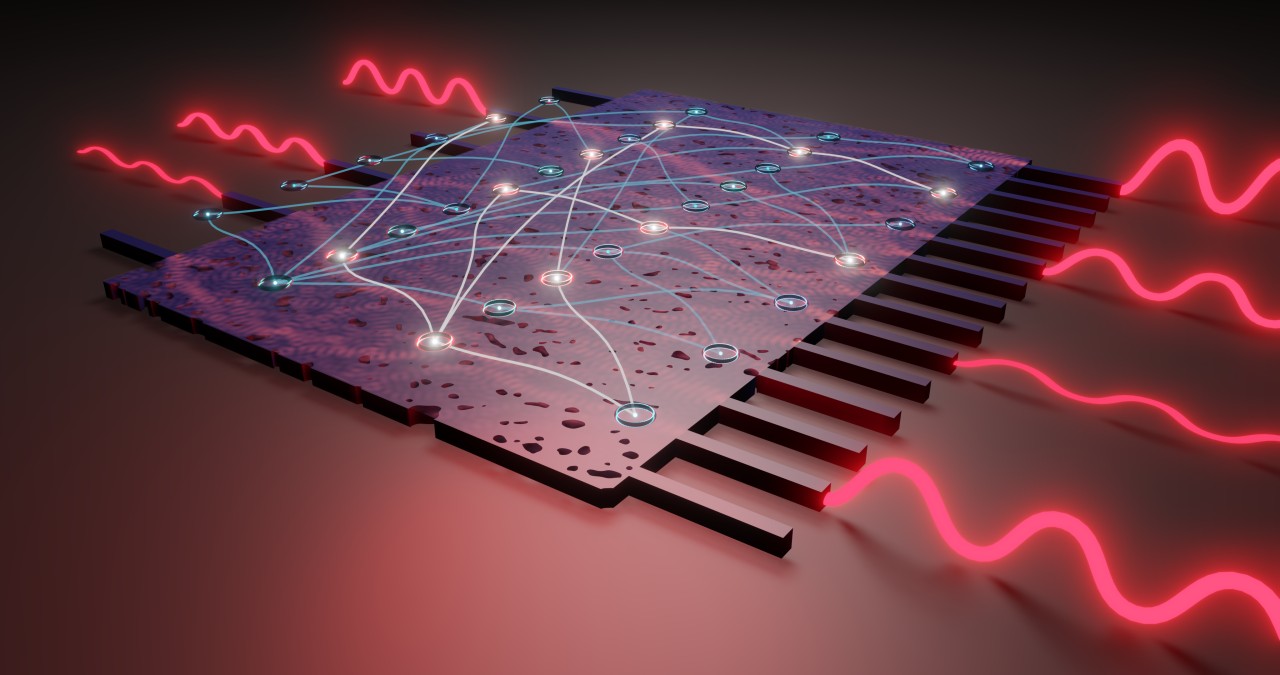
The nano photonic chip prototype, which harnesses the power of light particles (photons) is built completely in-house at the Sydney Nano Hub at the University of Sydney.
The researchers say the prototype could play an important role in developing more energy-efficient AI hardware as global demand for artificial intelligence continues to grow, potentially lowering the overall energy footprint of future computing systems.
Traditional computer chips use electricity to process information, which means moving tiny, charged particles (electrons) through wires. This produces heat.
The nano photonic chip prototype uses light. Light can travel through materials without electrical resistance, so it does not generate heat in the same way electricity does. As the light passes through the nanostructures within the chip prototype, these structures themselves perform the calculation automatically.
The nanostructure on the chip takes up tens of micrometres, roughly comparable to the width of a human hair. The nanostructures together help form a neural network: artificial neurons that mimic the human brain to recognise and complete calculations.
The prototype performs calculations on the picosecond timescale, or trillionths of a second – the time it takes light to pass through the nanostructure.
The researchers say the advantage of using photonics is the computation is much faster, taking place at the speed of light. The technology also uses light to operate instead of electricity. This is compared to current data centres that rely on massive amounts of water and energy to power them.
“We’ve re-imagined how the photonics can be used to design new energy efficient and ultrafast computer processing chips,” said Professor Xiaoke Yi, from the School of Electrical and Computer Engineering and director of the Photonics Research Group.
“Artificial intelligence is increasingly constrained by the energy consumption. This research performs neural computation using light, enabling faster, more energy-efficient and ultra-compact AI accelerators.”
Published in Nature Communications, the study demonstrates how AI models can be designed into nanoscale photonic structures that manipulate light to perform the mathematical operations required for machine learning.
To validate the technology, the researchers trained the nanophotonic chip to classify more than 10,000 biomedical images such as breast, chest and abdomen MRI scans.
In simulations and experiments, the nanophotonic neural network achieved approximately 90 to 99 percent classification accuracy.
The technology offers a pathway to sustainable AI infrastructure capable of supporting the growing demands of computing without proportional increases in power consumption.
Sustainable AI hardware that is better, faster, stronger
Photonics, short for photon-based electronics, is the study of controlling light particles. It has been used to power technology we use day-to-day, such as lasers, fiber-optic networks and in medical imaging.
But photonics being harnessed for computer processing has only been explored in recent years, with increasing urgency with the rise of AI demand.
PhD student Joel Sved, who played a key role in design and implementation of the prototype, said the prototype shows how intelligence can be embedded directly into nanoscale photonic structures.
For more than a decade, the Photonics Research Group at the University of Sydney has had a long history of studying how to push the limits of photonics including to improve our technology.
This includes using photonics to tackle challenges in wireless communications and advanced sensing technology which can detect and measure chemical or biological traces in the environment.
Following the successful testing of the nanophotonic chip prototype, Professor’s Yi’s team is now working advancing the technology toward larger-scale photonic neural networks.

